

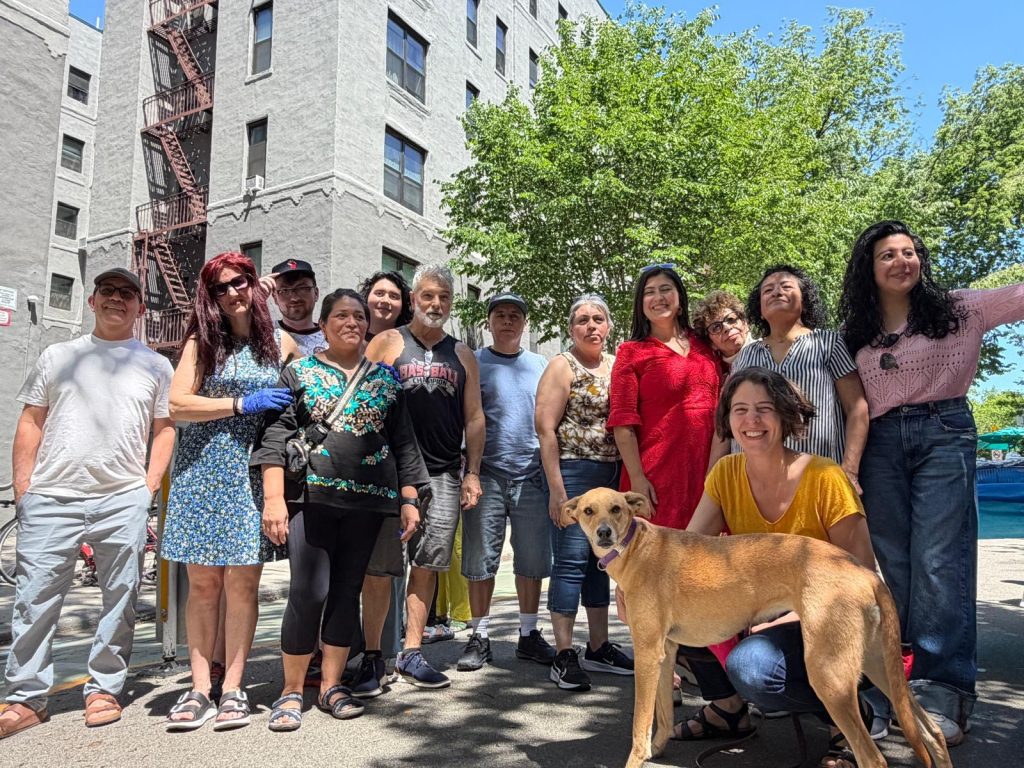
JACKSON HEIGHTS — Dozens of Jackson Heights neighbors gathered along a closed-off stretch of 34th Avenue on Sunday afternoon, sharing food, laughs and lively conversation under the bright May sunshine. Even local State legislators Jessica Ramos and Jessica Gonzalez-Rojas — who are running against each other for Senate District 13 in the upcoming June primary election — made appearances, putting aside their political differences to deliver speeches and share smiles with their Jackson Heights neighbors.
This was, however, no ordinary spring block party. It was convened by residents of the adjacent La Mesa Verde apartments — a massive, six-storey apartment complex that’s made headlines recently after residents sued landlord A&E Real Estate Holdings. Ranked New York City’s worst landlord of 2025, A&E’s negligence had allowed many of La Mesa Verde’s apartments to slide into such a state of disrepair that residents were suffering health problems due to chronic mold, broken elevators and failing heating. When the Queens Ledger toured the building in December, residents described apartments infested with abnormally large rats and unattentive management that would send incompetent exterminators who’d show up at odd hours and do little to address the problem.
But with the help of lawyers from legal nonprofit Communities Resist and a group of tenant organizers with the Party for Socialism and Liberation, tenants sued A&E for damages for alleged harassment and to order the correction of hundreds of the building’s hundreds of outstanding HPD violations. They’ve organized the independent Mesa Verde Tenants Union and now, as a result of the lawsuit and subsequent political pressure, La Mesa Verde residents are finally starting to see repairs.
“I wanna start by telling you how emotional and proud I feel to see tenants coming together across generations, across cultures,” Ramos said in her speech, which she delivered in both Spanish and English. “This is actually what Jackson Heights and Queens is all about.”
“It’s also about keeping landlords in check so that they do what they have to do in order to comply with the laws that are on the books,” she continued.”
During Sunday afternoon’s gathering, Mexican-born mother of two Ivonne Calderon eagerly served up spoonfuls of home-cooked pasta and braised pork chunks to neighbors, friends, and passersby alike. Back in December, the Queens Ledger toured Calderon’s apartment, which had remained for months in a state of near-unlivable decay — covered in mold, chipping paint and infested with rats despite her every effort to stay tidy and her repeated calls to management. HPD inspectors would issue violations, yet nothing changed while her rent continued to climb.
Since the lawsuit and the attention that followed, Calderon said management has finally begun to make repairs. Sunday’s festival served not only to celebrate the improvement of hers and her neighbors’ apartments, but to commemorate their organizing efforts and collective solidarity, which she said was instrumental in A&E finally taking their plight seriously.
“The more united we are, the more demands we can make of the owner of our apartments and the more they listen to us,” Calderon said.
But while Mesa Verde residents say conditions have improved since the winter, there’s still work to be done. There’s a broken door in Calderon’s building that allows in strangers whom she says sometimes leave behind syringes in the lobby. Once, Calderon found a couple she didn’t know sleeping in the stairwell. Meanwhile, Calderon and several of her neighbors described continued Band-Aid fixes from A&E, with contractors coming to paint over moldy walls that would bubble and chip after only a few days.
Packages routinely get stolen too, she said, although since the formation of the tenant union neighbors have kept an eye out for each other’s belongings, staying in touch about expected deliveries via a Whatsapp group chat and picking up packages for neighbors who are at work or on vacation.
But beyond its utility, the union has also catalyzed a sense of neighborly camaraderie that Calderon says hardly existed before, the natural result of a diverse group of otherwise unconnected New Yorkers working together to build their collective power and improve their material conditions.
“With all this I’ve learned to get to know my neighbors,” Calderon said. “Before, there wasn’t so much communication, but now we’ve all gotten to know each other. My neighbors come up to me and say ‘Hi Ivonne! How are you?’”