

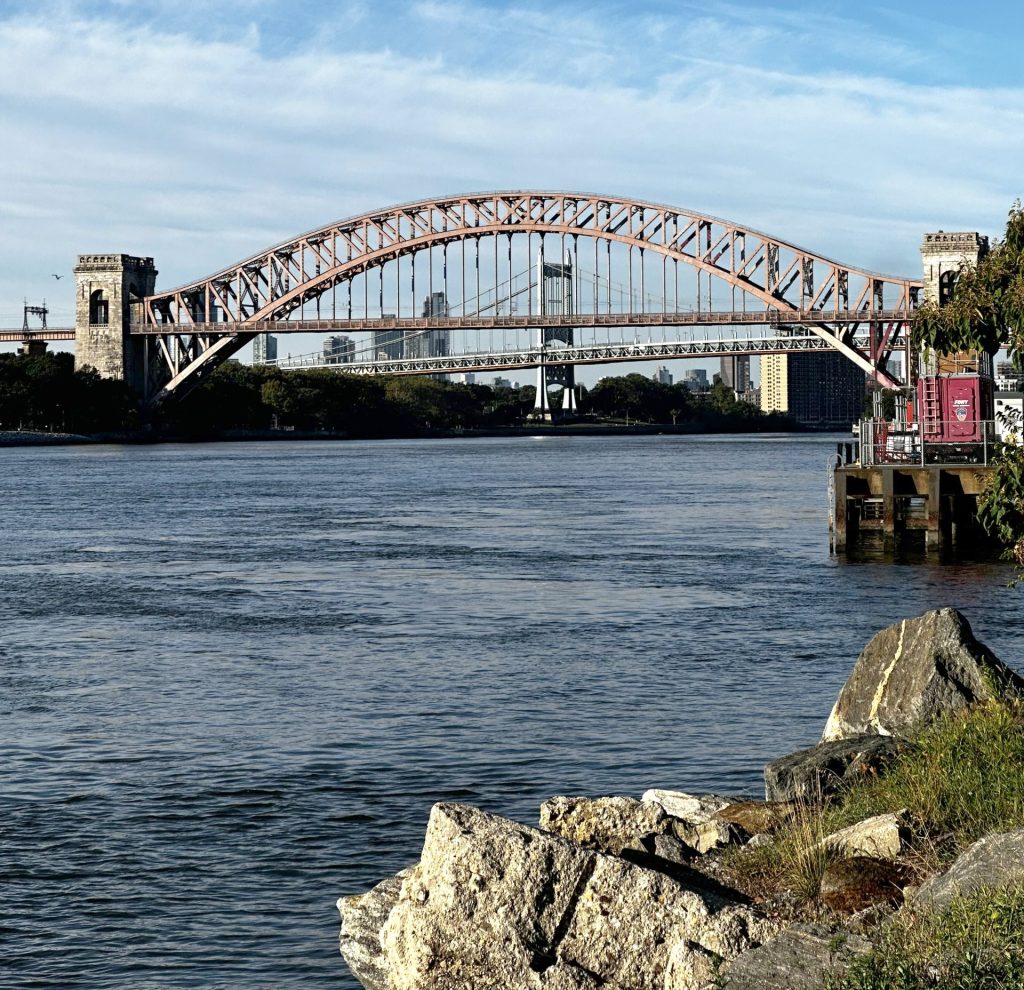
A British warship sunk in the Hell Gate channel in 1780. But what became of its rumored gold cargo?
BY ALAN ARICHAVALA
news@queensledger.com
HALLET’s COVE — As summer approaches, Astorians flock to Astoria Park to picnic and sunbathe on the Great Lawn, take in sweeping views of Manhattan and the East River, or cool off at the Astoria Pool which is set to open on June 27. It’s unknown to most, however, that beneath the murky waters of the East River lies a longstanding mystery involving a sunken British warship and its rumored treasure.
The HMS Hussar was a 28-gun, Mermaid-class sixth rate frigate that served in the Royal Navy during the American Revolution. Designed by Sir Thomas Slade and constructed between 1761 and 1763, the vessel was commissioned in August 1763 under Captain James Smith to patrol the waters off Cape Clear along Ire- land’s southern coast. It was the sec- ond ship to bear the name Hussar, derived from the light cavalry horse- men who originated in the Kingdom of Hungary during the 15th and 16th centuries. Its predecessor, the first HMS Hussar, ran aground off His- paniola–the island that is currently shared by the Dominican Republic and Haiti–in 1762 due to the negli- gence of its pilot and captain, fore- shadowing the fate that would later befall its successor.
After an uneventful period of ser- vice off the North American coast, the Hussar returned to England for repairs and refitting at Woolwich. In July 1777, she was recommissioned under Captain Elliott Salter and as- signed to the British fleet operating in North America during the American Revolution. But her primary role was carrying military dispatches. In 1779, shortly after Spain declared war on Great Britain and offered support to the Ameri- can cause along with the French, the Hussar captured the Spanish ship. Nuestra Senora del Buen Confeso. However, the Spanish ship had been refitted as a transport and stripped of much of its armament, making its capture by the smaller Hussar a relatively easy feat.
By 1780, the British found them- selves in an increasingly precari- ous position. France had fulfilled its promise of military support the American cause: a French fleet under Admiral de Ternay had landed an army of roughly 6,000 sol- diers, commanded by the Comte de Ro- chambeau, at Newport, Rhode Island, posing a direct threat to British forces and the Royal Navy stationed in New York City. At the same time, another French fleet, commanded by Admiral De Grasse, had sailed from the Caribbean to the Atlantic to threaten British po- sitions in the South. In November 1780, Admiral Sir George Brydges Rodney dispatched his twenty ships to con- front the French fleet.
The Hussar, meanwhile, now under the command of Captain Charles Pole, received a different assignment.
She was ordered to transport the British Army’s payroll – rumored to consist of approxi- mately 960,000 British pounds in gold bullions – to Gardiner’s Bay off eastern Long Island. Against the advice of his pilot, Pole had ordered the Hussar through the treacherous Hell Gate channel. Flanked by Mon- tressor and Buchanan islands (to- day’s Randalls and Wards islands) and the northern shores of the ham- let of Hallett’s Cove (modern-day Astoria), Hell Gate was notorious for its violent currents, jagged rocks, and whirlpools capable of drowning even seasoned mariners. Swept by the current, the Hussar struck Pot Rock and began to sink. Unable to run the vessel aground, Pole ordered the crew to abandon ship. The frigate ultimately settled 16 fathoms, or roughly 96 feet, beneath the surface.
A court martial was held by the Admiralty to investigate the loss of the Hussar; however, the minutes that have been preserved at the National Maritime Museum in Green- wich, England, make no mention of the loss of the gold bullions.
After American Independence was secured in 1783, rumors began to circulate about the lost gold aboard the Hussar. Although, Brit- ish officials denied that any gold had ever been carried on the vessel, they nonetheless mounted three unsuc- cessful salvage attempts to locate the wreck. Over the next 150 years, nu- merous treasure hunters, salvagers, and divers continued the search for both the ship and its rumored treasure.
On November 6, 1810, the wreck was reportedly located by Samuel Palmer, Daniel Woodward, and James Brown using a diving bell. The following year, Commodore Isaac Chauncey confirmed the location of the wreck to the Secretary of the Navy. The men in their diving bell had brought back a few wooden planks, nails, and copper sheathing.
In 1843, after several failed recov- ery efforts due to the Hell Gate’s cur- rents, George W. Taylor became the first diver to descend to the wreck in a diving suit. He would die not long after, but his expedition was contin- ued by his protege, Charles Pratt. Pratt discovered and recovered nu- merous artifacts from the wreck, in- cluding cannons, swords, and wine bottles, but it was something else that would surprise Pratt. Beyond the stories of buried treasure, dark- er rumors persisted: that the HMS Hussar had been carrying American prisoners of war confined in chains within the ship’s hold. It is likely that they were left behind by the British crew when the vessel sank, left to drown. Pratt would find skel- etal remains of these prisoners, still bound in shackles, lending credence to these rumors.
Despite his successes, Pratt was unable to reach the ship’s lower decks, where he believed the gold would have been stored. His final dive took place in 1866. Two of the cannons he helped recover were do- nated to Central Park in 1865 where they were displayed at Fort Clinton until they were put into storage due to rampant vandalism in the 1970s. In 2013, the Central Park Conser- vancy began restoration on the can- nons. But to their shock, one of the cannons was still loaded with gun- powder, wadding, and a cannonball. An NYPD bomb squad was called to remove 1 .8 pounds of gunpowder after it was determined that the gun- powder was still active.
“We silenced British cannon fire in 1776, and we don’t want to hear it again in Central Park,” the police said in a statement.
By the end of the 19th century, the location of the wreck of the Hussar had been forgotten, lead- ing some to speculate that the ship may have been blown up by the US Army Corps of Engineers during the clearing of the Hell Gate channel in 1876-1885. Further efforts to find the wreck as recently as 1985 were still conducted but the Hussar was never found.