

Though all are progressives committed to universal healthcare, a robust social safety net and immigration reform, NY-7 congressional candidates differed widely on their solutions to the affordability crisis.
BY COLE SINANIAN
cole@queensledger.com
SUNNYSIDE — For anyone wondering, State assemblymember Claire Valdez’s deli order is an egg and cheese with pepper on a roll.
Brooklyn Borough President Antonio Reynoso’s is a bacon egg and cheese on a roll with ketchup, mayo, salt and pepper.
City councilmember Julie Won’s, meanwhile, is a chopped cheese with jalapeños on a roll.
And the apparent black sheep of New York’s 7th Congressional District hopefuls — at least when it comes to sandwich preferences — is public defender Vichal Kumar, whose go-to is pepper turkey, pepper jack cheese, lettuce, tomato, onion, salt, pepper, oil and vinegar on a roll.
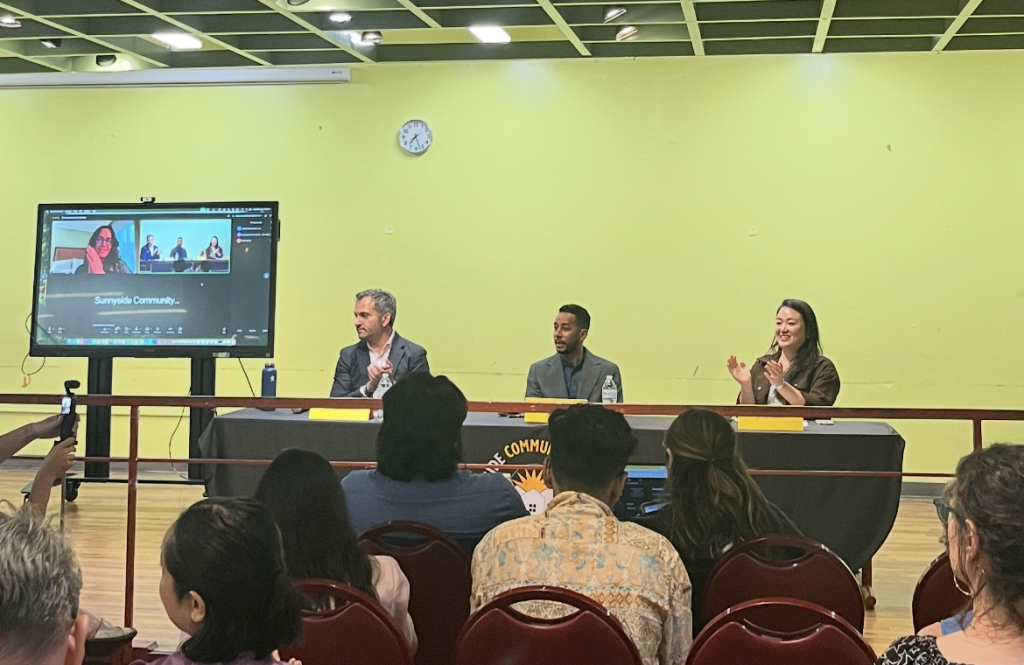
As a torrential spring rain thrashed the pavement outside, the four candidates discussed their political platforms — as well as sandwiches — at a Sunnyside Community Services (SCS) NY-7 candidate forum on Wednesday, May 24. Moderated by SCS Executive Director Judy Zangwill and journalist S. Mitra Kalita, the forum sought to introduce the candidates — whose congressional district stretches north-south from Astoria to Downtown Brooklyn, and East into Sunnyside, Maspeth, Ridgewood and Woodhaven — to Sunnysiders as they seek to secure local votes ahead of the June 23 primary.
Reynoso, Won, and Kumar addressed the crowd of a few dozen in person, while Valdez — caught in Albany for a budget vote — tuned in via Zoom. Over the course of the hour-long discussion, all three candidates pitched progressive visions for the seat, vowing to protect the district’s large immigrant community from Trumpism, invest in the local nonprofit network recently threatened by federal funding cuts, and to advance the construction of a social safety net that would make life more affordable for working New Yorkers.
Four Candidates, Four Platforms
But although the candidates largely agreed on hot-button issues like dismantling ICE, passing universal healthcare and building fast-tracked affordable housing (all four said they supported the proposed Sunnyside Yards megaproject, though Won and Kumar said their support had conditions), they differed widely on more than just their deli orders.
State Assemblymember Valdez, a democratic socialist backed by the DSA and Mayor Mamdani, doubled down on her commitment to empowering organized labor as a means of boosting affordability and confronting the takeover of the US government by large corporations, while also promising to end US military interventionism abroad and to use her seat as a “bully pulpit” to advance progressive ideas nationally in addition to passing legislation.
Reynoso — who introduced himself Wednesday as “the President of Brooklyn” — positioned himself as a master negotiator and fierce local advocate who cut his teeth as a City councilmember and later Brooklyn Borough President, capable of securing wins for his constituents amid complicated legislative landscapes. The son of Dominican immigrants with deep roots in North Brooklyn, Reyonoso has been cast as the heir to outgoing Congresswoman Nydia Velazquez’s political legacy, securing endorsements from Velazquez herself, as well as the Working Families Party.
Won, who was born in South Korea, flexed her Western Queens bonafides and achievements as a City councilmember for the 26th District, casting herself as the most community-minded of the group and somewhat of a political outsider, having come to politics after a career in the tech sector. Her congressional campaign, titled “A Lifetime of Care,” is focused on ensuring quality, government-funded care from birth to death, including universal childcare, healthcare, prenatal and postpartum care and burial assistance.
But perhaps the true political outsider of the group is public defender Vichal Kumar, who characterized himself Wednesday as the only non-politician on the ballot. Through his legal work representing New Yorkers at their most vulnerable, Kumar has grown intimately familiar with the failure of government to address peoples’ needs, particularly those of immigrants caught amid the compounding forces of exclusion, discrimination and poverty.
Affordability, Affordability, Affordability
When asked about how to ensure that federal income brackets reflect the true cost of living in New York, the candidates used the opportunity to outline their diagnoses of the affordability crisis and their vastly different approaches to solving it. The discussion put the candidates’ differences on clear display, in what was perhaps the evening’s starkest moment of political disagreement.
Reynoso interpreted the question from a housing perspective, spending his allotted 60 seconds on the debate over New York’s Area Media Income (AMI) — which is set federally and is used to determine what kinds of housing should be considered “affordable.” For Reynoso, this stagnant number — currently $108,000 for a single-person household — is not as important as politicians’ ability to negotiate lower percentages.
This AMI conversation, this ‘affordable for whom,’ is something that a lot of people tell you, and it gets a lot of people riled up,” Reynoso said.
“I don’t think AMI is necessarily something that we have to spend too much time discussing,” he continued. “It’s where we land.”
Kumar brought up his experience working with the city’s home health aides, who — as a result of being misclassified as ‘independent contractors’ — have dealt with institutionalized wage theft, and explained that legislators should work to both end policies that allow the misclassification of workers and fight for a higher minimum wage.
”What we need is that our wages reflect our cost of living, and this has been an issue that we have seen in this city for a generation— people being forced into labor where their wages weren’t reflecting high enough,” Kumar said.
Valdez, who began her political career as a labor organizer for the United Auto Workers, made clear her commitment to empowering labor unions as a means to help the working class raise their own wages. Equally important to her platform, she explained, is using the federal government to take on corporate greed.
“I think the best way to take on the affordability crisis and to take on this profound stagnation of wages for most working people is to organize as many people as possible into unions, ” Valdez said.
“We have to, as a federal government, take on these corporate bad actors who have suppressed wages and make billions of dollars doing exactly that,” she continued.
Won, meanwhile, highlighted the need for a functioning social safety net and reliable public services to relieve struggling New Yorkers.
“When we think about how our government should work, it should really come down to how they’re saving us money,” she said, “So, if you’re in a safety net, like our Lifetime of Care platform, that means that universal child care should save you on average $4,000 a month, if you’re a mom of two like me,” Won said.
New Yorkers Weigh In
After the forum, several New Yorkers mulled about, chatting with their neighbors and grabbing voter registration forms from the tables in the back. Gale, a 74-year-old former schoolteacher and 29-year Sunnysider said she arrived at the forum already committed to voting for Valdez. She said her top issues are healthcare for all and public education, and is attracted to Valdez’s involvement in the broader democratic socialist movement, which she said makes her more powerful than any individual candidate.
“Communities need help,” Gale said. “Not top-down, but bottom-up. That’s what Claire is all about. She’s a real fighter for the people.”
Mike Murthi, who lives in Williamsburg, also arrived ready to vote for Valdez, whose union background and pro-labor platform he said is highly attractive to him. Though Murthi also said that Won impressed him with her specificity and broad policy knowledge.
“It was interesting for her to jump into a race like this, where you have Nydia’s protege and you have Mamdani’s candidate,” Murthi said. “I was like, ‘Holy shit,’ Julie Won’s coming out. And then she fundraised a lot, she’s out here campaigning, and she made a lot of good points
“But I’m all-in for Claire,” he continued. “I come from a union household and she’s a big union proponent. And in Claire’s view — and obviously coming from the DSA — it’s a very collective solution at the federal level. It’s people power, it’s getting people together, and I think for her it’s an understanding that the federal government can deliver for all.”