

BY COLE SINANIAN
cole@queensledger.com
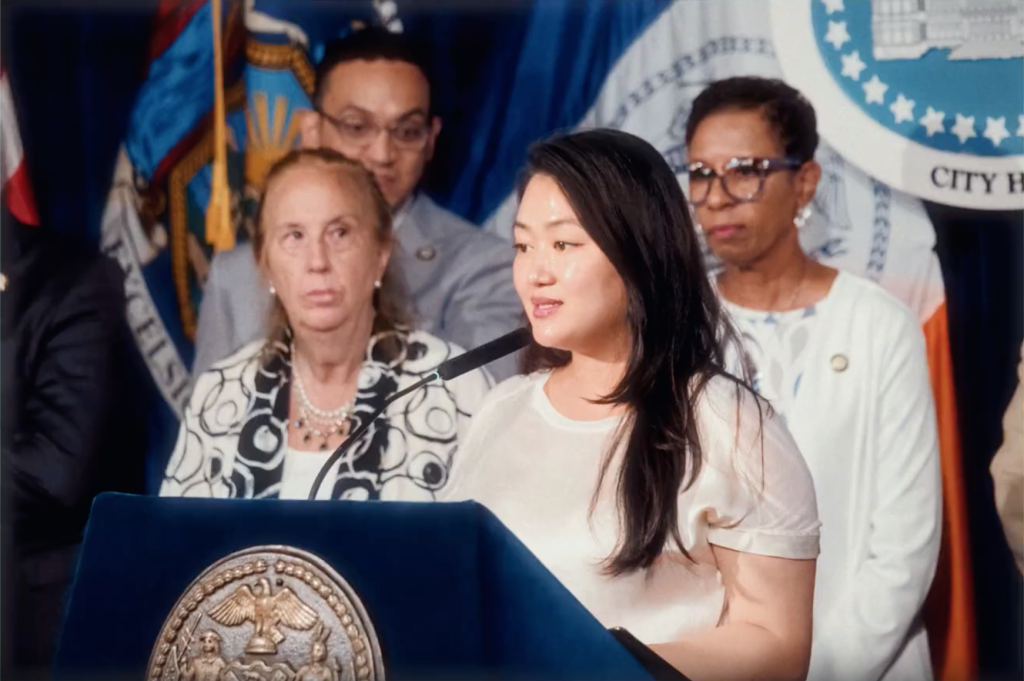
During the quarantine days of the COVID-19 pandemic, Julie Won was delivering meals to her neighbors with Rethink Food, a nonprofit that contracts local businesses to prepare restaurant-quality meals for low-income families. Won had experienced hunger as a child and knew how important free school lunches are for children from struggling families, so when then-Mayor Bill DeBlasio announced in a press conference that public schools would be moving online, she jumped into action.
But Won was hardly prepared for what she saw when she came to deliver food to the Queensbridge and Ravenswood public houses. Unreliable internet access had exacerbated the class divide. Children were using LinkNYC kiosks to connect to their classes. One little girl, Won recalled, wouldn’t turn on her camera or microphone because she didn’t want her classmates to know she was poor.
The experience was deeply politicizing. Won, who arrived in Queens from South Korea at age 8, was enraged that in the richest city in the richest country in the world, not even internet access was guaranteed.
“What is wrong with our country that people still don’t have internet access?” Won said in a recent interview at the Queens Ledger’s Sunnyside offices. “I’m ashamed that this country is so behind. I go back to South Korea to visit and you get free internet on the street, you get free internet on the subway, you get free internet anywhere you go.”
It was “WiFi for All” Won ran on in the 2020 race for City Council District 26, which she won in a nail-biter of an election with a crowded field and no clear frontrunner. Within months of taking office Won had delivered on her promise, securing internet access for all public housing residents in her district, a program that has since been expanded to the entire city with Big Apple Connect.
Now, Won is running to replace Nydia Velazquez in New York’s 7th Congressional District among a competitive field that includes close Velazquez ally and Brooklyn Borough President Antonio Reynoso, and Democratic Socialists of America-backed trade unionist Claire Valdez. Though all three are focused on boosting social welfare, Won pursues her politics from the perspective of an immigrant committed to making the American Dream achievable to all via a comprehensive program of universal care from birth to death, as so many other rich, democratic countries seem to do so effortlessly.
But Won is careful to distance herself from the language of socialism. Unlike some of her DSA counterparts, Won does not consider the socialization of the economy necessary to building common-sense social welfare programs. A system of care is compatible with capitalism, Won says, and it can be built by cooperative electeds willing to work with their political enemies, who have the skills to cut through the wastefulness of government bureaucracy.
“South Korea is not a communist country or a socialist country, but we have one of the best universal health care programs,” Won said. “Normal democracies can have functional efficient social programs, yet we just cannot get it right.”
Won was raised in Sunnyside and Astoria in the early 2000s to a mother who worked in a nail salon and father who worked odd jobs. This part of Queens was different back then. Before the glass high-rises and vast waterfront parks of today, Western Queens was known for its thriving Korean community and for its rougher patches, Won said. She described having to be careful about what kind of shoes she wore while walking at Queensboro Plaza. If they were too nice they could get stolen; a thief would slip them off the feet of unsuspecting passersby as they climbed the subway stairs.
“That’s what Queens was like back then,” she said. “But it was also a great community. You still see all the Korean churches— there used to be a thriving Korean church community. That is where all the immigrants came together. Even if you weren’t religious, you just came because that’s where you went to Korean school.”
After graduating from Syracuse University, Won went on to work in DC as a consultant for IBM, advising government agencies. Won’s experience working in tech in both the private and public sectors has shaped her pragmatic approach to governance. The “hot-button issues” likely to elicit strong responses across the political aisle are not hills worth dying on if the goal is providing basic care to Americans, Won says. So her “Lifetime of Care” agenda begins with serving the poorest among us with basic welfare programs, many of which she believes would have broad, bipartisan support.
Burial assistance, for example. Low-income New Yorkers who lose loved ones can go into debt paying for expensive funerary services, particularly those whose religious observances restrict them to a certain kind of burial. A government that offers care and support at these universal moments of vulnerability that we all experience throughout our lifetimes should have broad legislative appeal, Won says.
“I know that there’s a lot of different ideas of how we get universal health care, so people fight over it,” she said. “But I think things like burial assistance, postpartum care, making sure people have access to home care if they’re injured, or if they have just had a baby, or if they’re elderly. These are things that we should all care about.”
And Won has experience in bipartisanship. During her City Council tenure, she managed to get all 51 council members to sign onto her bill asking Senate Minority Leader Chuck Schumer to renew funding for her Affordable Connectivity Program. Currently, Won is drafting a City ordinance to call for an AI Consumer Protections Bureau that would hold tech companies accountable to consumers led astray by chatbot hallucinations.
But, in terms of what she can do to bring about her “Lifetime of Care” as a City councilmember, she’s hit somewhat of a ceiling, above which lie the halls of Congress.
“I’m at the lowest level of jurisdiction,” Won said. “I could pass all the resolutions I want with my pipe dreams of how the country should be run, but at the end of the day, I have legal parameters.”
She continued: “Unless I’m in the federal government, it just becomes a resolution most of the time, where people are like, I call on Congress to do these lofty things, and then you have no actual power.”