

BY SIDDHARTHA HARMALKAR
JACKSON HEIGHTS — Advocacy groups are calling for the passage of legislation to prohibit caste discrimination in employment, housing, and public accommodations.
Assembly bill A. 6920, sponsored by Assemblymember Steven Raga, and Senate bill S. 6531, sponsored by State Sen. James Sanders Jr., would include caste as a protected category under New York civil rights law.
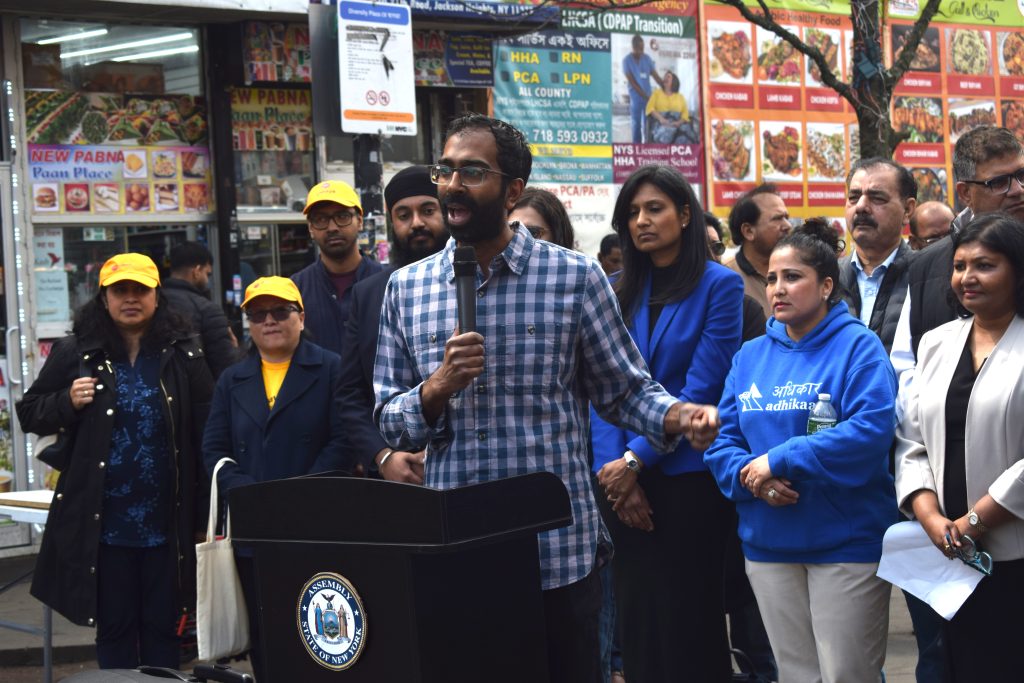
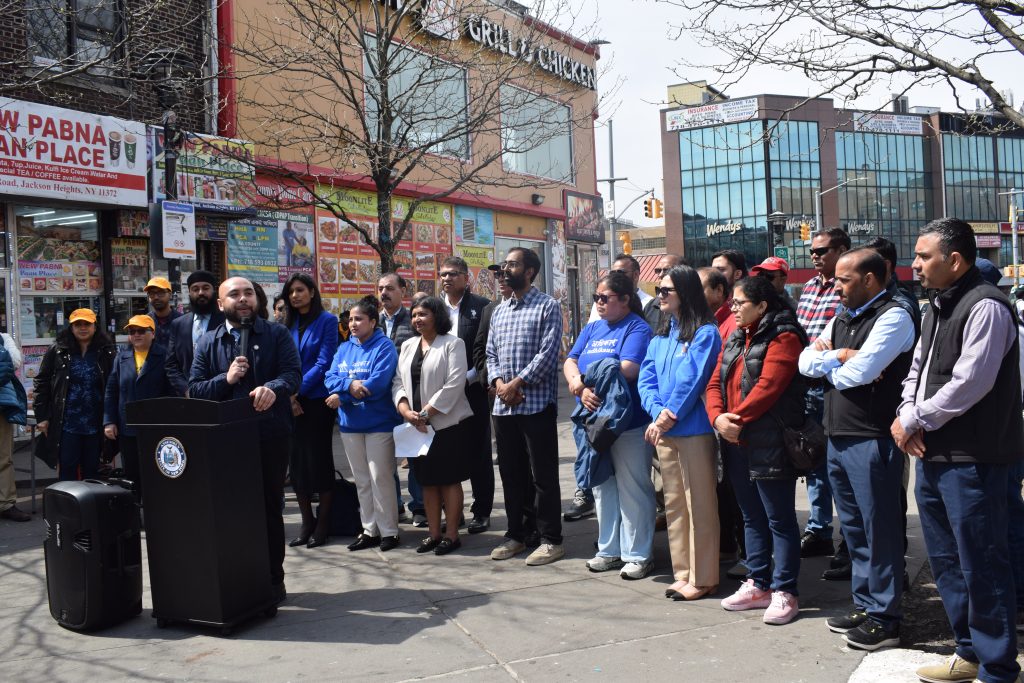
“New York is one of the most diverse places in the entire world. Our strength comes from that diversity, but our responsibility comes with it. As our communities have grown, so too have the reports of caste discrimination,” said Raga at a press conference at Diversity Plaza in Jackson Heights on April 13.
“This bill is about something very simple, ensuring that no one is denied opportunity, dignity, or safety just because of the circumstances of their birth,.” he continued.
A caste system is a hierarchy of hereditary social groups, with each group having a rank in the social order. Members of a caste traditionally share a similar occupation and primarily marry within their community.
The most commonly known caste system originated within Hindu communities in South Asia thousands of years ago, before spreading to other religions and regions as Hindus converted to other faiths and migrated around the world.But the proposed bill does not refer to any specific faith or region, and defines caste as a class in a social hierarchy based on birth that limits social and economic mobility and access to fundamental rights and opportunities.
The legislation has nine cosponsors in the Senate and 18 cosponsors in the Assembly, including backing from Zohran Mamdani during his time as an Assemblymember. Pabitra Dash, a senior organizer at Adhikaar, a Woodside-based worker and community center that serves and organizes Nepali-speaking immigrants and refugees, shared the story of Deepa Sunar, a Nepali worker in Elmhurst. Sunar said she was immediately questioned about her caste upon meeting with a potential employer while searching for employment as a domestic worker last year. After she explained that she was from a caste-oppressed community commonly known as Dalits, she was told that her caste was considered “untouchable,” and that she could not be hired out of fear of contaminating water used for religious purposes in the potential employer’s house. Dash, who also identifies as Dalit, said that Sunar was heartbroken.
“I have many stories myself as well,” said Dash.
Attempts to prohibit caste discrimination in states and universities across the country have come under scrutiny from Hindu organizations. The Hindu American Foundation, an advocacy group for the Hindu diaspora in the United States, claims that discrimination on the basis of caste is already banned by U.S. law that prohibits discrimination based on national origin. The organization argues that including it as a specific category would target people of Indian descent due to the strong association of caste with India and Hinduism.
Advocates for the bill say that caste-based discrimination has not been sufficiently protected by current law, and that including caste as a protected category would not single out the Hindu caste system. The proposed bill does not refer to any specific faith or region, and defines caste as a class in a social hierarchy based on birth that limits social and economic mobility and access to fundamental rights and opportunities.
Caste systems exists within a variety of faiths worldwide, said supporters of the bill in a statement, including “casta” distinctions between indigenous and “mestizo” communities that persist in the Mexican American community.
Swati Sawant, an immigration attorney and caste equity advocate, is one of the few Dalit lawyers practicing law in the United States, and said that there are many stories like Sunar’s across the city.
In 2018, Sawant filed New York’s first caste discrimination lawsuit on behalf of a Dalit Nepali worker in New York City. Sawant said her client faced harassment, exclusion, and humiliation after his caste became known at work, resulting in him losing his job after raising concerns about his treatment.
The New York State Division of Human Rights dismissed the complaint, arguing that caste is not a protected category under existing law.
“The fact of the matter is, caste discrimination is happening every single day, not just in India and broader South Asia, but here in America, from the East Coast to the West Coast. And as a former civil rights and fair housing lawyer myself, I can tell you that the civil rights laws in New York State and the city are not complete until they end caste discrimination,” said Councilmember Shekar Krishnan.
In 2022, Krishnan became the first Indian American and first Hindu American elected to the City Council in New York City history. A 2025 survey of 1,206 Indian American residents in the United States by the Carnegie Endowment for International Peace showed that 77% of Indian Americans favor laws prohibiting caste discrimination.
If passed, the bill would make New York the first state in the nation to ban discrimination on the basis of caste.
A similar bill in California passed in 2023, but was vetoed by California Gov. Gavin Newsom on the grounds that the state already banned discrimination based on religion, origin, and other characteristics. In 2022, California State University added caste as a protected category in the university’s anti-discrimination policy. Columbia and Barnard University updated their discrimination policies to include caste in 2023. Seattle became the first U.S. city to ban caste discrimination in 2023, with Fresno, California soon passing a similar law.
“The most fundamental teaching of Hinduism is that every human being is inherently divine,” said Anuraag Khandelwal, one of the New York City chapter leads at Hindus for Human Rights, a nonprofit advocating for civil rights in South Asia and the U.S. that supports the legislation.
“Caste discrimination is not Hinduism. It is a betrayal of Hinduism. The bill does not target our faith. It protects our people. So I urge our elected officials to do the right thing for the people of the greatest city in the world in this state by passing the bill and setting an example not only for this country but for the entirety of South Asia.”