

Students and faculty are criticizing university President Frank Wu’s conduct after a threatening email demanding his resignation was sent the morning of a high-profile accreditation ceremony.
BY COLE SINANIAN
cole@queensledger.com
FLUSHING — A vaguely threatening email demanding the resignation of three Queens College administrators including university President Frank Wu disrupted the final day of the Middle States convention — a high-stakes accreditation event with major financial implications for the university — and prompted a series of decisions that have led some students and faculty to question the president’s security protocol.
The threat, which turned out to be a hoax but brought the evacuation of two campus buildings on March 25, comes amid recent financial troubles and growing tension between faculty, staff and administration. And while school leadership has maintained it acted in accordance with law enforcement’s direction, the incident has also brought renewed scrutiny to President Wu, who students and staff say has fumbled several safety issues in recent years that’s left some feeling unsafe on campus.
“I have no confidence that my workplace (and my students’ learning environment) is a safe one, where my well-being is prioritized,” wrote Erica Doran, chair of the Queens College branch of the Professional Staff Congress (PSC) union, in a letter sent to university administration.
At 9:01am on Wednesday, March 25, administrative email accounts associated with Admissions, Academic Advising, Vice President of Student Affairs and the School of Music received an email demanding the “immediate and unconditional removal” of Wu and administrators Troy Hahn and Joseph Loughren, before a “fireworkz show” would start at 10:30 that day.
The message came just before a scheduled “read out” at 10:00am at LeFrak Concert Hall, during which faculty and administrators from other regional universities — who had spent the past few months studying Queens College’s academic performance as part of the Middle States convention — would present the results of their evaluation to the university community. A favorable evaluation means the university can maintain its status as a accredited institution, which ensures degrees have value and allows the university to receive grants.
The message was sent through an encrypted Proton Mail account from a sender called “Frankly Concerned” in an apparent reference to President Wu’s email newsletter, titled “Frankly Speaking.”
Meanwhile, the The Knight News student newspaper and several members of the Middle States Committee had received a separate email that morning. The email, a screenshot of which was viewed by the Queens Ledger, was also from “Frankly Concerned” and seemed to accuse Wu of “intoxication on campus grounds,” Troy Hahn of “bribery scandal with tax levy suppliers” and Joseph Loughren of “embezzlement of public funds.”
Student and The Knight News Secretary Sebastian Delapaz was in class in the science building during the Middle States event. He recalled seeing the email and not taking the accusations seriously at first.
“The sender of the email was coming out with very heavy accusations for the three of them,” said Delapaz. “It was just very weird.”
The music school’s Director of Administration, Thomas Lee, who attended the Middle States readout at LeFrak, was initially unaware of the email threats. He described how, as about 100-200 attendees took their seats in the auditorium just before 10:00, one of the university’s vice presidents took the stage and ordered everyone to exit and move to the nearby Goldstein Theater due to potential “overflow, despite the fact that Goldstein Theater is smaller than Le Frak.
What followed was a series of confusing orders that failed to acknowledge the security threat. After everyone had relocated, Lee said, President Wu took the stage, then asked the attendees to leave the theater once again and reenter through a metal detector. Sensing something strange afoot, Lee texted his colleagues with concerns about how the unusual security protocol would make the university look to the Middle States Committee.
President Wu returned to the stage to tell the audience that the event had been moved to Zoom and the Middle States Committee would be reading their evaluation results remotely.
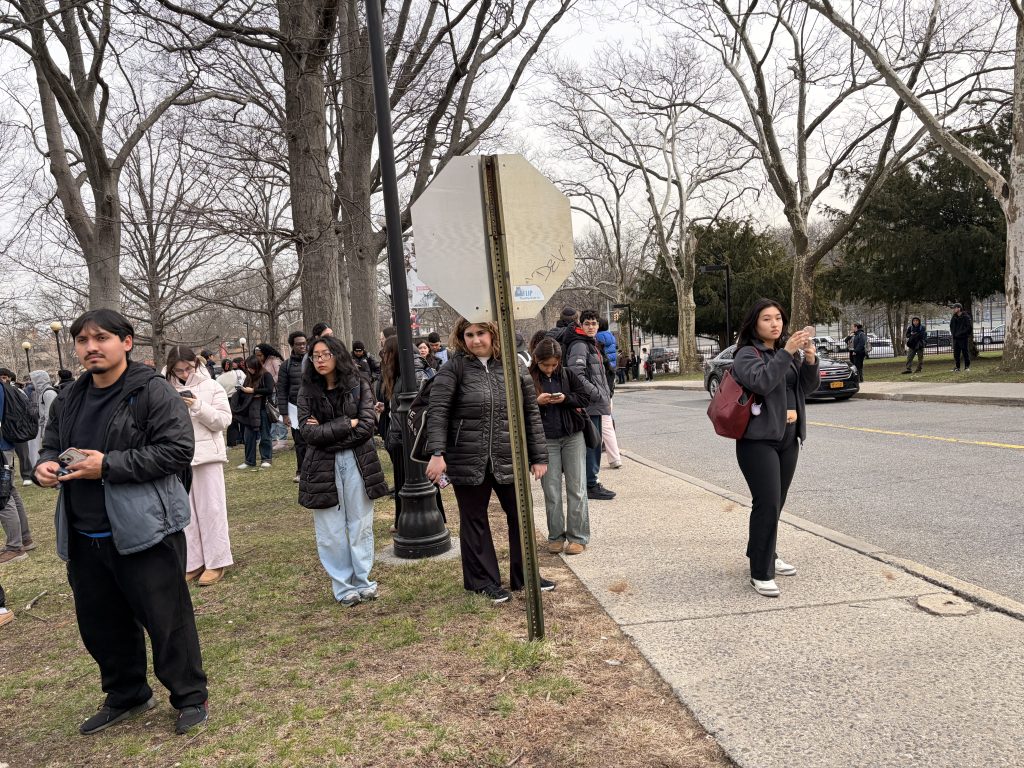
Students outside after the evacuation of Kiely Hall on March 25. Photo by Soho Jung.
Meanwhile, the nearby Kiely Hall — a building that houses both academic classrooms and the president’s office— had been evacuated and a crowd of people was amassing outside.
“To my mind, there’s a threat, and the President chose to evacuate this special group of people and have his building searched,” Lee said.
Doran had a similar assessment: “My concern is there was this clearly what they deem to be a credible threat, and they failed to take proper action to protect the community,” she said in an interview
An email sent at 11:35 am from Interim Vice President for Finance and Administration Troy J. Hahn included the link for the virtual readout. It had the subject line “Zoom Link for Middle States Exit Report Readout,” and provided the link to the virtual event in the first paragraph, before attributing the shift to Zoom to “an abundance of caution after anonymous threats were received.”
“The bomb threat is kind of just mentioned,” said Shadman Hoque, a student at Queens College and the Editor-in-Chief of The Knight News, who had received the email with the Zoom link. “It’s not the actual focus of the email, which I think personally is very manipulative.”
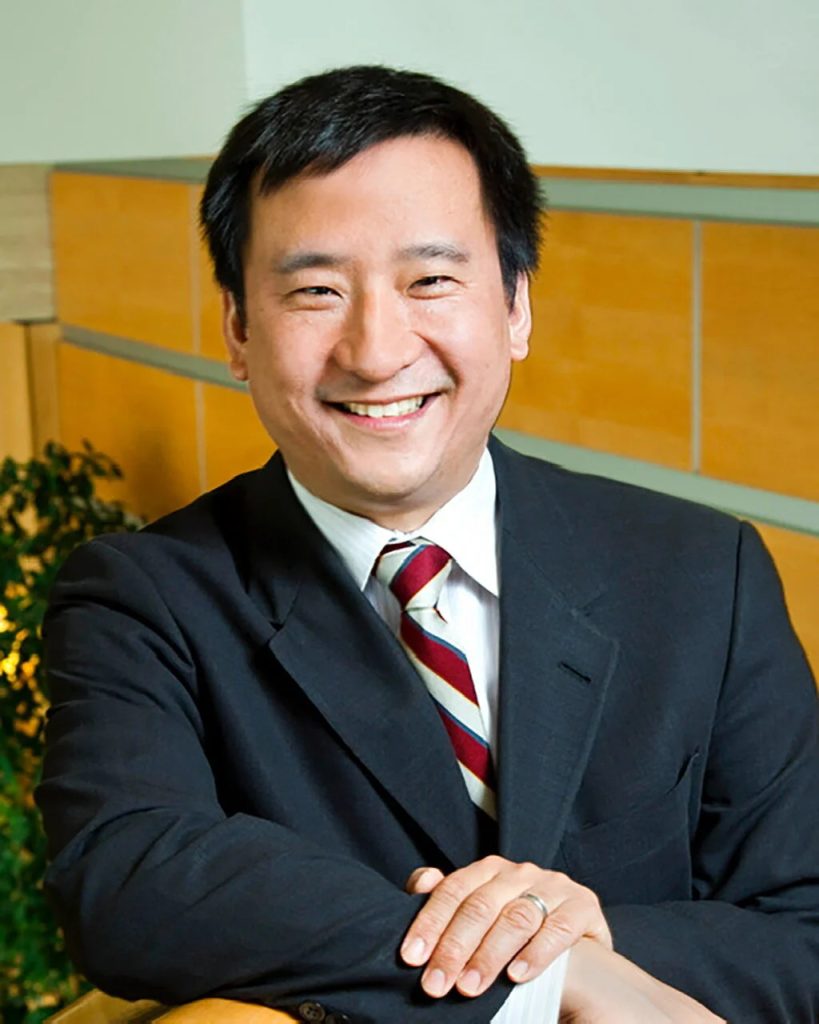
Queens College President Frank Wu.
Wu’s Response
Administration contacted the NYPD’s 107th precinct at 9:58 am and officers arrived on campus at 10:10 am, according to a statement from Maria Matteo, Queens College Media and College Relations Associate Director.
“Queens College Public Safety Chief Vincent Sinclair, a recently appointed and former captain of the NYS Office of Court Administration with over twenty years of law enforcement and security experience, is conducting a review of the incident in coordination with the NYPD and CUNY officials,” Matteo wrote in her statement.” “Chief Sinclair’s aim is to strengthen overall campus readiness and communication going forward,” she continued.
Around 8:00 on the morning of Friday, March 27, Wu released a video to the campus community addressing the prior Wednesday’s events. In the video, Wu explained how he had learned of the threat while on a walk prior to the Middle States event Wednesday morning, and immediately contacted Queens College Public Safety Chief Vincent Sinclair, who in turn got in touch with the NYPD’s 107th precinct.
“This was a dynamic situation on a day that was already a complicated day, and that should have resulted in all of us as a community celebrating,” Wu said in the video.
“I’m always mindful that how we handle something sets precedent for the future,” he continued. “We don’t want to have any panic. We don’t want to create incentives that would encourage some other wrongdoer to perpetrate a hoax like this.”
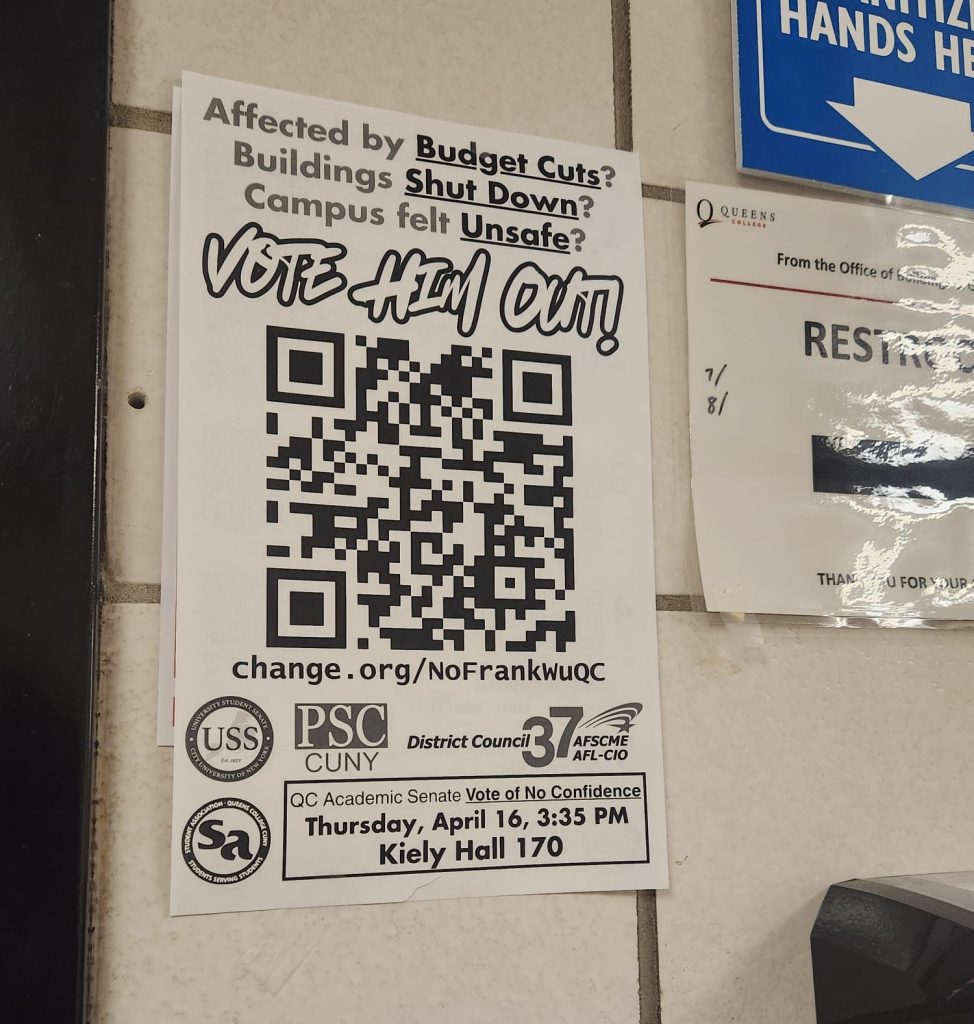
A QR code to an anonymous petition posted around campus in the days after the threats. Photo via Thomas Lee.
Ongoing Concerns
But in the days since the email threats, staff and faculty have expressed continued concern over campus security. For one, those who sent the initial email are still at large. In the weeks since March 25, several flyers with QR codes linking to a change.org petition demanding Frank Wu’s removal have appeared around campus. Though the flyers and petition reference the PSC and several other unions, Lee and Doran have maintained that PSC has no connection
“It definitely has to be someone that’s very in the know,” said Hoque, “because it’s not many students that know about Middle States.”
On April 16, the Queens College Academic Senate will hold a vote of no confidence regarding President’s Wu’s leadership.
In her letter, Doran called attention to previous safety issues, including failure to evacuate a building on campus as it underwent potentially hazardous renovation. She also drew attention to prior email bomb threats the university received in February 2024 and the administration’s subsequent delay in evacuating campus.
Student and The Knight News Treasurer Emmanuel Kragbe, meanwhile, contextualized the events of the 25th amid a broader split between administrators and the university community, with recent funding cuts and perceived mismanagement leading to growing distrust of administration amid faculty and staff.
“Students have been advocating for more art programs, but some faculty members are losing their jobs, or if they have been promoted, they’re not seeing it in their salaries,” Kragbe said. “There’s this distress between administration and faculty that has just been building up and building up.”