

Birthing centers have been shown to improve health outcomes for both mothers and infants. Queens may be about to get its first.
By MARYAM RAHAMAN
In New York City, babies have been born on the Jackie Robinson Parkway, on the W train, in an Uber, and of course, at home and in hospitals. Queens native Charline Mitchell, a former school counselor turned full spectrum doula and lactation counselor, is hoping to add another option for Queens families: a freestanding birthing center.
Birthing centers are facilities that aim to provide a more comfortable environment for births. Centers often follow a midwifery-led model of care and predominantly staffed by midwives. Only those with low-risk pregnancies can be admitted to a birthing center. Currently, there are two freestanding birth centers in New York City—both of which are in Brooklyn.
“I like to joke and say ‘A lot of babies are being conceived in Queens, but not born in Queens,’” Mitchell said.
The center, led by the Birth by Queens foundation, will open in December 2027 if it receives the necessary funding and approvals. Mitchell anticipates that the center will either be placed in Jamaica or Astoria. Per state regulations, birthing centers must be able to transport a patient to a hospital in twenty minutes.
Beyond supporting families through delivery, the center will offer comprehensive resources including prenatal and postpartum services as well as breastfeeding and parenting support.
The center also aims to serve the most diverse borough by addressing inequities in maternal and infant healthcare. Research has shown that midwifery-led care can offer greater patient autonomy and improve both maternal and infant health outcomes. In New York City, Black women are over five times more likely to die of pregnancy-associated causes than white women, according to an NYC Department of Health report. The majority of those deaths were preventable.
“These stories keep happening. Families who are losing their life, or the baby is losing their life. It weighs on us, because what if this person had other options?” said Mitchell, who is a Black woman herself. “At this point in life, we have robots that are completely doing surgeries, not even in the same room. But we can’t figure out how to fix maternal health.”
Mitchell also says that the birthing center will help immigrants coming from countries with a midwifery-care model, where midwives are the specialists.
“We talk about how important our diversity is, but you know, when it comes to the diversity of options, that’s like second nature,” Mitchell said.
Mitchell will not have exact estimates on cost until later in the process, but anticipates that many families will be able to have their births fully covered by insurance—including the over forty percent of Queens County residents who are Medicaid recipients.
Low rates of insurance reimbursement, as well as costly medical malpractice insurance, both remain significant barriers for those trying to open a birthing center. Previous birthing centers, such as the Soho Midwives in Manhattan and the Morris Heights Birthing Center in the Bronx, have closed due to financial reasons.
“We spend more time with our patients, but we actually get reimbursed less,” Melissa Bair, a midwife who lives in Queens but works in Manhattan said. “Our work is not reimbursed at the same rate as physicians, even for vaginal birth.”
Bair says that while offering more holistic services may be one way for birthing centers to be financially solvent, “frankly, discussing ways to reimbursement equity is probably the easiest.”
Mitchell is currently running a 1000 day social media campaign chronicling the birthing center’s journey. The project is still $5 million short. One challenge she anticipates is completing the certificate of need (CON) process. While the CON process aims to limit unnecessary facilities and healthcare costs, it can pose a barrier of capital and costs to those looking to open birthing centers.
Some future Queens moms, like Joy Wang, would still prefer a hospital even if a birthing center was available. “I personally do want to have an epidural, but I know that a lot of women don’t want that anyways,” Wang said. “But I could understand the desire to be in a more comfortable setting, especially for people who have had bad experiences in hospital settings.”
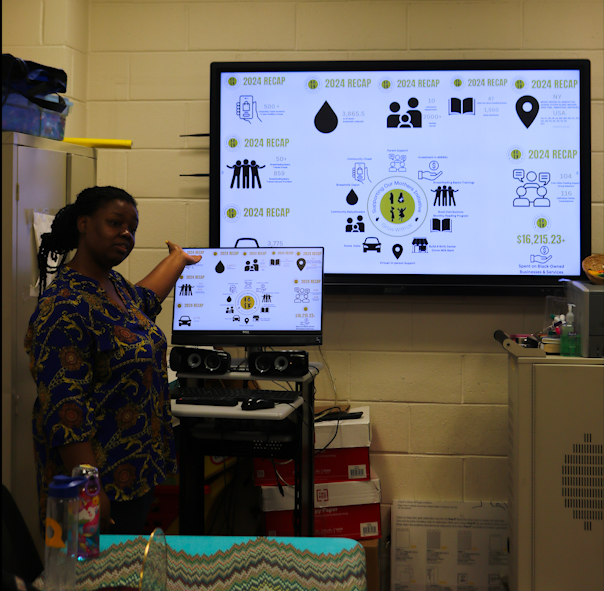
Mitchell is currently conducting an outreach survey to determine community needs in maternal and infant health. The survey can be found at birthbyqueens.org/need. She has also been conducting in-person assessments and presentations in every community board district.
On Saturday, Mitchell held an in-person needs assessment at Queens Public Library at South Hollis. A few members of the community stopped by, with one woman enthusiastically speaking with Mitchell for over an hour about the center and her own birth story. She asked Mitchell how she transitioned to opening her own birthing center. Last March, when she had moved from Los Angeles to New York, she had caught the tail end of a presentation Mitchell gave on birthing centers.
“Wow, she’s been at this for an entire year,” the woman remarked of Mitchell’s work.
“Doing something for the first time could be very fear driven right? If it’s something that you do and you’re comfortable, you’re paying your bills, even though you’re not necessarily in the best of situations, it really can distract you from your purpose,” Mitchell said of her career transition. “And now I look at babies come into the world.”