

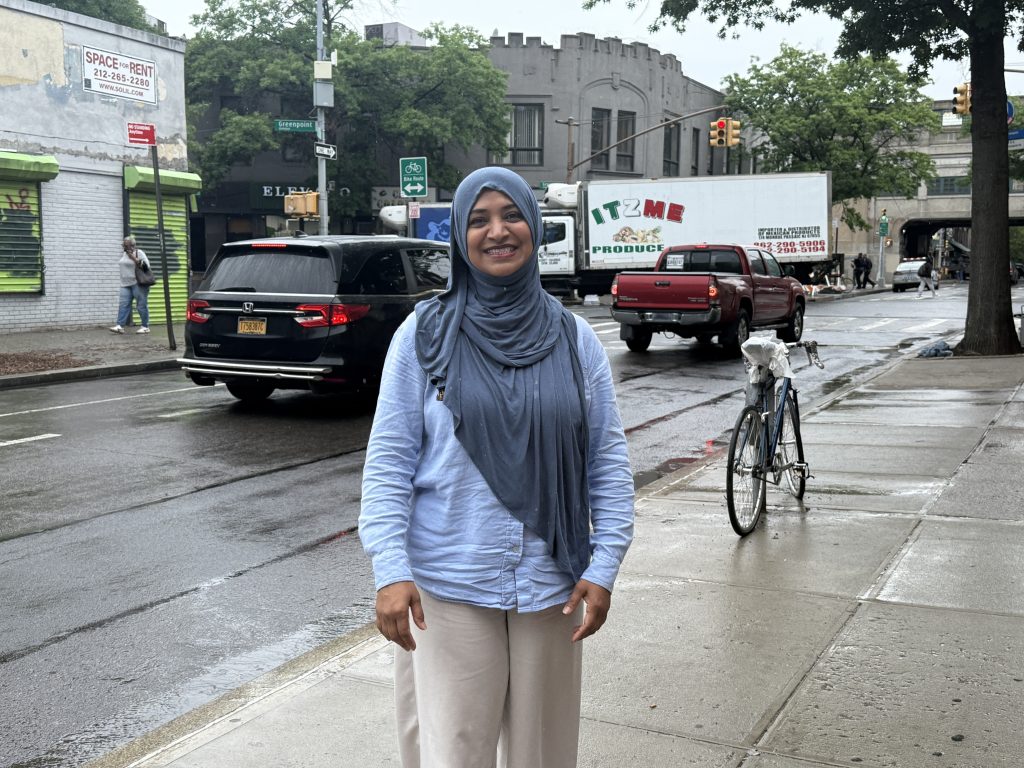
The State Assembly candidate talks her unconventional upbringing, NYCHA, disability rights, and putting low-income New Yorkers first.
BY COLE SINANIAN
cole@queensledger.com
It was gratitude that led Mary Jobaida to run for office.
Having arrived in Long Island City in 2001 from a rural Bangladeshi village, Jobaida’s assimilation into American culture wasn’t easy. The aftermath of 9/11 wasn’t a great time to be walking around New York in a full head-to-toe burqa, as Jobaida did. And for a partially deaf woman like her, learning English as an adult was no small feat.
But with the help of her patient, tight-knit Long Island City community, Jobaida not only gained quick command of the language, but earned her Bachelor’s and Master’s degrees before pursuing a career in journalism — during which she worked for New York City’s first Bangladeshi TV channel, Time Television — all while raising her three children.
“My background is very humble and very non-American,” Jobaida said. “And this very community accepted me as one of their own.”
Now, she’s ready to give back to the community that accepted her as an advocate in the State Assembly. Jobaida’s running for Assembly District 36, a seat that covers Astoria and is currently occupied by Diana Moreno, a democratic socialist who won a special election back in January after the seat was vacated by Mayor Zohran Mamdani, who held it before becoming mayor.
As Astoria voters head back to the ballot for the June 23 democratic primaries, Jobaida — who, like Moreno, is a dues paying member of the Democratic Socialists of America — is once again on the campaign trail, this time seeking to unseat the newly elected Moreno with a campaign focused on inclusivity, accessibility, and fierce advocacy for working-class immigrants, the disabled, public housing residents, and all who are typically excluded from the political conversation.
“I represent the working class, the excluded people, the poor people,” Jobaida said at a candidate forum at the Hellenic Cultural Center in January. “Rich people see us through their lenses. The people who come to us, who sell our struggles back to us, have zero idea how my people are living in Queensbridge, Ravenswood, and Astoria houses.”
The ninth born of 11 children, Jobaida’s upbringing was one of lush nature, a large family, and the culture of collective care that comes with life in a small village. They ate fresh grown fruits and vegetables and captured wild animals. By age 12 Jobaida was riding around the village’s dirt paths on a motorbike.
To get to her middle school was a two mile walk. When the monsoon season hit, the village community would come together to repair damages incurred by floods.
“We’d often see big monsoons, twisters, storms breaking the houses,” she said, “with the community coming together to build each other up through collaborative works.”
Though she now gets by just fine using a combination of lip-reading and hearing aids, Jobaida’s hearing loss diagnosis didn’t come until adulthood, meaning she’s spent much of her life reading lips— to the confusion of her family members.
Jobaida recalled her mother’s annoyance when she would call a teenage Jobaida’s name from another room, only to be met with silence.
“She would say, ‘I’ve been calling you for so long, how come you didn’t respond?’” Jobaida said. “I thought I was just deep into the books.”
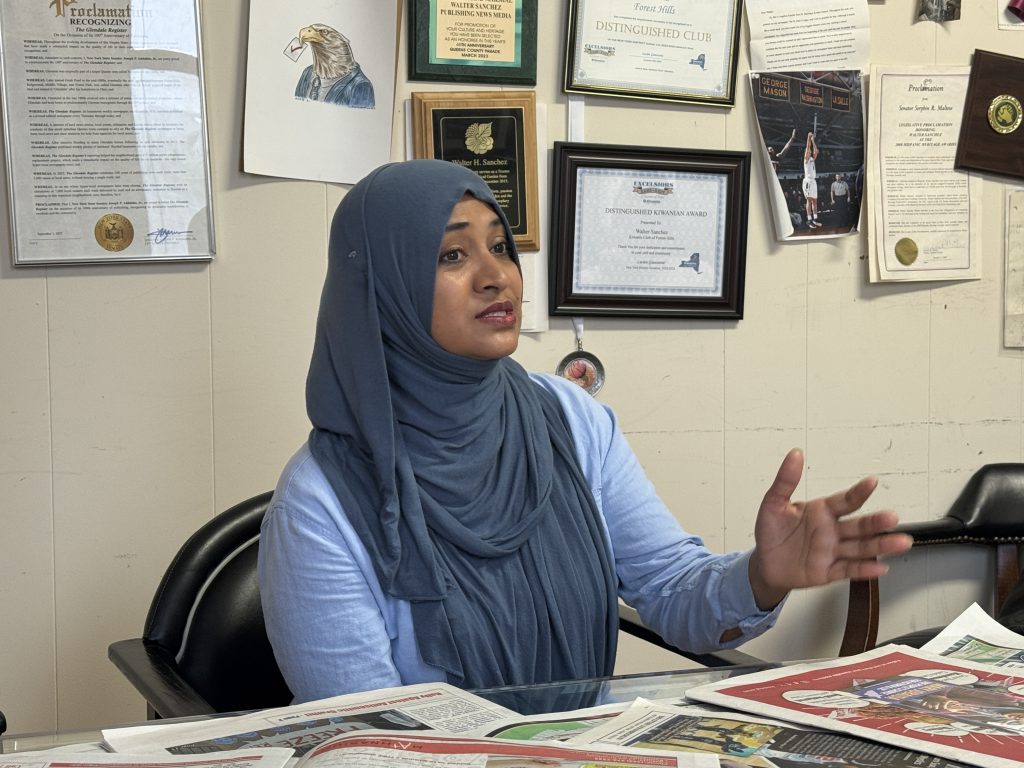
Later, Jobaida had no trouble lip-reading her instructors as a student at LaGuardia Community College, where she earned her Bachelor’s degree and served as Vice President of the Student Government Association. But things were different when she pursued her Masters at NYU, where large lecture halls made lip-reading near impossible. Still, she pulled it off by keeping up with reading assignments and closely following lecture slides, eventually earning a Master’s degree in media and communications.
Jobaida partially attributes her perseverance to her loving family and accepting community, who she said always supported her and was incredibly patient as she learned to live with her disability.
The State, however, could do more for people like her, Jobaida says, whose disabilities often make public spaces difficult to navigate in ways the able-bodied masses might never consider. Announcements on the subway for example. A visual display, she says, could go a long way toward making hearing-impaired commuters’ days just a bit easier.
“Information should be through different modes of accessibility,” she continued. “I’m fighting for disability justice, and there are so many kinds of disabilities. So I am representing all of them.”
Earlier this month, a CBS news crew followed Jobaida as she toured Long Island City’s Queensbridge Houses, many of whose residents had been left without gas for weeks. Jobaida, who’s devoted much of her time to drawing attention to NYCHA management’s broad failure to maintain basic living conditions for its residents, has repeatedly called out the City for not prioritizing public housing, which serves some of New York’s lowest income residents.
“I’m the leader who wants to make sure that my communities are all supported, that they all deserve the same quality of life,” she said. “Because privilege is temporary. Some in luxury housing say they’re well-off, but then in two years they’re going to be also facing displacement, because they’re going to be priced out if we cannot control the district and keep it livable and affordable for everyone.”
It’s her focus on the often overlooked communities in her district that she says sets her apart politically, and would make her a valuable addition to the DSA slate. While Jobaida said she’s still proud to be a DSA member, she’s been disappointed by the organization’s tendency to endorse candidates based on seniority instead of the depth of their ties to local issues. Jobaida has positioned herself as a true political outsider, someone whose identity and life experiences does not currently have representation in the State Assembly. The DSA, Jobaida says, could benefit from having someone like her in its coalition in the New York State Legislature.
“I was not invited, so I needed to introduce myself,” Jobaida said. “It bothers me that a movement that I love is becoming a movement of a certain type, much detached from the local marginalized community.”
“My win will help this mass DSA movement,” she continued, “to keep it grounded and not continue to become detached from the community and become a machine.”