
Two NYPD Officers Indicted for Misconduct in Jackson Heights


By MOHAMED FARGHALY
mfarghaly@queensledger.com


Two probationary NYPD officers have been indicted on multiple charges, including
burglary, forcible touching, and official misconduct, following an investigation into
alleged misconduct while on duty in Jackson Heights.

Queens District Attorney Melinda Katz announced on March 31 that Justin McMillan,
27, and Justin Colon, 24, both assigned to the 115th Precinct, face eight criminal
counts related to incidents that occurred on July 19 and 20, 2024. According to the
charges, the officers responded to a 311 call regarding prostitution at a residential
building on 89th Street.

Upon arrival, the officers allegedly deactivated their body-worn cameras before
interacting with a woman who had just exited the building. The officers are accused
of taking a key from the woman, which they used to return to the building hours
later.

Around eight hours later, McMillan and Colon allegedly entered the building using
the stolen key. Inside, they found a woman engaged in prostitution. After the man
involved fled the scene, McMillan is accused of stealing money from the woman’s
purse and groping her before she fled the location and called 911.

The officers did not report the incident or file any paperwork related to their
actions, and both were placed on modified duty in August 2024 after the
investigation began. They surrendered to the NYPD’s Internal Affairs Bureau (IAB)
on Monday.

District Attorney Katz condemned the officers’ alleged actions, stating that the
charges represented a serious breach of public trust.

“The allegations in this case are an affront to the shield worn by the countless police
officers who serve and protect the residents of this city,” Katz said. “The defendants,
both sworn NYPD officers, are accused of using their authority to break into a
building, steal money and forcibly touch a woman while on duty, with their body-
worn cameras intentionally turned off so that their misdeeds would not be
recorded. I thank the NYPD’s Internal Affairs Bureau for their crucial assistance in
bringing charges against the two defendants, both of whom are now indicted and
face justice in our courts.”

NYPD Commissioner Jessica S. Tisch also spoke out against the officers, emphasizing
the department’s commitment to holding officers accountable.

“Wearing the uniform of a New York City Police Officer is one of the highest
privileges in law enforcement, and the legitimacy of that work is based on the
public’s trust,” Tisch said. “So, when that trust is broken, as it was in this case, the
entire police department must answer for it. I want to thank the NYPD’s Internal
Affairs Bureau, the Queens District Attorney’s Office, and everyone else who worked
on this investigation. We hold our officers to the highest standard of professionalism
and integrity, and failing to meet that standard is disqualifying. Let me be perfectly
clear: Any officer who violates their oath will be investigated, exposed, and held
fully accountable. That standard will never change.”

McMillan and Colon face charges of burglary in the second and third degrees,
forcible touching, petit larceny, and official misconduct. If convicted of the top
charge, they could each face up to 15 years in prison.

Both officers were arraigned Monday and are due back in court on April 28. The
case is being prosecuted by the Queens District Attorney’s Office, with Assistant
District Attorney Christine Oliveri leading the prosecution.

McMillan, who joined the NYPD in April 2023, and Colon, who joined in July 2023,
were both stationed at the 115th Precinct after completing their training.

Former area councilmember and senator Hiram Monserrate expressed shock at the
indictment of two local NYPD officers, Justin McMillan and Justin Colon, who are
accused of using their authority to break into a building, steal money, and forcibly
touch a woman while on duty. Monserrate criticized the officers’ actions, which
allegedly took place on Roosevelt Avenue in Jackson Heights, emphasizing the
disturbing erosion of trust in law enforcement due to the officers’ alleged

misconduct. He acknowledged that many local officers perform commendably but
stressed the need for integrity and accountability within the department.

“While we respect the presumption of innocence in our
judicial system, everyone is accountable before the law,” Monserrate said in a
statement. “This indictment will serve only to erode trust. I know many of our local
officers and I know they do great work, but this revelation is chilling. We need our
police officers to step up and for the Police Department to ensure integrity.”

Monserrate also highlighted the ongoing issues of prostitution and human
trafficking on Roosevelt Avenue, including frequent complaints about brothels and
street walkers in the area. He noted the community’s efforts to address these
problems through marches, rallies, and press conferences but stressed that the
situation remains a serious concern.
Safety Concerns Spark Outrage at Proposed Battery Storage Site

By MOHAMED FARGHALY

mfarghaly@queensledger.com

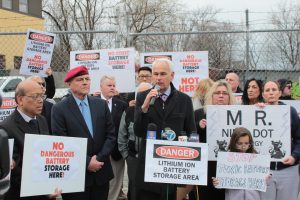
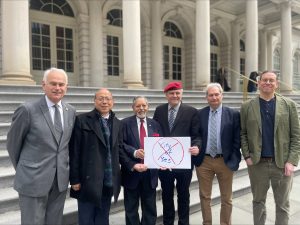
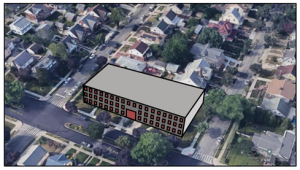
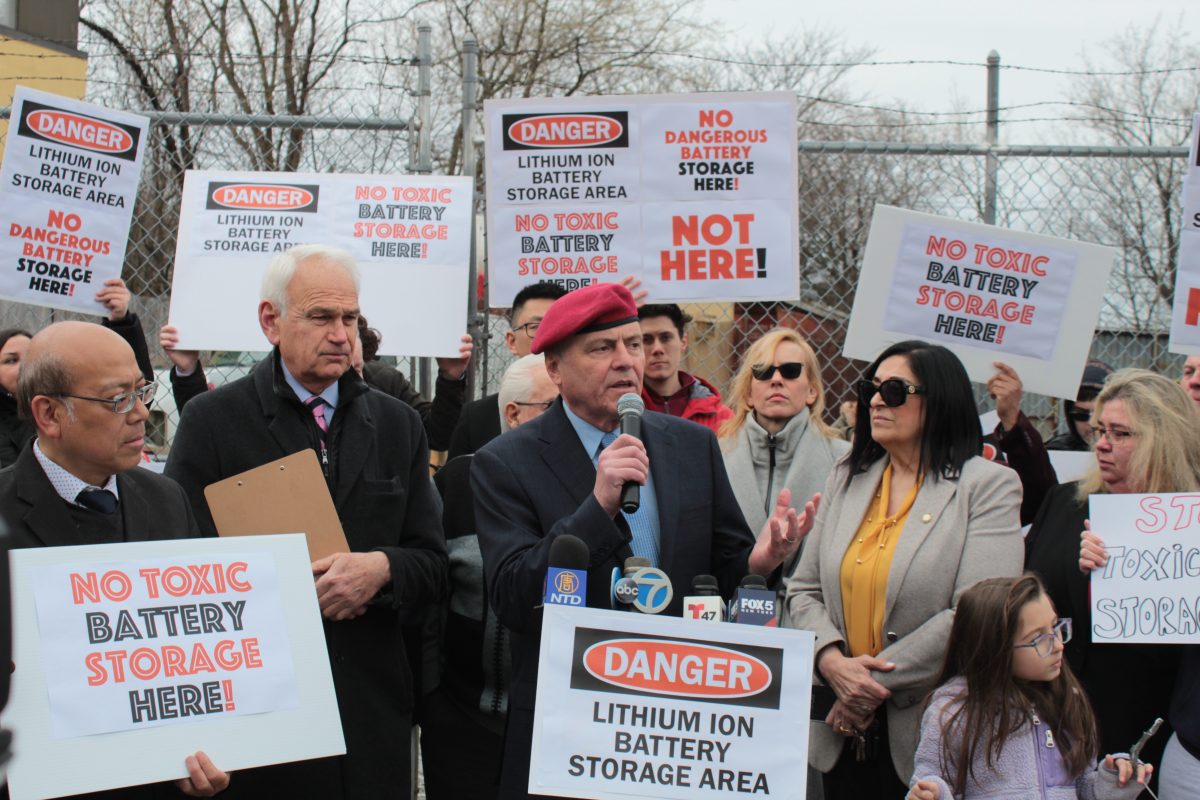
A rally was held on April 2 to protest the proposed installation of a lithium-ion battery storage system in Middle Village, located at 64-30 69th Place, directly across from PS/IS 128. The proposed project, which has sparked community outrage, would position the large-scale energy storage system in a residential area already home to a daycare center, an animal hospital, and a children’s play center—raising serious concerns about safety and the well-being of the community.

The rally, organized by Council Member Robert Holden, drew a crowd of concerned residents, political figures, and local parents who voiced their fears about the safety and environmental impact of the facility in such a densely populated area. Holden emphasized the potential dangers posed by the facility, particularly for the nearby schools.

“We go around here, and we see who are the most affected, the children that go here, the parents of the children, the homeowners who live close to this facility,” Holden said. “We’re not going to take this lying down, we have to fight back. They are always shoving these kind of places at us, but this is now very, very dangerous.” 

Republican mayoral candidate Curtis Sliwa, who also attended the rally, criticized the siting of such facilities in residential areas, urging officials to consider industrial zones for energy storage systems instead.

“You say to yourself, why would you be putting such dangerous facilities in residential areas,” Sliwa said. “So, I’ve been the Paul Revere on this only because I spent time in Staten Island, where it first became very obvious, eight locations alone, North Shore, mid Island, South Shore. But it doesn’t mean that people are opposed to green energy or lithium-ion batteries or the warehouse, they just need to be in industrial areas. And it’s a Democratic issue, and it’s a Republican issue.” 

Sliwa’s remarks echoed concerns about the city’s energy infrastructure. He blamed former Governor Andrew Cuomo’s decision to close the Indian Point nuclear plant, which once provided a third of the region’s power, as a key reason for the city’s reliance on alternative energy storage solutions. The issue has ignited concern across multiple neighborhoods. Sliwa pointed to locations in Staten Island, Brooklyn, and now Queens where similar facilities are being proposed, citing a growing trend of placing these sites in areas with higher residential density. 

The debate over lithium-ion battery storage has become a flashpoint for broader discussions about the balance between green energy initiatives and community safety. While proponents argue that the facilities are necessary to stabilize the grid and store renewable energy, opponents contend that the risks of storing such volatile materials in residential areas outweigh the benefits.

The rally also featured a speech from Donald Cranston, a representative from Assemblywoman Jaime Williams’ office. Cranston highlighted the health risks associated with lithium-ion batteries, including the release of toxic metals such as cobalt.

“On a personal note, I have a brother who died from 911 illness in 2019 he was 48 years old,” Cranston said. “These batteries emit cobalt, high metals. They’re toxic. What are we going to do when we find out 10 years from now, what the effects are on the children to go to school here?” 

Cranston added that Assemblywoman Williams had introduced a bill (A6955) aimed at restricting the placement of battery storage facilities near schools and residential areas. The bill would require a 1,000-foot buffer zone between such facilities and schools, homes, or commercial properties that people frequent.

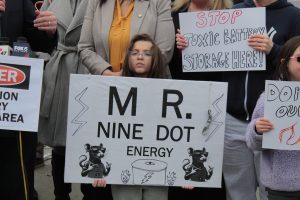
​Eight-year-old Paula, a third-grade student at PS/IS 128, got a chance to expresse her concerns during the rally. 

“I’m in the third grade and I love this school, and I really hope there’s not gonna be a power facility here,” she said. “It’s harmful to our community, it’s harmful to our classmates, the students, the teachers, the parents and even for the houses across the street.”  

In response to the backlash, Holden vowed to continue pursuing legal action to halt the facility’s construction. “Right across the street over a thousand kids attend, who in their right mind would want to put this kind of facility next to a school?” 
​Holden then went on to initiate a chant, to further emphasize the community’s opposition to the proposed facility:​

“No storage facility here, protect our children!”

At the rally, Paul Pogozelski, a candidate for city council, expressed concerns about the proposed lithium-ion battery storage facility, suggesting that the $2.25 million property in question may have been bought with prior knowledge of the facility’s plans. 
“Maybe we can find a better location for it, where it’s in a little more industrial area,” Pogozelski said.  “That in case of an incident that you’re not having to evacuate kids from school, veterinarian clinics and local residents, because it’s right across the street from them.”

Pogozelski questioned how the facility would handle emergencies like fires, especially in such a densely populated area, highlighting the potential risks for local residents, schools, and businesses. While acknowledging the need for solutions to issues like brownouts and blackouts, he argued that a more appropriate location in an industrial area would be safer and less disruptive. 

The FDNY report, issued on January 8, highlights significant progress in reducing lithium-ion battery-related fires and fatalities in New York City, following ongoing efforts to address the growing safety concerns associated with these batteries.  

The report highlights a significant 67% decrease in lithium-ion battery-related deaths, from 18 in 2023 to 6 in 2024. This reduction is attributed to improved public education, safety campaigns, and increased inspections of e-bike shops, which led to numerous violations being issued. Despite this progress, the number of lithium-ion battery fires remained high, with 277 incidents in 2024 compared to 268 in 2023. However, the increase in outdoor fires suggests that public awareness about proper storage and charging is improving. Overall fire fatalities in the city decreased by 25%, with electrical fires, including those caused by lithium-ion batteries, identified as the leading cause.

Trip to the NASA Wallops Flight Facility

Quinten Jansen


A group of 30 high school students from Monsignor McClancy Memorial High School,
recently had the experience of visiting the NASA Wallops Flight Facility in Virginia, the
only NASA-owned facility of its kind in the state. The trip marked the culmination of a four-
year journey that began with a classroom project measuring the tree height using various
NASA techniques, and ended with recognition and a chance to see science come to life.

The project began during the students’ freshman year under the guidance of the STEAM
Faculty coordinator Deanna Danke and with support from Brian Campbell, Senior Earth
Science Specialist and GLOBE Observer Trees Science Lead at NASA Wallops and GST,
Inc. Initially met with confusion especially on how math applied to tree measurements, the
students quickly discovered the real-world application of their studies. Using NASA’s
satellite-based methods, they measured the height and diameter of local trees to assess
environmental health and sent their data to NASA. They thought little of it until a paper was
published in June 2022 featuring their work.

NASA later invited them to create a digital reel about their research. The students kept in
close contact with NASA over the next four years, which eventually led to their trip to the
Wallops Flight Facility.

Senior Richard Stock IV, who joined the project later, said, “I found the project really
exciting. Everyone had their own role, and it felt great to contribute.” He was especially
fascinated by how NASA uses lasers to study precipitation and climate change. Chris
Georgeopoulos was captivated by the NASA balloons. “The ropes can carry up to 8,000
pounds. They send up cameras and microphones 30 miles into the atmosphere.” he said.

Sophomore Joseph Werner recalled a school presentation on climate change, where they
linked tree health to environmental conditions. He recommends the program to others for its
real-world learning. Thiago Costa, initially uninterested, discovered a passion through the
project. “Now I know what I’m interested in,” he shared.

For Jake Wood, the turning point was learning about NASA’s ICESat-2, which uses lasers to
map land and sea ice every 90 days. Santiago Uribe-Correro, inspired by Campbell’s
leadership, credited him with bringing the whole experience together.

The opportunity wasn’t always guaranteed. These seniors only learned of the trip during their
final year. Students like Brandon, were drawn by the chance to see rockets and to learn how
radar detects precipitation. Sebastian Leonowicz, who hopes to pursue engineering, loved
seeing the rocket assembly process firsthand. “I was expecting a lot, and NASA delivered,”
he said.

Through it all, these students not only learned math in a hands-on, meaningful way, they
shaped the direction of their own learning and saw how their efforts connected to global
scientific work. What started as a simple class project turned into a powerful journey fueled
by curiosity, collaboration, and a bit of rocket science.

Community Split, Casino vs. Connectivity in Metropolitan Park

Courtesy SHoP Architects, Field Operations


By MOHAMED FARGHALY
mfarghaly@queensledger.com


A transformative $8 billion infrastructure proposal, the Metropolitan Park
development, is making significant strides as New York Mets owner Steve Cohen and
Hard Rock International push forward with plans to reshape the area around Citi
Field in Queens. The ambitious project, which envisions a sprawling casino, hotel,
and entertainment complex, has been made possible by recent legislation
introduced by State Senator John Liu. The legislation allows for the use of parkland
surrounding Citi Field for the construction of the casino, hotel, and related facilities,
which has been a key hurdle for the project to move forward.

The project, which recently received approval from the City Council in a 41-2 vote,
has now cleared a major regulatory hurdle. In addition to this massive project is the
caveat of the creation of the Flushing Skypark, a pedestrian and bicycle bridge that
will span Flushing Creek and connect downtown Flushing to Willets Point. Liu has
emphasized the importance of community connectivity and infrastructure
improvements, which have become a focal point of the project. The Skypark,
inspired by Manhattan’s High Line, will not only serve as a crossing but also a
destination, featuring recreational spaces, public areas, and flexible hubs for
community gatherings.

Senator Liu, who has long been an advocate for expanding Queens’ pedestrian and
bicycle infrastructure, believes that the Skypark will help address gaps in the
borough’s connectivity while also providing a vibrant public space.

“It’s going to be esthetically attractive, it’s environmentally sound, and it would not
only be a way for people to get to and from either side of the Flushing Creek, but it

would also instead be its own destination, because it’ll have space for people to hang
out, to congregate, to rest, whatever people would do in an actual park.”

Courtesy Community Board 7

As part of the project’s development, Liu is introducing legislation that will allow for
the use of the land surrounding Citi Field for the construction of a casino, hotel, and
related facilities. The legislation is seen as a necessary step for Cohen to submit his
application to the Gaming Commission for approval to build the casino. Liu,
however, made it clear that his support is not an endorsement of the casino itself
but rather a way to ensure that the broader project, including infrastructure
improvements like the Skypark, moves forward.

“My bill allows his application to move forward and there are potential benefits that
would come to the community if he were to win the casino proposal, but without
this legislation, he can’t even submit the proposal,” Liu said.

The Metropolitan Park project has drawn mixed reactions, with some local residents
and advocacy groups expressing concerns over the impact of the casino on their
communities. Critics argue that it will contribute to displacement, increase traffic
congestion, and privatize public parkland.

In response, Cohen and Hard Rock International have committed to ensuring that
community benefits are a key part of the project, including a binding agreement
with the Waterfront Alliance, a regional community organization. If for any reason
the Flushing Skypark cannot be completed, Cohen and Hard Rock have pledged to
allocate $100 million for infrastructure improvements at Flushing Meadows Corona
Park.

“As I have made abundantly clear for more than a year, the Metropolitan Park plan is
a grand slam for Northwest Queens — a region of our borough that has historically
been minimized, marginalized and maligned,” Queens Borough President Donovan
Richards Jr said. “In a time of growing economic uncertainty, this revolutionary
project would create 23,000 good-paying union jobs, unlocking new levels of
upward mobility for families across Corona, Flushing and beyond. Meanwhile, a
nine-figure community improvement fund, a 25-acre park, a Queens-specific food
hall that will boost countless local small businesses will generate positive outcomes
for generations of area families.”

Courtesy Fed Up Coalition

Despite these promises, community opposition has been vocal. Local groups have
raised concerns about the potential harm the casino could bring to the
neighborhood, particularly regarding economic exploitation and the social impacts

of gambling. Residents from Flushing, Corona, Jackson Heights, and East Elmhurst
have rallied together at the end of March to oppose the project, urging Governor
Kathy Hochul to reject the idea of casino development on public parkland.

“A casino at Citi Field will only make things worse,” long-time Corona resident
Marilyn Mendoza said. “We already deal with unbearable traffic and parking issues
every time there’s a game at the stadiums, and with a new stadium being built
against our community’s wishes, we are being ignored yet again. Adding a casino on
top of that will increase congestion, drive up rents, and bring more harm than good.
Instead of a casino that preys on our community, we need real
investments—affordable housing, good jobs, and resources that help families thrive.
I urge our leaders to listen to us and put our community first. We deserve better.”

Environmental groups have also voiced opposition, arguing that the development
threatens the area’s public parkland and fails to address crucial climate resilience
issues. Rebecca Pryor, Executive Director of the Guardians of Flushing Bay,
emphasized that the project’s proposal would privatize significant portions of public
land, limiting access to park spaces that are essential for local residents.

“The proposed project is for Flushing Meadows Corona Park, which is formed in the
path of Flushing Creek and one of the most flood-prone parks in the city”, said
Rebecca Pryor, the Executive Director of the Guardians of Flushing Bay. “Any
development in an NYC public park should be a meaningful investment in the city’s
public parkland. Queens Future’s Vegas-like casino fails this basic requirement

“For the City of New York to allow such an entity on public land is unacceptable,”
Memo Salazar, Board Co-Chair of the Western Queens Community Land Trust said.
“The precious few parcels of public land left in this city should be used to address
the many dire needs New Yorkers- and Queens residents in particular- face: open
space, community centers, and truly affordable housing, to name a few.”

For more details, readers can visit queensforall.com to access resources and support
those opposing the Metropolitan Park project.

Despite these concerns, Liu has stood firm in his belief that the Metropolitan Park
project, particularly the Skypark, can provide long-term benefits for Queens,
creating new public spaces while enhancing connectivity.

“Senator Liu has been a champion for infrastructure and a lifelong advocate for
Flushing. As an organization based in Willets Point, we shared the community’s

concerns around connectivity and recognized that the Skypark would be a great way
to bring Queens together,” said New York Mets owner Steve Cohen. “Metropolitan
Park is committed to working to make Flushing Skypark a reality. And if for any
reason we cannot, then we will still follow through on our commitment to the
community by dedicating $100 million to the betterment of Flushing Meadows
Corona Park.”

Over 100 Officials Challenge “City of Yes” Zoning Reform

Courtesy Office of Council Member Joann Ariola

MOHAMED FARGHALY

mfarghaly@queensledger.com

In a bold move to challenge New York City’s ambitious zoning reform, the City Council’s Common Sense Caucus, joined by over 100 elected officials, civic organizations, and concerned residents, has filed a lawsuit to overturn the controversial “City of Yes” zoning overhaul. The lawsuit, filed last week in the New York Supreme Court in Richmond County, argues that the city violated fundamental environmental laws during the passage of the sweeping rezoning plan.

The lawsuit targets the city’s failure to comply with both the State Environmental Quality Review Act (SEQRA) and the City Environmental Quality Review (CEQR), specifically accusing the administration of neglecting necessary environmental assessments. According to the suit, the city’s adoption of the new zoning rules disregarded established procedures meant to ensure the protection of New Yorkers and their neighborhoods.

“Respondents violated their environmental obligations in at least three critical ways: first, by failing to take a ‘hard look’ at significant areas of environmental concern without providing a rational basis or reasoned elaboration for this failure; second, by segmenting City of Yes (‘Rezoning’) into three distinct stages as if each stage were independent, this violation of law served to avoid assessing the cumulative impacts of each phase of the Rezoning; and finally, Respondents overhauled New York City Zoning without proposing any mitigation or any rational explanation for failing to propose reasonable alternatives that offered mitigation,” the lawsuit alleges.

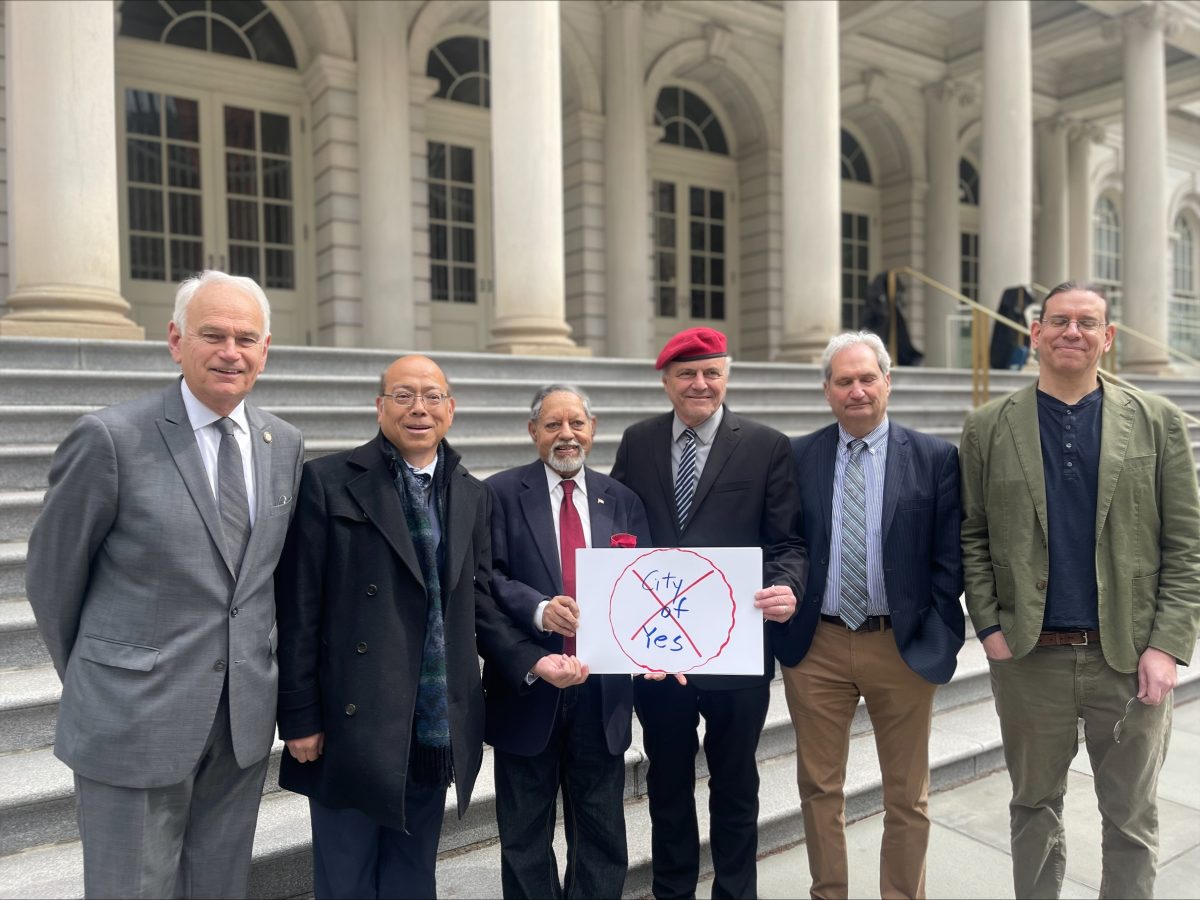
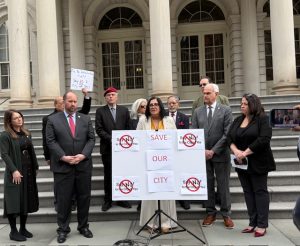
Opponents of the “City of Yes” have been vocal in their criticism of the plan, which they argue prioritizes development over the needs of local communities during the announcement at city hall on March 26.

Minority Leader Joann Ariola, who has been a leading voice in opposition, asserted that the rezoning effort was not about addressing the city’s housing crisis, but about making way for large-scale developers to push through projects with little regard for environmental or social consequences.

“The City of Yes was never really about solving an economic or housing ‘crisis’ – it was about clearing the decks for big development in our communities, then trying to deceive the public into believing it would have no negative environmental consequences or impact on our quality of life,” Ariola said. “The lawsuit we filed today makes it clear that not only did the city lie to us all, it broke the law in the process. It is the culmination of a diverse, citywide grassroots movement of residents who refuse to have their neighborhoods destroyed or their rights trampled.”

The “City of Yes” initiative, which aims to address the city’s housing shortage, was divided into three phases: Zoning for Carbon Neutrality (approved in December 2023), Zoning for Economic Opportunity (approved in June 2024), and Zoning for Housing Opportunity (approved in December 2024). Despite the plan’s goal to create more housing options, it faced strong opposition, especially the final phase, which was rejected by 38 of the city’s 59 community boards and nearly half of the New York City Council Members.

Each of the plan’s three phases was subject to its own Environmental Impact Statement (EIS), which controversially concluded that the expected influx of new development and density would have “no significant” negative effects on surrounding communities. Critics have disputed these findings, pointing out the strain on infrastructure, public services, and the environmental challenges faced by many already-overburdened neighborhoods.

“The Rezoning represented a wholesale departure from longstanding public policy that respects open space, air and light, stress on infrastructure and the neighborhood character of vast areas of New York City’s low-density communities,” the lawsuit concludes. “To have undertaken this Rezoning contrary to the requirements of basic environmental law must result in a nullification of Respondents’ unlawful behavior.”

The backlash has been broad and includes Republican mayoral candidate Curtis Sliwa, who praised the Common Sense Caucus and the civic groups for taking legal action against the Adams administration’s rezoning plan. Sliwa, a vocal critic of the “City of Yes,” warned that the zoning changes were a “top-down scheme” that ignored public input.

Courtesy Office of Council Member Robert Holden

“This lawsuit is a wake-up call to City Hall that New Yorkers will not be steamrolled,” said Sliwa. “The City of Yes is nothing more than a land grab for developers at the expense of the working and middle-class New Yorkers who built this city.”

Sliwa has also raised concerns about the potential risks posed by a specific aspect of the plan—its provision for lithium-ion battery storage facilities. These sites would be placed across the city, including residential and low-density areas, which Sliwa deems a safety hazard.

“New Yorkers should not have to live next to ticking time bombs,” Sliwa said. “The City of Yes put profit over public safety, and as mayor, I’ll fight to reverse that.”

City Council Member Robert Holden, another outspoken critic of the plan, has joined the lawsuit as a citizen plaintiff. Holden has called for the city to abandon the “reckless” rezoning initiative, emphasizing that local communities should not be undermined in favor of developers.

“I’m proud to be a citizen plaintiff alongside civic advocates Tony Nunziato, Alicia Vaichunas, and Phil Wong to say NO to the City of Yes,” Holden said. “This community rejects giving a blank check to developers—we will fight tooth and nail against this reckless plan.”

Council Member Robert Holden echoed Curtis Sliwa’s concerns, specifically criticizing the proposal to build a lithium-ion battery storage facility in Middle Village, directly across from PS/IS 128 and near an animal hospital and daycare centers. Holden called the plan “dangerous” and emphasized that such facilities do not belong in residential areas, vowing to fight the project “every step of the way.”

The “City of Yes for Housing Opportunity” initiative was designed to address New York City’s housing shortage by relaxing long-standing zoning rules. The plan aimed to provide more housing options across the city without overburdening any one neighborhood. The proposed rezoning changes are expected to enable the creation of 82,000 new homes over the next 15 years.

While proponents argue that the plan is necessary to tackle the city’s housing crisis and bring down costs, opponents remain steadfast in their belief that it could have far-reaching and negative consequences for local neighborhoods, their residents, and the city’s infrastructure.

This Will Not be the Typical Mayors Race

By Robert Hornak

The very complex and highly technical process of collecting nominating petitions to get on the ballot for this year’s citywide elections just concluded. And there are a few interesting surprises that could make this one of the most competitive and wide-open mayoral elections in decades. 

First, we have dozens of candidates filed to run for mayor. This is no doubt due to the incredible unpopularity of Eric Adams. Even after having the charges against him mercifully dropped, his political career still appears to be over. Adams recently dropped the bombshell that he won’t even run in the Democrat primary for reelection, but instead as an independent. 

Recent polls have shown that among Democrat primary voters Adams is less popular than even President Trump. Corruption allegations aside, voters still think he’s done a very poor job as mayor and does not deserve another four years to do more of the same. Adams surely senses this is the end for him, even if he doesn’t want to admit it. Were he to run in the Democrat primary and lose badly, his status as a lame duck would be cemented for the rest of his term. 

But by declaring his candidacy as an independent, he stays in the race until November, delaying the inevitable while being able to fool himself into thinking he might be able to turn things around by the time the general election rolls around. 

Then there’s the Democrat primary in June, with Andrew Cuomo far and away the frontrunner. All the players in the Democratic Party are lining up with Cuomo, including all the unions that typically matter. They see him as the likely winner and want to be able to take some of the credit for his miraculous comeback around contract negotiation time. 

In a massive field, socialist Assemblyman Zohran Mamdami is holding on to a distant second place. But in multiple ranked choice voting simulations, Mamdami falls to third place, showing that his support, while very passionate and full of youthful energy, doesn’t attract many second choice rankings and his ability to grow is likely very limited. Even most NYC Democrats don’t like his socialist and antisemitic positions. 

The exception is the Working Families Party, which in recent years has not worked well with the Democratic Socialist candidates. But their passion is built on a hatred of Cuomo, who as governor changed the ballot access rules for party organizations to achieve a permanent line on the ballot in order to kill the WFP. 

The WFP submitted petitions for a candidate named Gowri Krishna, but he is surely a place holder until after the June primary when they will make the ultimate decision on who to give their line to. They recently endorsed four of the Democrats running, including Mamdami, but are waiting to see how each ultimately performs and has the best chance to derail Cuomo.

Then there is the Republican primary, with nine candidates filing petitions to run. However, because of the hyper-technical nature of the process and the difficulty of getting valid Republican signatures, many if not most of these candidates will get knocked off the ballot. 

Guardian Angels founder and WABC radio host Curtis Sliwa is the frontrunner for the Republican nomination, and with all five Republican County organizations collecting petitions for him, he’s sure to survive any potential petition challenge. 

Then there is another independent candidate, powerhouse lawyer and former federal prosecutor James Walden. Walden is a centrist Democrat who skipped the messy party primary and is just running in the November general election. 

The big question this year is can independent candidates break through all the noise the media makes around major party candidates while trying to overcome the barriers for independents in a very strong two-party system?

Instead of the typical “choose one from column A or one from column B” general election, we could have multiple well-financed candidates running in November from across the political spectrum. 

And with the wide-open contest this campaign is looking to become, other independent candidates could be inspired to jump in. If Walden or any other independent candidate captures the voters’ attention this year, it could be a very fascinating election with a very unpredictable result. 

Robert Hornak is a professional political consultant who has previously served as the Deputy Director of the Republican Assembly Leader’s NYC office and as Executive Director of the Queens Republican Party. He can be reached at rahornak@gmail.com and @RobertHornak on X.


NYC Ramadan Night Market Unites Communities

MOHAMED FARGHALY

mfarghaly@queensledger.com

Steinway Street became a vibrant hub of culture, flavor, and connection on March 13 as Malikah hosted its second annual NYC Ramadan Night Market. The stretch between 28th Avenue and 25th Avenue was alive with the sounds of bustling crowds, the aromas of halal street food, and the colorful display of modest fashion and handmade goods from Muslim-owned businesses.

The night market wasn’t just a feast for the senses—it also served a larger purpose as a fundraiser for Malikah. The event’s proceeds went directly to the organization’s mutual aid fund, supporting efforts to uplift and protect vulnerable communities. As attendees enjoyed an eclectic mix of local vendors, they also helped fuel Malikah’s mission of empowerment and solidarity.

Guests savored diverse culinary delights and discovered one-of-a-kind creations, all within a warm, inclusive atmosphere that celebrated Muslim culture in New York.

“We couldn’t be more excited about the success of this past week’s Malikah Ramadan Night Market. With over 30 amazing vendors and thousands of community members, it was truly a celebration of everything that makes our community so special. Malikah’s mission has always been to support small businesses, create space for connection, and bring joy, especially during such an important time of year for all of us. Seeing the energy, the love, and the unity at the event reminded us why we do this work. It was a beautiful opportunity to come together, lift each other up, and celebrate our shared values.” Rana Abdelhamid, Executive Director and Founder of Malikah said.

Small Businesses in NYC Seek REAP Extension

Courtesy Ferrara Manufacturing

MOHAMED FARGHALY

mfarghaly@queensledger.com

As the cost of living continues to rise in New York City, particularly in the borough of Queens, Governor Kathy Hochul is pushing a key tax incentive aimed at spurring business growth and job creation. The Relocation and Employment Assistance Program (REAP) is designed to help businesses move to areas like Queens, providing crucial support at a time when small businesses are struggling with inflation, high rent, and competition from neighboring states.

Since its inception, REAP has successfully attracted businesses to Queens by offering tax credits for relocating jobs from outside the city or Manhattan below 96th Street to designated areas in the city’s outer boroughs. The program has been particularly beneficial for small businesses, which make up the backbone of Queens’ economy. With a growing need for affordable and sustainable business opportunities, local leaders and economic development advocates are urging for the program’s extension beyond its current expiration in 2025.

Tom Grech, President of the Queens Chamber of Commerce, explained the significance of the program. “The most important part about all of this is that the rest of the world is not waiting for New York to figure out how to be efficient and affordable,” Grech said. “This program helps level the playing field, especially for small businesses, and allows them to compete in a city that’s becoming increasingly expensive.”

The REAP program offers businesses a $3,000 tax credit per eligible employee for up to twelve years if they relocate to qualifying locations in Queens or other outer boroughs. These designated areas are typically revitalization zones in the city’s industrial and commercial districts. In areas outside these zones, businesses can still receive a $1,000 annual credit for each qualifying employee. With benefits like these, REAP has become an attractive option for businesses seeking to expand or relocate to Queens.

Queens is home to roughly 57,000 small businesses, many of which are struggling to survive amid rising operational costs. “90% of those businesses have 10 or fewer employees,” Grech said, emphasizing the challenges of sustaining these enterprises. “This effort has been on the books for years, helping ensure that small businesses can stay open in places like Queens.”

Despite its success, REAP faces an uncertain future. Coalition members from the Five Borough Jobs Campaign, a coalition of local economic development corporations, business improvement districts, and businesses, are advocating for the program’s continued support. The coalition, which is focused on bringing new jobs to New York’s communities, believes REAP is vital to addressing the affordability crisis and ensuring that small businesses have access to the resources they need to thrive.

The program’s extension is currently under consideration in this year’s state budget, with advocates urging state lawmakers to reaffirm its importance. Grech stressed that as New York recovers from the economic toll of the COVID-19 pandemic, supporting small businesses through programs like REAP is more crucial than ever.

“I think it’s really, really important to extend this program, especially as we look to rebuild in the post-COVID era,” Grech said. “This is about reaffirming our commitment to small businesses, which are the lifeblood of our community.”

Queens residents and business owners alike are hopeful that the state will continue to support the REAP program, ensuring that local businesses can prosper in the face of growing economic challenges. While the program’s future remains uncertain, advocates remain committed to fighting for the job creation and economic sustainability that businesses in Queens need to succeed.

The REAP program, which is slated to expire in June 2025, will play a key role in the future of business development in the outer boroughs. As local leaders push for an extension, the focus remains on securing a more affordable and equitable environment for businesses and workers across New York City.

For more information about the Five Borough Jobs Campaign, visit fiveboroughjobs.com, for more information about the the REAP program, visit tinyurl.com/reapnyc.

CORD MEYER DEVELOPMENT AGAIN SERVES AS PREMIER SPONSOR OF FRIENDS OF CROCHERON & JOHN GOLDEN PARK

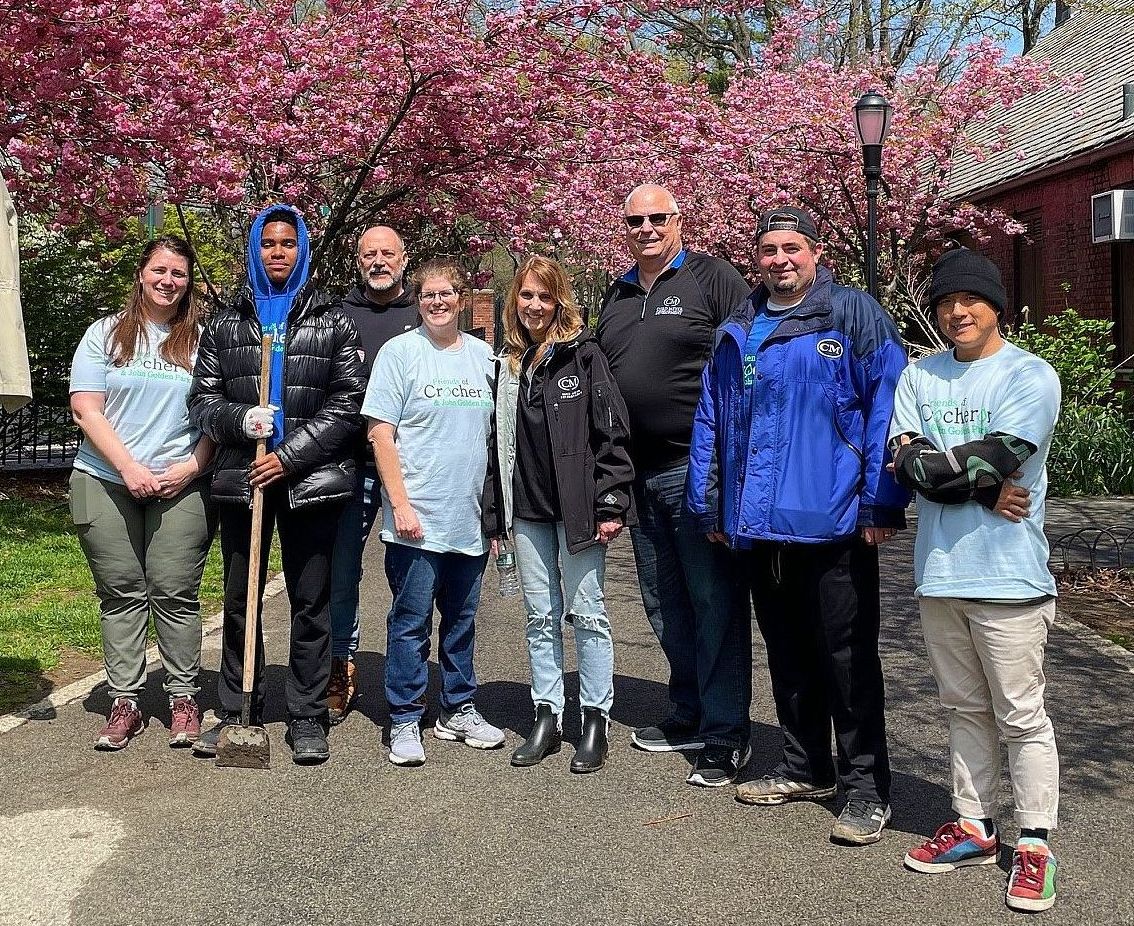
All are invited to participate in the Cord Meyer Park Cleanup on Saturday, April 12th.

For the fourth year in a row, Cord Meyer Development will serve as the Premier Sponsor of Friends of Crocheron & John Golden Park, a not-for-profit organization that works alongside New York City Parks to advocate for improvements to the 63-acre park situated at 214th Street and 35th Avenue in Bayside, Queens. The joint announcement was made by Friends of Crocheron & John Golden Park Founding President Jessica Burke and Cord Meyer Vice President and Bay Terrace Project Lead Joe Forgione.

“All of us at Friends of Crocheron & John Golden Park are thrilled that Cord Meyer has again stepped up as our Premier Sponsor,” explained Burke. “As a volunteer-run organization, we depend on outside funding to accomplish our many goals. It’s been a pleasure partnering with Cord Meyer these past three years and we look forward to their participation in 2025, beginning with the Cord Meyer Park Cleanup on Saturday, April 12th.”

According to Burke, the cleanup event runs from 10 AM – 12 PM and is open to everyone, with refreshments provided and free T-shirts available on a first-come basis. Participants will meet at the Tennis Court House at 215th Place and 33rd Road and are asked to register first at www.crocheronpark.org/volunteer-registration.

Founded in 1904, Cord Meyer is a developer, owner, and operator of retail, commercial, and residential properties in Queens, including its historic Bay Terrace Shopping Center, located less than one mile from Crocheron Park.

“One of our top priorities is to have a positive impact in the neighborhoods we do business,” observed Forgione. “Working with Jessica and her group is a great partnership between the two main meeting places for the neighborhood. Historically, Crocheron Park and the Bay Terrace Shopping Center are destinations where the entire community comes together.”

Founded in 2020, Friends of Crocheron & John Golden Pond assists NYC Parks in stewardship of the parkland, which today consists of Crocheron Park and the adjoining John Golden Park. By protecting environmentally sustainable functions of the pond, woodlands, and gardens, the volunteer organization helps support pollinator populations, wildlife, and biodiversity while also creating environments that support educational endeavors. More information is available at www.crocheronpark.org.

More information on Cord Meyer Development Company is available at www.cordmeyer.com.

#     #     #

Fill the Form for Events, Advertisement or Business Listing