

BY COLE SINANIAN
LONG ISLAND CITY — In a preliminary vote, the Rent Guidelines Board (RGB) set up a possible rent freeze across the city’s roughly one million rent stabilized apartments, while rejecting a motion that would have guaranteed it.
At the Laguardia Community College Performing Arts Center on Thursday night, seven board members voted in favor of a range of 0 to 2% rent increases on one-year leases and 0 to 4% for two-year leases. Landlord representative Christina Smyth voted no, while Mamdani appointee Maksim Wynn abstained. Tenant-friendly Mamdani appointees make up five of the nine board members.
The vote marks the first time that the RGB has considered a rent freeze for two-year leases, and is the most recent in a series of public hearings ahead of a final, binding vote on June 25. It sets the stage for the promised rent freeze that Mayor Zohran Mamdani campaigned on, and has put on display the political influence of the new mayor, whose newly inaugurated Office Mass Engagement has engaged in door-knocking and information campaigns to boost public awareness and turnout at RGB hearings.
“As the RGB begins its public hearings, tenants, owners, and New Yorkers from every borough should make their voices heard and speak directly to what this housing crisis looks like in their lives,” Mamdani wrote in a statement.
“I’m confident the Board will weigh those perspectives carefully,” the mayor added, avoiding a direct appeal for legal reasons, “and arrive at a decision later this summer that reflects the urgency of this moment.”
The first of several public hearings and meetings before June’s binding vote, Thursday’s gathering was part of the RGB’s research and engagement phase, during which board members review relevant data and take public testimony in preparation for the June vote. The RGB last approved a rent freeze for one-year leases under former Mayor Bill de Blasio, doing so in 2015, 2016, and 2020. A rent rollback — or rent reduction — has never happened in RGB history.
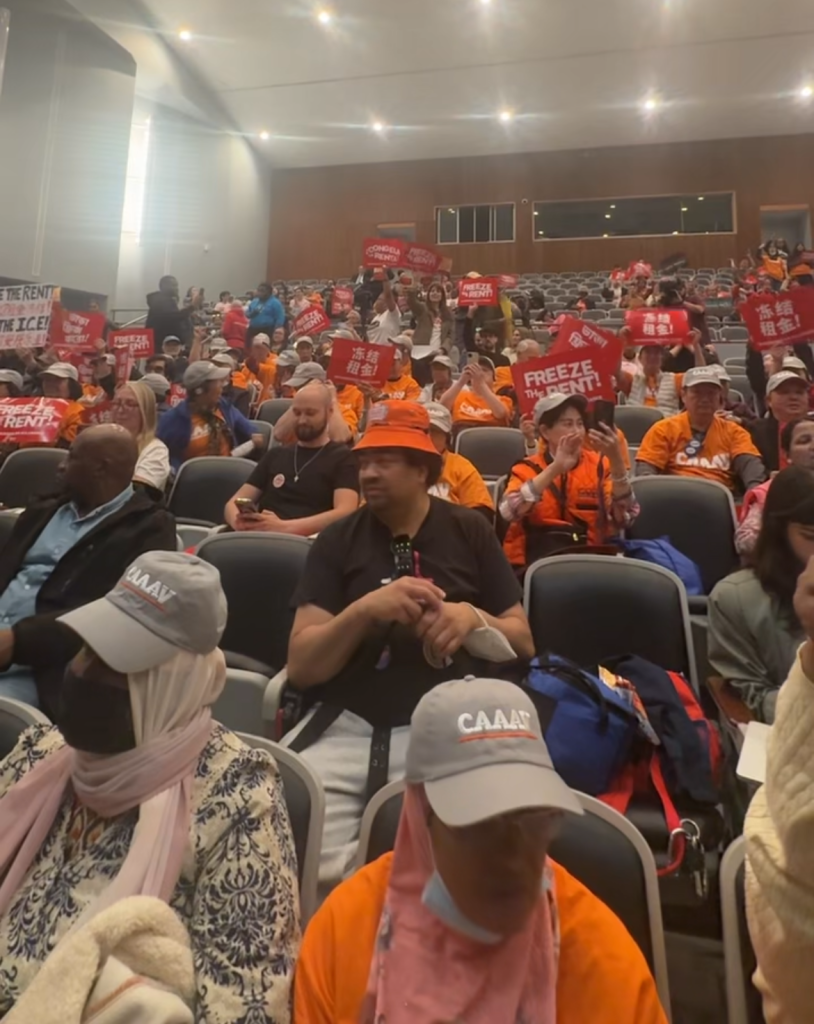
Amid cheers from the hundreds of protesters with tenants advocacy groups packed into the LaGuardia Community College Performing Arts Center, pro-tenant members of the nine-seat board proposed a -3% to 0% increase on one-year leases and a -4.5% to 0% range on two-year leases, which would have guaranteed a rent freeze, and set up the possibility of an unprecedented rent rollback
But the proposals failed with a split vote. In response, pro-landlord board members attempted to approve rent hikes, proposing ranges of 3 to 5.5% increases for one-year leases and 6 to 8% increases for two-year leases, all of which failed to pass. Protesters in the room — booing, holding signs and chanting “freeze the rent!” from their seats — nearly drowned out board members as they tallied the vote.
Afterwards, Jaren Forbes-Browne — a rent-stabilized tenant in Bed-Stuy and organizer with a group called Housing Organizers for People Empowerment — expressed frustration at the board’s failure to vote for rent rollbacks.
“They’re trying to play a middle ground, which is still unfair to us,” she said. “That’s why I’m like, ‘who’s paying who? Who’s in their ear, who’s in their pocket? What corporations?’”
But Forbes-Browne, whose family has lived in the same 38-unit building since the 80s, was also cautiously optimistic that as long as tenants keep attending the hearings in force, the RGB will eventually vote in their favor.
“We have to still show up, we have to put our fear in them,” she said. “They need to feel it. Because if we don’t show up, regardless of what we get, that shows them that we are complacent, that we are compliant. We are not compliant. We are not happy.”
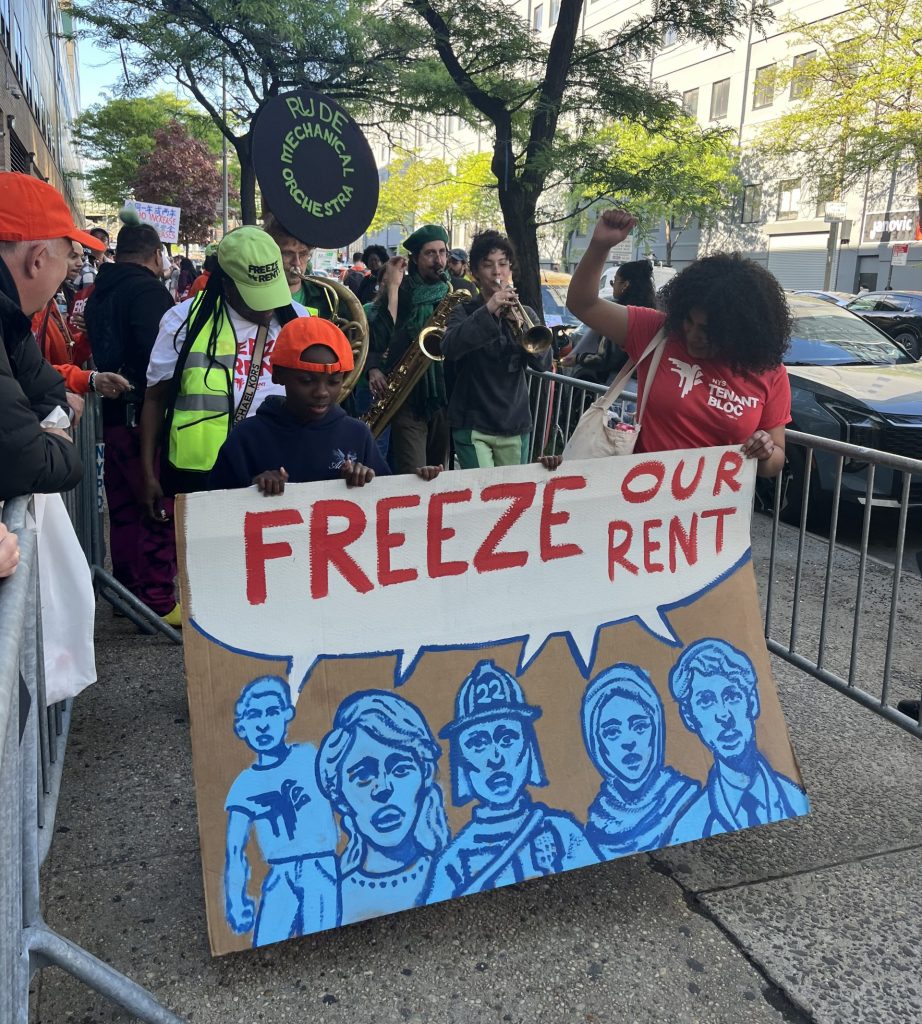
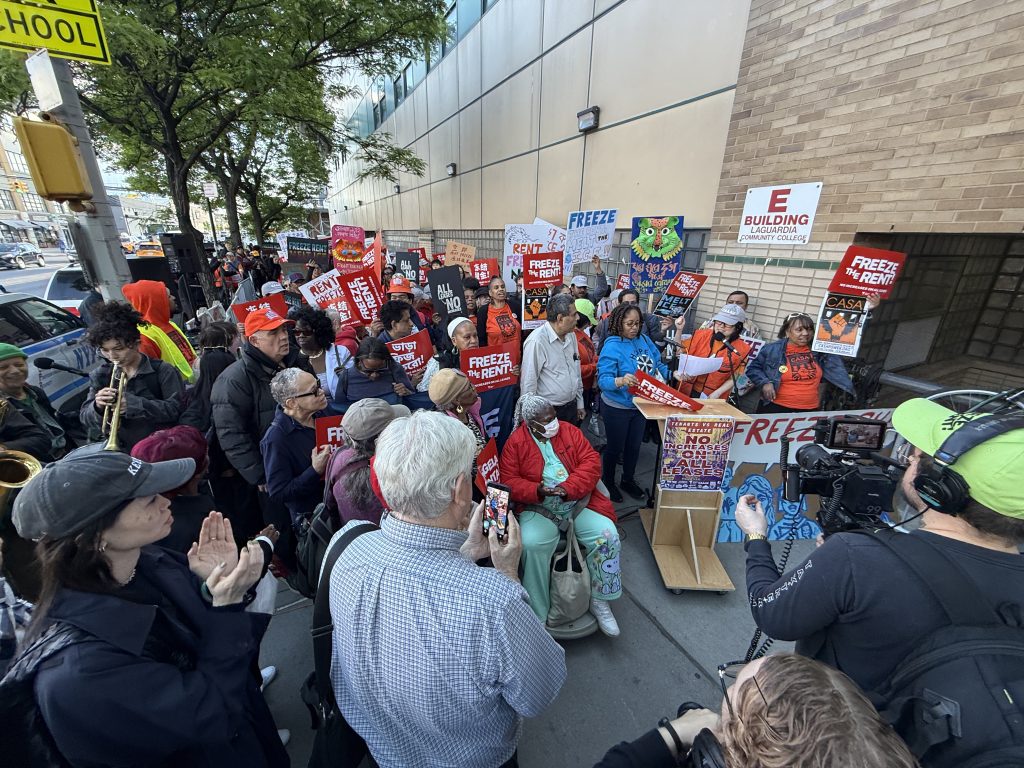
At a sidewalk rally before the hearing, protesters, politicians, and organizers from local groups like Chaaya CDC, the Metropolitan Council on Housing, CAAAV: Organizing Asian Communities, and the NYS Tenant Bloc gave speeches and led chants while a brass band called the Rude Mechanical Orchestra hyped up the crowd with protest anthems. At one point, state Assemblymember and Democratic Socialist congressional candidate Claire Valdez appeared to lead a few chants through a megaphone.
Among the crowd was Brian Romero, an East Elmhurst native and renter who’s running to represent NY State Assembly District 34. Romero was one of several Democratic Socialist of America (DSA)-backed politicians who came to Thursday’s hearing. Many of the groups present, Romero said, were part of the same political movement that got Mamdani elected, though their organizing and tenant advocacy long predates Mamdani and his Office of Mass Engagement.
“Zohran won because these groups have been organizing for years with tenants, and then when he announced his rent freeze pledge, they threw their support behind him,” he said. “So they’re just continuing their work from the electoral side.”
Private real estate broker Anna Klenkar — who exclusively represents renters and buyers and did not attend Thursday’s hearing — added that while much discourse surrounds rent freezes due to Mamdani’s touting of the phrase, it would likely not be as consequential for owners as Mamdani’s political opponents have made it out to be.
“An increase of 2% isn’t going to move the needle for the landlords that are actually genuinely underwater,” Klenkar said. “But it’s going to continue to squeeze the tenants whose incomes are not keeping up with inflation and the cost of housing.”
But while tenants have touted a rent freeze as a necessary relief in a tight housing market, owners’ advocates have criticized it as misguided.
In an open letter posted on Substack, New York Apartment Association Head and former State Assemblymember Kenny Burgos called out the RGB’s tendency to ascribe a single adjustment percentage to all rent stabilized apartments as ineffective, given the vast financial differences between new buildings and older, distressed buildings needing millions of dollars worth of repairs.
He also dismissed rent freezes, arguing that they’d only increase financial burdens on owners and decrease their ability to repair distressed buildings, and that rent-burdened tenants should instead get direct relief from the city.
“Owners cannot fund emergency repairs today based on promises of future relief,” Burgos wrote. “A rent freeze now would not hold the line — it would deepen the problem immediately, in the buildings that are already closest to the edge.”
“If we want to preserve this housing,” Burgos continued, “rents must cover costs, and tenants who need help must be supported directly.
But tenants organizers and advocates have questioned this logic, citing increasing landlord profits and failure to maintain building conditions even when rents increase. A March 2026 income and expense study published by the RGB recorded a 6.2% increase in landlord revenue for buildings with rent stabilized units between 2023 and 2024 and a more than 30% increase over the past three years. Housing Preservation and Development (HPD) violations, meanwhile, jumped 24% between 2023 and 2024 across all NYC apartments.
“I’ve worked with tenants, mostly in rent stabilized buildings,” said Samantha Kattan, a tenant organizer who’s running for a State Assembly seat in District 37, which covers much of Western Queens. “For many years, repairs are not getting made, even when rents are going up. So it’s not a good argument for continuing to pass the increases, especially if they’ve been deferring maintenance for years and decades.”
Klenkar added that landlords are obligated to keep their buildings in livable condition, regardless of costs and profits.
“If you can’t afford to have your tenants, then you have to sell the building,” she said. “Because a lease is a binding contract, and you are required to provide heat and hot water and a habitable place to live, which they all seem to forget.”
Organizers at Thursday’s rally characterized a rent freeze as a necessary early step in a broader process of housing and affordability reform. It’s only temporary, so it must be coupled with longer-term affordability programs, they argued.
Romero, who once lived in a NYCHA building and has spent time unhoused, suggested increasing funding to the Housing Access Voucher Program (HAVP), a four-year pilot program rolled out this year that helps New Yorkers who are housing insecure pay rent, and other rental assistance programs like City FHEPs (Fighting Homelessness and Eviction Prevention Supplement).
“I don’t think it’s radical for us to say that in a city and state that has as many millionaires and billionaires as we have, where the real estate industry is doing fine, that we are just asking to pause the increases,” Romero said, “It’s so that folks can get their bearings, and the administration, along with the state government, can roll out other affordability measures.”