

BY COLE SINANIAN
cole@queensledger.com
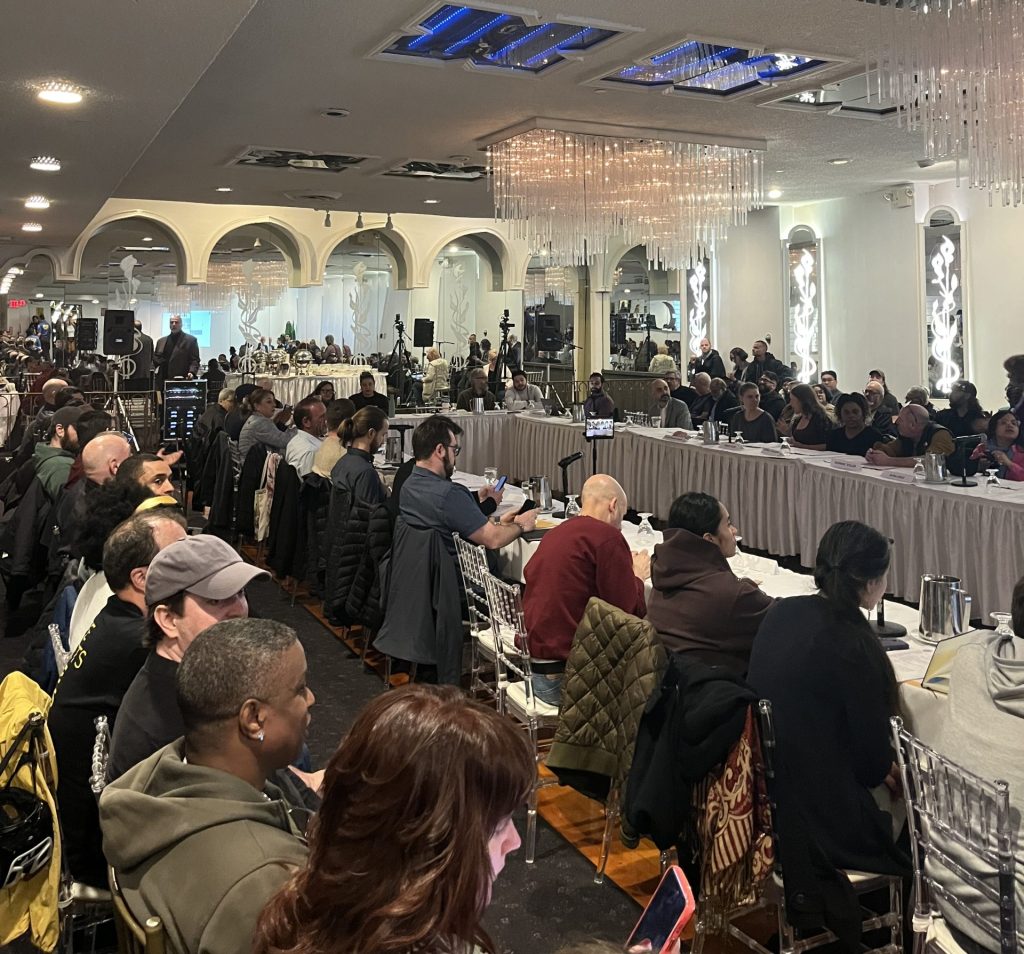
The Marquee event room at the Astoria World Manor was so packed Tuesday evening that, by the Community Board 1 meeting’s scheduled start time of 6:30, the Fire Department was already sending attendees to the overflow room.
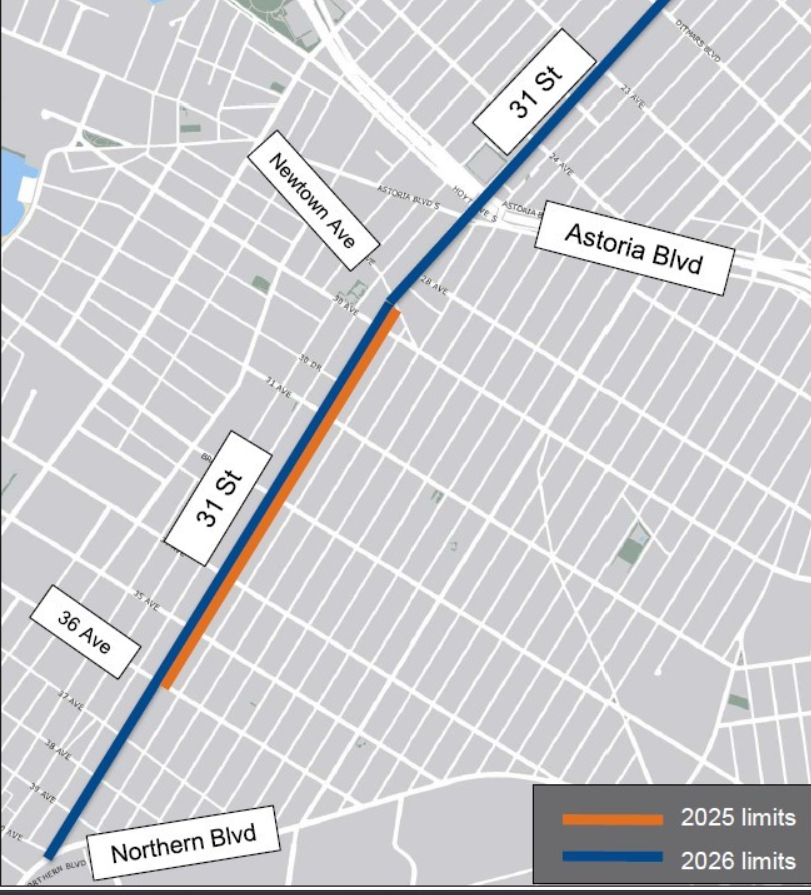
The crowd of more than 100 had come to view the Department of Transportation’s (DOT) presentation on the 31st Street redesign, a project that would see the addition of a protected bike lane and other safety improvements along a 2.5 mile stretch of 31st St from Northern Blvd to 20th Ave. Ultimately, the board would vote in support of the project 35-4, but not before nearly four hours of questioning, debate, and public testimony that at times verged on the explosive.
“I’d like to remind you that this is a public hearing, not a rally for or a protest against anything,” said Community Board 1 Chair Evie Hantzopoulos at the start of the meeting
Backed by then-Assemblymember Zohran Mamdani when it was first proposed in 2023, the project received fierce backlash from local businesses when the DOT began construction in August 2025. A group of business owners organized as the 31st St Business Association sued the DOT to stop the bike lane’s construction, and in December Queens County Judge Cheree Buggs ordered the DOT to halt it on the grounds that the agency had not submitted the required paperwork— a decision that some legal experts have contested.
But Mamdani revived the project after taking office in January, prompting the DOT to revise the plans and reintroduce the 31st St redesign, this time with a much longer bike lane and multiple updated curb regulations that they said would better accommodate truck loading for local businesses.
The redesign is somewhat of a personal project of Mayor Mamdani’s, which has turned it into a sort of proxy battle between older locals and business owners who see bike lanes as a dog whistle for gentrification and the more progressive, socialist-leaning Mamdani voters who support his pro-pedestrian mobility agenda. The DOT and bike lane supporters have argued that safety improvements are sorely needed to reduce traffic injuries and fatalities on a notoriously dangerous street, while opponents seemed to argue Tuesday that the redesign could displace older, mobility impaired Astorians.
“I’m one of the mobility impaired,” said a woman named Kathy during the meeting’s public testimony portion. “We live in Astoria because we want a more sedate lifestyle, dare I say ‘suburban’ lifestyle, otherwise we’d be living in the city.”
But in a roughly 30-minute presentation, DOT Director of Safety Projects and Programs Chris Brunson positioned the bike lanes as a necessary to public safety on one of Queens’ most dangerous corridors, where awkward gaps and “ambiguous space” under the elevated N/W train columns create hazardous conditions for pedestrians and motorists alike. The 31st St corridor is among the top 10% most dangerous in Queens, Brunson said, with an average of 11 people killed or severely injured per mile. In total, DOT counted three fatalities and 502 injuries on 31st St, 23 of which were severe.
Safety statistics collected by the DOT across multiple street redesign projects have shown that protected bike lanes reduce severe injuries by 29.2% for pedestrians and 18.1% for all road users. The 31st St redesign, Brunson argued, would improve safety outcomes for all road users via a complex system of pedestrian and cyclist-focused upgrades like the eight-ft-wide protected bike lane — which would run on both sides of the street and feature a three-foot-buffer zone to widen emergency vehicle access — new pedestrian islands to shorten street crossings, daylighting, and reconfigured travel lanes meant to improve roadway predictability.
“We want to increase visibility, increase organization, and increase safety throughout,” Brunson said. “And I think that’s really the big takeaway of this project. This is a tool in our toolbox. It’s not just a bike lane, it’s a safety treatment.”
DOT Queens Deputy Borough Commissioner Jason Banrey clarified the project does not yet have a start date, and that the public hearing was meant to secure further feedback.
Prior to the community board’s vote, several dozen passionate Astorians took to the podium in a tense public testimony that at several moments boiled over into palpable rage.
A group of firefighters with the FDNY’s Ladder 116 stood together at the front of the room during the meeting. One, a Health and Safety Officer named Mike Schreiber, worried that the bike lanes and their buffer zones would be blocked by illegal parking and therefore impede first responders’ access to the adjacent buildings’ upper storeys.
“I’m here to tell you that the redesign will jeopardize the lives of residents along 31st street and New York City firefighters,” Schreiber said. “The proposal would push trucks almost 20 feet from the curb, making it impossible to reach the upper floors,” he continued, referring to the distance between the traffic lane and the curb.
At one point, a local pro-bike activist who goes by “Miser” got into a shouting match with an older man who interrupted his testimony with the taunt “you’re not even from here!”
The words “f— you” were uttered and Hantzopoulos promptly asked the older man to leave, to which followed applause from the pro-bike corner of the room.
Another member of the public, a man named Matthew, spoke out against the bike lanes and ended his testimony by suggesting that the board should “check IDs to see where these people are living, because most of them don’t even live over here.”
But the majority of Astorians who testified on Tuesday spoke in favor of the redesign, with several drawing attention to the seemingly out-of-proportion backlash to a project that would, per the DOT’s data, make the roadway safer for everyone.
“I love you drivers,” said a woman named Ashley, “but don’t forget, once you’re done driving, once you get out of that car, you turn into one of me! You’re a pedestrian. We’re all one my friends, so we need to think about that.”
A man named Chris, meanwhile, evoked the balance between convenience for motorists and safety for pedestrians.
“Look, safety isn’t a luxury at a time when the gas price is over $4 a gallon,” he said. “Whether you are a senior crossing the street or a parent with a stroller or a cyclist, you deserve a street design built for your survival, not just for speed.”