

The $21 billion megaproject can’t move forward until federal funding is secured. And even then, it could still take 100 years to complete.
BY COLE SINANIAN
cole@queensledger.com
Sunnyside Yards, the recently revived DeBlasio-era plan to build a massive new neighborhood on an elevated deck over Sunnyside’s Amtrak railyard, might not be completed until the 22nd century.
That is, if it gets funded at all.
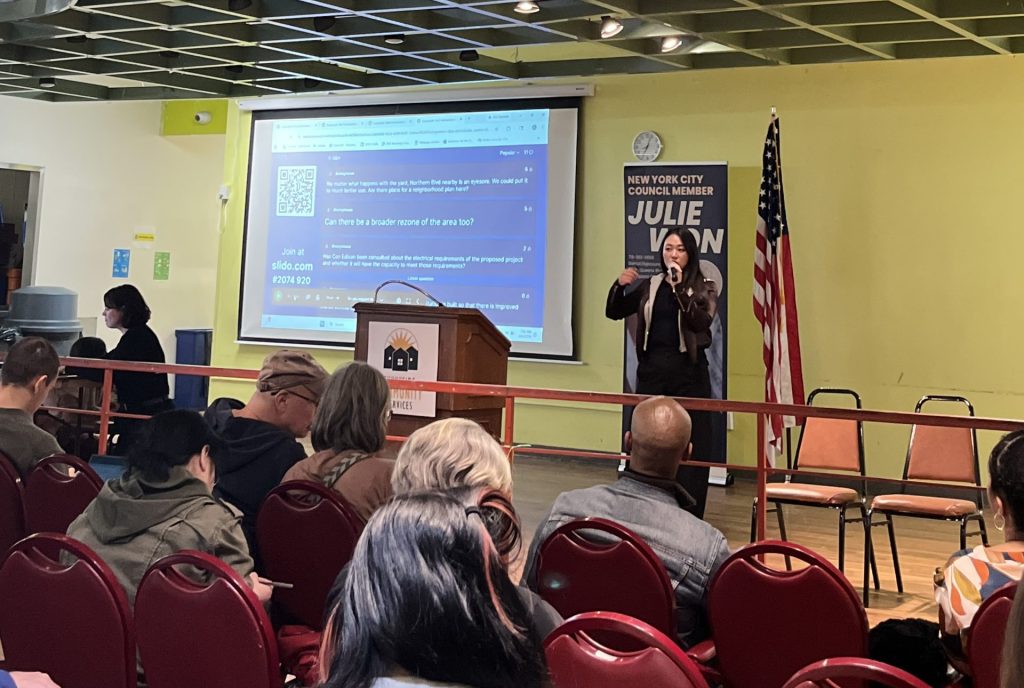
Still, enough concerned Sunnysiders called local City councilmember Julie Won’s office with questions about the plan that she felt it necessary to hold a town hall at Sunnyside Community Services Monday night.
Questions have swirled about the railyard’s future since Mayor Zohran Mamdani visited the White House in February to request $21 billion in federal funding from President Trump to revive the redevelopment, which died in 2020 after major pushback from local elected officials and the Sunnyside community. The NYC Economic Development Corporation’s 2020 Master Plan lacked key information — like a detailed cost analysis or project timeline — and failed to address major community concerns like infrastructure and flood resilience. Fears of over-development, meanwhile, led Representative Alexandria Ocasio-Cortez to resign from the initial Sunnyside Yards committee, criticizing the plan for its potential for displacing vulnerable communities and warning of the potential for “a luxury development that is Hudson Yards duplicated in Sunnyside.”
But, as Won reiterated during her presentation Monday, the Sunnyside Yards Master Plan is just a framework to guide future decision-making— not a comprehensive blueprint for a shovel-ready project. The new version of the plan is essentially the original updated for inflation, she said, and no future developments are guaranteed until federal funding is secured.
“There is no new plan,” Won said, a hint of irony in her voice. “There is only 2020 Sunnyside Yards Master plan. There has been no new study, and there is no new plan from the Zohran Mamdani mayoral administration, no new plan. The plan will not move forward to plan more plans unless we get $21 billion from President Trump.”
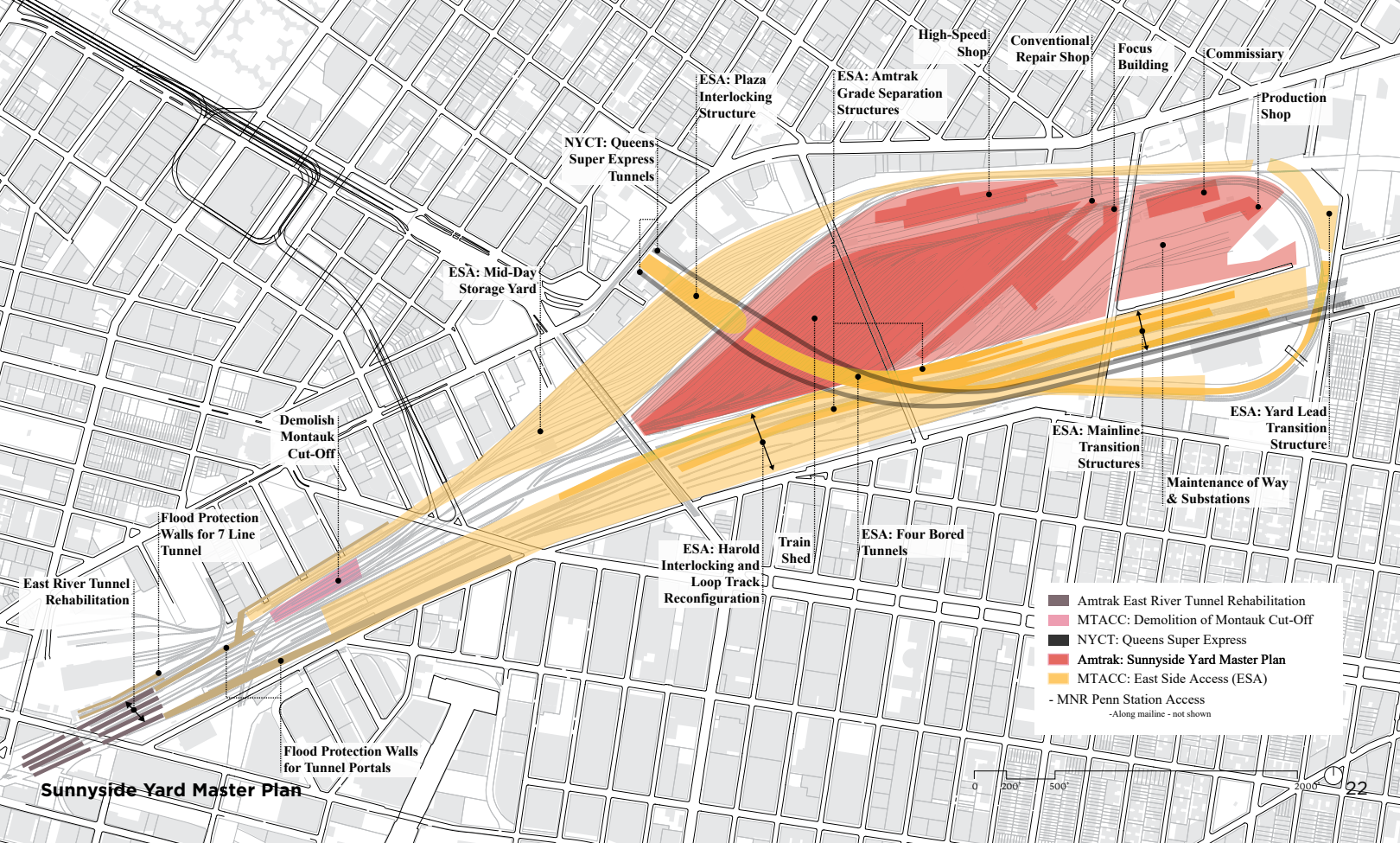
According to the 2020 Master Plan, 140 acres of the 180-acre railyard would be covered by an elevated deck.
Upon entry, the some 200 attendees at Monday’s town hall received paper packets of Won’s presentation. She began with a brief of the proposed project and a history of the site.
Set to occupy 140 acres of the railyards separating Long Island City and Astoria from Sunnyside, the Sunnyside Yards redevelopment would see 12,000 units of housing built atop an elevated platform over 85% the current Amtrak-operated railyard, which sees some 800 trains pass through daily and would have to remain operational throughout construction. According to the 2020 Master Plan, of these 12,000 units, 6,000 would be deeply affordable, Mitchell Lama-style housing at 0-50% Area Median Income (AMI).
This would not have been the first time Donald Trump took an interest in Sunnyside Yards, she noted. Back in 1984, seven years before Mayor Mamdani was born, Trump scouted Sunnyside Yards as a potential location for a football stadium named in his honor.
The project’s estimated $21 billion price tag accounts for the cost of constructing the deck, open space, and public infrastructure, but it does not include the cost of housing.
Importantly, it would be finished by the 2070s if building technologies improve significantly. If not, the EDC estimated the project could take 100 years. That would put the ribbon cutting sometime in the 2120s.
In the presentation, Won highlighted key components missing from the plan. The 2020 Master Plan outlines several public benefits, the result of three public meetings, four community workshops, a digital town hall and input from more than 145 community organizations. In addition to the housing, Sunnyside would get 60 acres of parks and open space, 10-12 schools, 2-3 libraries, and a total of 30 child and healthcare centers, as well as a new subway station and regional rail transit hub. But the Master Plan does not include the specific locations of each, nor does it describe a full project timeline.
Also of concern, Won noted, is an absence of flood resiliency or stormwater management— important considerations in an area like Sunnyside, which was all once marshes and wetlands and remains vulnerable to flooding.
“If the mayor decides to move forward with this project, where we would raise our hands and say, ‘Mr. Mayor, if you were to get $21 billion we have to make sure that there’s a clear resiliency and stormwater management plan in the next round of studies,’” Won said. “Because the former study from 2020 did not include that, and it’s incredibly important for our community.”
All of this, of course, could only happen once Trump agrees to handing over the $21 billion check, after which point Sunnyside Yards would likely undergo either a comprehensive Uniform Land Use Review Procedure (ULURP) — a standardized community engagement process that guides citywide development — or the less comprehensive, state-led General Project Plan (GPP).
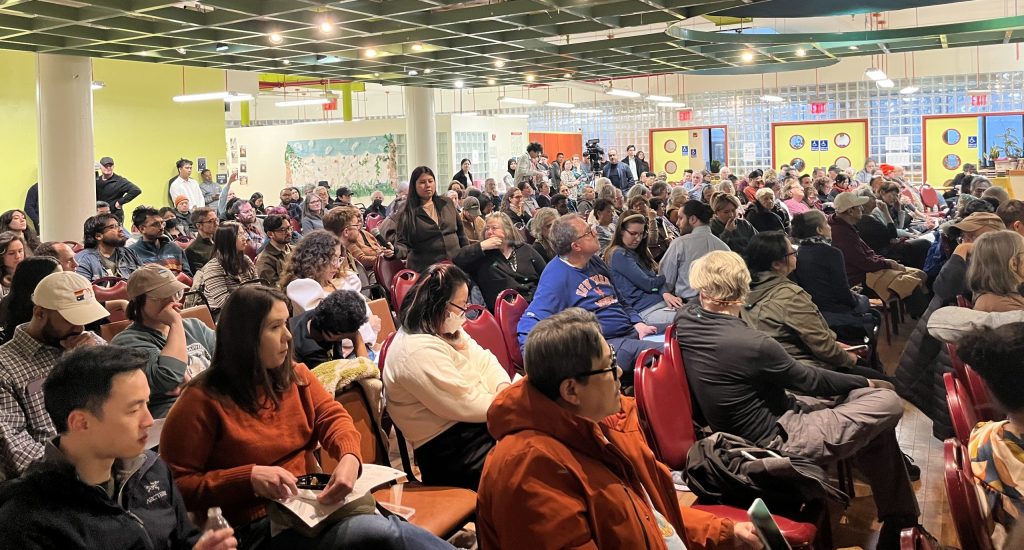
More than 200 people attended Monday night’s meeting at Sunnyside Community Services.
After the presentation, Won asked attendees to respond to a digital survey on their perception of the plan, whose results she promised to deliver to Mamdani herself.
Of the respondents, 32% said they “need more information and engagement to form an opinion on the Sunnyside Yard project,” while 23% said they “somewhat support the Sunnyside Yard project” and 17% said they “strongly support” it. Another 15%, meanwhile, said they “strongly oppose the Sunnyside Yard project,” and 11% said they “somewhat oppose” it.
During the Q&A portion, several New Yorkers aired grievances and expressed their ideas about the site.
“I think the decking is going to be a boondoggle for the cement industry, which is a manufacturer of cement and is an environmental disaster,” said one audience member, an older man named Jeff. “It should live up to its name and be developed as a massive solar farm. That is the development that we desperately need, even more than affordable housing.”
“We need the open space there, we’re over-populated in this city,” said a man named Bill. “It has strained our services. Just look at our trains and buses. They’re packed on there. Half the time they’re not even paying.”
Another man wondered who exactly was in charge of the Sunnyside Yard project.
“So I’m a little bit confused,” he said. “Who is the individual or office that is directly responsible for moving this plan forward? It seems like your office is taking a kind of a wait and see approach, and so I’m curious if anyone is.”
Won responded by explaining that only once the funding is secured will the plan advance: “The next step is this project will only move forward if we get $21 billion to cover for the cost of the deck from Donald Trump.”
“Until that happens, this project cannot move forward,” she continued. “But if that money comes, this is what we will be faced with: either the ULURP or GPP and the mayor will decide which route he wants to take, like, choose your fun adventure.”