
The secret history of the Irish American Athletic Association and its Sunnyside home.
GEOFFREY COBB | gcobb91839@Aol.com
Author, “Greenpoint Brooklyn’s Forgotten Past
Every four years tens of thousands of residents of Queens, New York watch the Olympic Games, unaware that the borough wrote a glorious chapter in early Olympic history and that a group of Olympians who trained in a sporting complex between Woodside and Sunnyside became the first superstars of the Olympics. It’s a history every Queens resident should know and take pride in. Few people today, however, know the fascinating, but little-known story of the Irish American Athletic Association and its Queens home Celtic Park.
In the 1890s, when the modern Olympic movement was just beginning, few people could afford the luxury of competing as athletes, and those who did were almost exclusively white Protestant male members of New York’s Upper Class. Many of these blue bloods belonged to New York’s oldest sports club, the elitist New York Athletic Club, which looked askance at working-class and immigrant athletes who wanted to join the club, and often denied them membership.
In 1897, Irish immigrant P.J. Conway founded the Irish American Athletic Association and purchased land in what was then called Laurel Hill, Queens, near Calvary Cemetery. Though most of the members of the club were Irish American, anyone was free to join the club, unlike the New York Athletic Club. The I.A.A.C. quickly became one of the most ethnically diverse organizations in America and served as a “working man’s” athletic club, regardless of race of religion, in an era of fierce prejudice and discrimination.
The I.A.A.C. built a state-of-the-art track in Queens that opened in 1898 and the club would produce an astounding twenty-six Olympic gold medals, twenty-two silver medals and eight bronze medals for the American Olympic team between 1908 and 1924. The I.A.A.C. also won a total of 17 Amateur Athletic Union (AAU) national team championships—10 outdoor and 7 indoor. Additionally, club athletes won 81 individual national outdoor titles and 36 individual national indoor titles.
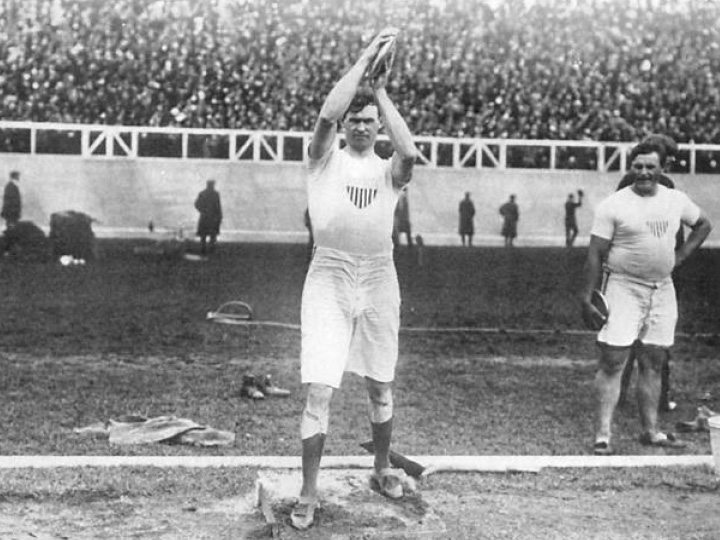
In the 1908 London Olympics alone, the club’s athletes won a remarkable twenty-four medals, including nine individual gold medals and two more in relay events. The I.A.A.C. won more medals alone in track and field than Great Britain, considered to be the world’s best track and field nation. The club’s Olympic medalists became the first Olympic athletes ever invited to a reception by the President. Theodore Roosevelt welcomed the I.A.A.C. Olympians to his summer home, where he was presented with a gold medal a club member had won and Roosevelt became an honorary I.A.A.C. member.
The I.A.A.C welcomed working class athletes of any backgrounds, and the first Jewish American and African American gold medal winners were members of the club. Myer Prinstein, a Polish-born Jewish immigrant who later practiced law in Queens, competed for the I.A.A.C at the 1904 St. Louis Olympics and won both the long jump, while setting an Olympic record, and the triple Jump on the same day, the only athlete ever to win both events in the same games. In Athens in 1906, he again won the long jump competition, beating the world record holder, Peter O’Connor. In 1908, African American John Baxter Taylor became the first African American gold medalist while competing for the I.A.A.C. in the men’s medley relay team. Tragically, Taylor contracted typhoid and died shortly after the games at age twenty-seven.
The I.A.A.C. also produced the first superstars of the games, a group of Irish immigrant weight throwers known as “The Irish Whales” for their huge size and enormous appetites. Between 1900 and 1924, with an interruption because of World War I, these athletes won an astounding twenty-three Olympic medals, including twelve gold medals. Perhaps the finest of the group of legendary athletes was New York City Police Detective Martin Sheridan, a five-time Olympic gold medalist who won two golds in the 1906 Athens Games and three silvers. Greek King George was so impressed by Sheridan that he had a statue erected in his honor and sent him a gold goblet. In his obituary the New York Times hailed him as “one of the greatest athletes the United States has ever known.”
Located in Queens between 48th and 50th Avenues and 42nd to 44th Street, Celtic Park was more than an athletic training grounds. It was ground zero for Irish events, labor meetings and political rallies, but it closed during World War I and problems arose during prohibition when alcohol raids by federal agents led to donnybrooks and arrests. In the 1920s, the Irish community opened a new sporting venue, Gaelic Park, in the Bronx, making Celtic Park, a secondary sports venue. Finally, in the 1930s, the land was sold to a developer and today an apartment building occupies the once hallowed sports ground.
For decades, the City of New York did nothing to commemorate the amazing achievements of the Irish American Athletic Association, but finally in 2012, thanks in large part to City Council Member Jimmy Van Bramer, the city designated 43rd street in Woodside Winged Fist Way, after the I.A.A.C.’s official emblem.