

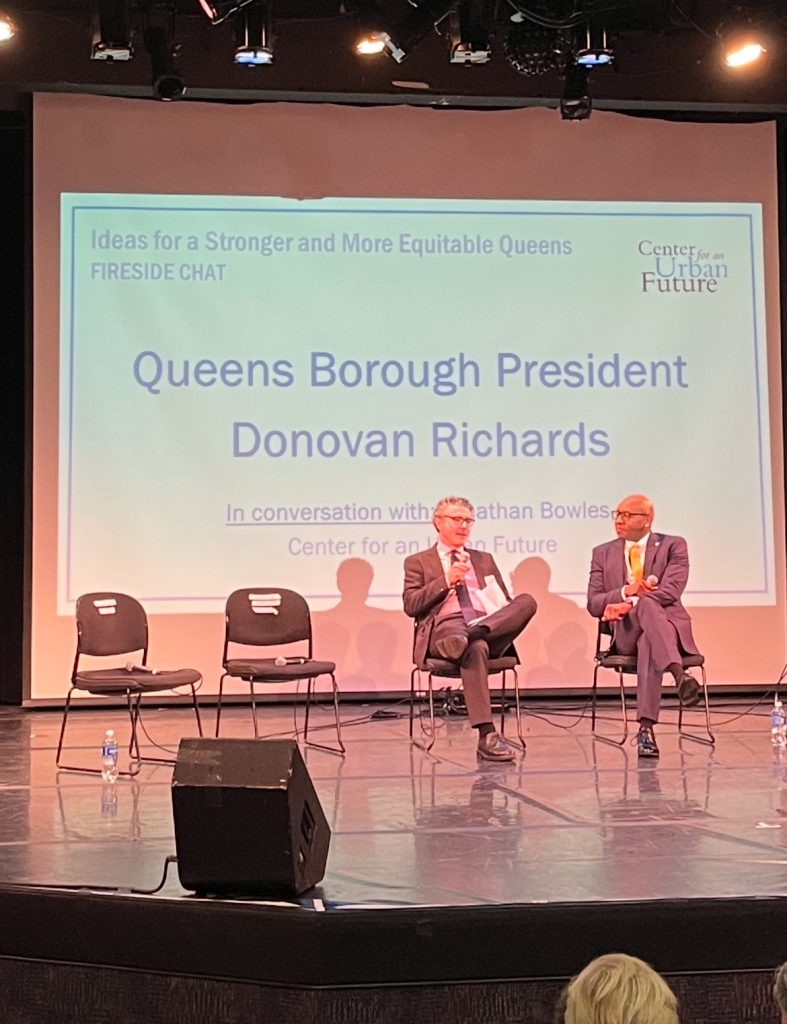
At a symposium at La Guardia Community College last Thursday, elected officials and business leaders discussed challenges and opportunities facing Queens.
BY COLE SINANIAN
cole@queensledger.com
LONG ISLAND CITY — “The City and the State are broke. The Feds? Who the hell knows what the Feds are doing. Our destiny is in our hands.”
This was Queens Chamber of Commerce President Thomas Grech’s message to the several dozen business leaders, politicians, students and members of the public gathered at La Guardia Community College’s Performing Arts Center on Thursday, March 5. They had come to hear Grech, Queens Borough President Donovan Richards, City councilmembers Julie Won, and more than a dozen local leaders discuss visions for a more equitable Queens at a symposium hosted by the Center for an Urban Future.
Grech’s message of economic independence for Queens in the face of unreliable City, State, and Federal governments resonated throughout the half-day event, where several speakers highlighted the importance of nurturing a local tech industry while investing in community development and taking care of an aging and housing-insecure population. The concept of a Queens where one could “live, work and play” without ever having to cross borough lines — a key focus of the Richards Administration — also underpinned the discussion.
“I think all of us can relate to that coming out of the pandemic,” Richards said. “We were all stuck in the house. We got to learn where our parks were. We got to work on our cultural organizations, and we want to strengthen the fabric of those organizations as we move forward.”
Richards, a former City councilmember, was elected Borough President in 2020 at the height of the COVID-19 pandemic. Key to his economic agenda was to “build back better” by not only restoring Queens’ pre-COVID economy, but by addressing inequities moving forward. Seated across from Center for an Urban Future Executive Director Jonathan Bowles, Richards pointed to several recent affordable housing developments as examples of his “build back better” plan in action, including the Jamaica Neighborhood Plan — a 230-block rezoning approved by the City Council in October that would add nearly 4,000 permanently affordable homes to the Jamaica neighborhood.
But there’s still work to be done. More than one-quarter of Queens renter households spent more than 50% of their income on rent in 2023, according to an NYU Furman Center study.
Richards reiterated his support for Mayor Mamdani’s proposed Sunnyside Yards redevelopment — which would add 12,000 units of affordable housing to Sunnyside — but criticized the mayor’s proposed 9.5% property tax increase to help close the City’s $5.4 billion budget gap. He argued it could further restrict Black New Yorkers — who’ve already struggled to own property due to racist policies like redlining — from accumulating wealth.
“It’s unfortunate that where I’m from, a house can go for 700,000 and in Brooklyn, you can have a brownstone that’s worth $5 million and they’re paying less taxes,” Richards said. “It’s very inequitable.”
He continued: “ We couldn’t get a mortgage in a lot of instances. So when you see everyday black New Yorkers who finally obtain a home, this is a pathway to upward mobility for their children to pass something down.”
William Jourdain, executive director of the local nonprofit Woodside on the Move, used his speech to draw attention to the elderly population of Queens, many of whom live month-to-month and are struggling under climbing costs of living. He told the story of his mother, a proud union member and longtime worker in the city’s hospitality industry, who, after being forced into early retirement by the pandemic, now must take money from her son in order to stay afloat amid ever rising living costs.
“But here’s the question that keeps me up at night: What about the seniors who don’t have someone like me?” Jourdain said. “They are the workers who kept the city running. They built New York. The least we can do is make sure they can afford to live in it.”
A 2023 study from the Center for an Urban Future counted 400,000 Queens residents aged 65 and older, some 14% of whom live below the poverty line— the fourth highest of any county in New York State.
Jourdain urged the City and State to create a dedicated housing subsidy for the elderly to ensure they’re spending no more than 1/3 of their income on rent. Such a subsidy, Jourdain said, could “mean the difference between stability and eviction, between groceries and prescriptions.”
As far as public infrastructure, Richards called for 1% of the City’s budget to go to parks funding, and vowed to spend $17 million to rebuild the Playground for All Children in Flushing Meadows Corona Park. Both Richards and Bowles agreed that the park in general could use some work. On rainy days like Thursday, Flushing Meadows gets muddy and flooded, with areas remaining unusable for days after, Bowles noted, which is indicative of broader parks disinvestment.
Much of Thursday’s discussion revolved around Queens’ nascent tech industry, with several speakers brainstorming ideas on how to both cultivate a local hi-tech job market through investments in education, and attract tech investment from elsewhere to Queens.
CUNY’s Queens College Campus, as Grech pointed out, graduates more computer science majors than any other school in the CUNY system.
City councilmember Julie Won — who once worked for IBM — highlighted the need to embrace the AI boom without losing jobs to automation, something she argued could be done by “upscaling,” or training employees in every industry for the kinds of higher level positions that cannot be automated.
“We cannot allow this narrative of the world telling us, every single one of us is going to become obsolete, that the AI, the robots are going to take over, and we’re all going to be sitting here wondering to ourselves, where did we go wrong?” Won said.
Grech, meanwhile, proposed utilizing partnerships between private capital and public investment to invest in local tech startups. Queens is churning plenty of young tech talent, Grech, argued. Now, it’s up to government and business leaders to invest in them.
“The rest of the world ain’t waiting for New York to figure out our stuff,” Grech said. “The rest of the world is plunging ahead.”