
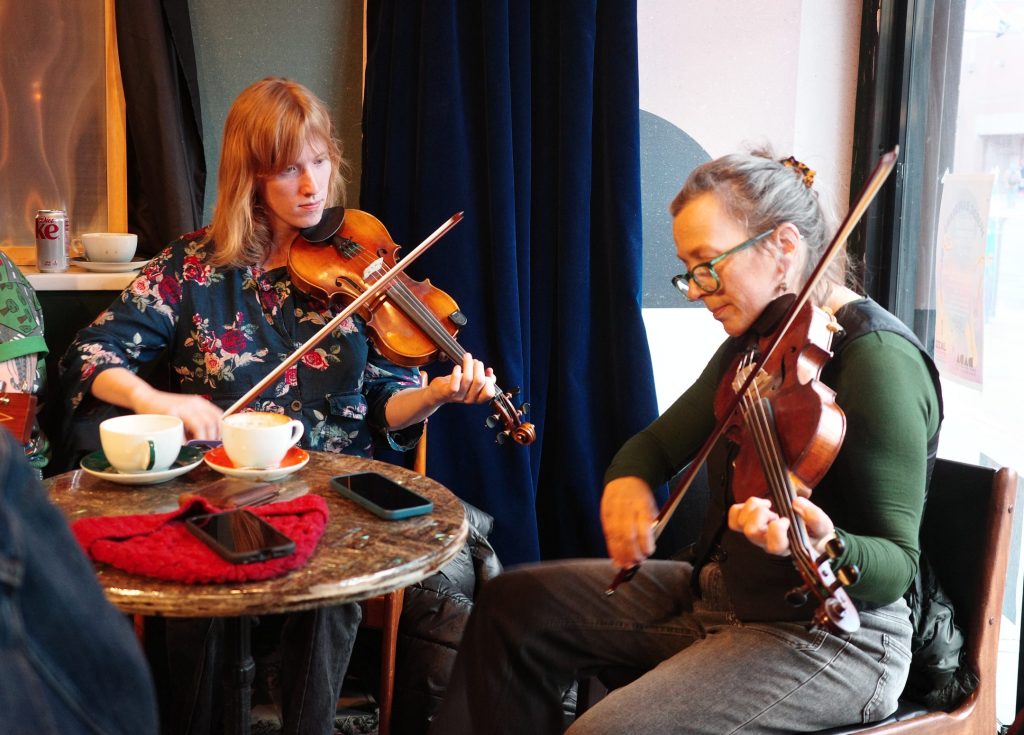
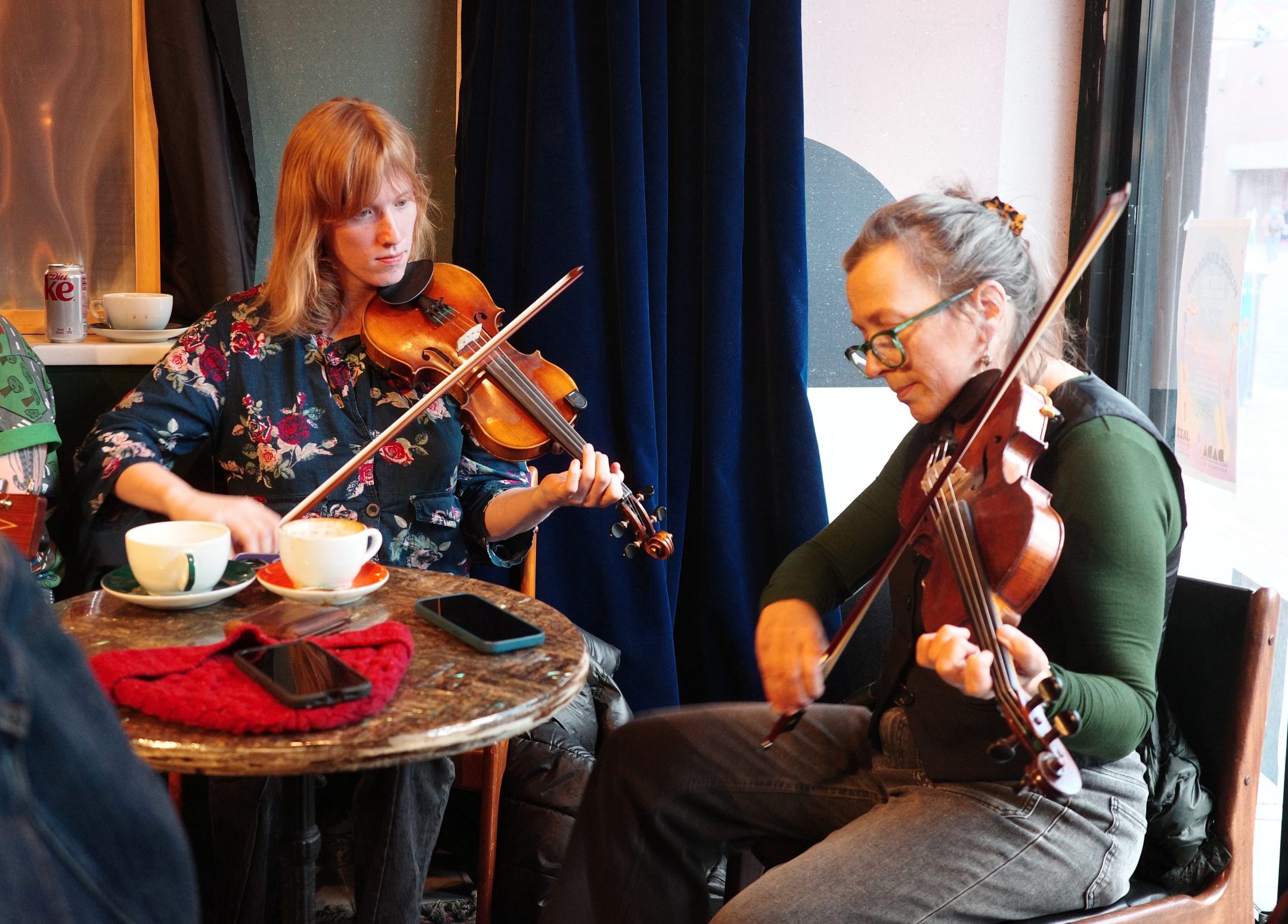
Musicians flocked to Dada, an artist-owned space at 60-47 Myrtle Ave, on February 21 — but attendees also gave their recommendations for regular open sessions throughout Queens and Brooklyn. (Photos: Tashroom Ahsan)
By Adeline Daab | news@queensledger.com
RIDGEWOOD — “What percentage of Irish folk tunes do you think are in the key of D?”
The question circulated around the group of good-humored musicians gathered on Saturday, February 21, for an Irish folk music open session at Ridgewood’s Dada, an artist-owned music & art space, cocktail club, and espresso bar. Fiddlers, flautists, accordion/concertina players, and a lone guitarist chimed in as they prepared to harmonize in Irish tune. Answers to the question ranged from “75% if you combine D and D minor,” to a conspiracy theory that “100% of Irish tunes are in D but we just moved some to other keys.”
The session kicked off with “Shoemaker’s Fancy,” and danced through dozens of other sprightly and charmingly-named tunes including “Toss the Feathers,” “Humours of Glynn,” and “The Rambling Pitchfork.” The notes fluttered and frolicked in lively rhythm, moving me to tap my toes along with the musicians. These fast instrumental dance tunes are a subgenre of traditional Irish music sometimes called “geantraí,” which means “joy music” more or less. Mixed in with these were some American folk songs, including songs from shape note singing—a participatory singing tradition that originated in New England in the early 1800s and lives on in the American South. A few Irish songs also made an appearance. ‘Songs,’ feature words, while ‘tunes’ refer to instrumental melodies. “Mrs. Gilhooley’s Party,” one of the songs that brought humor to the session, wraps up each verse with “so he picked up the pipes and he started to play until some lads got fooling about, and they cut a big hole in the bag of his pipes and this is the tune that came out” followed by an impressive display of “lilting”—a practice of imitating the sounds of Irish music through nonsense syllables.
As ice melted in the players’ iced coffees and foam disappeared from their once-frothy pints, folk music fans and curious passersby alike stopped to steep in the melodies. They sat as mesmerized as I was, conversations never rising above soft chatter. But the two dozen onlookers present at the session’s peak witnessed a ritual clearly intended not for us, but for the players themselves. There was a palpable love for the music within the ensemble and for the activity of playing it in the company of others. Musicians sat in a tight-knit oval, facing each other. They jovially passed around the opportunity to lead a tune, and the less experienced of the bunch were kindly guided through tough phrases.
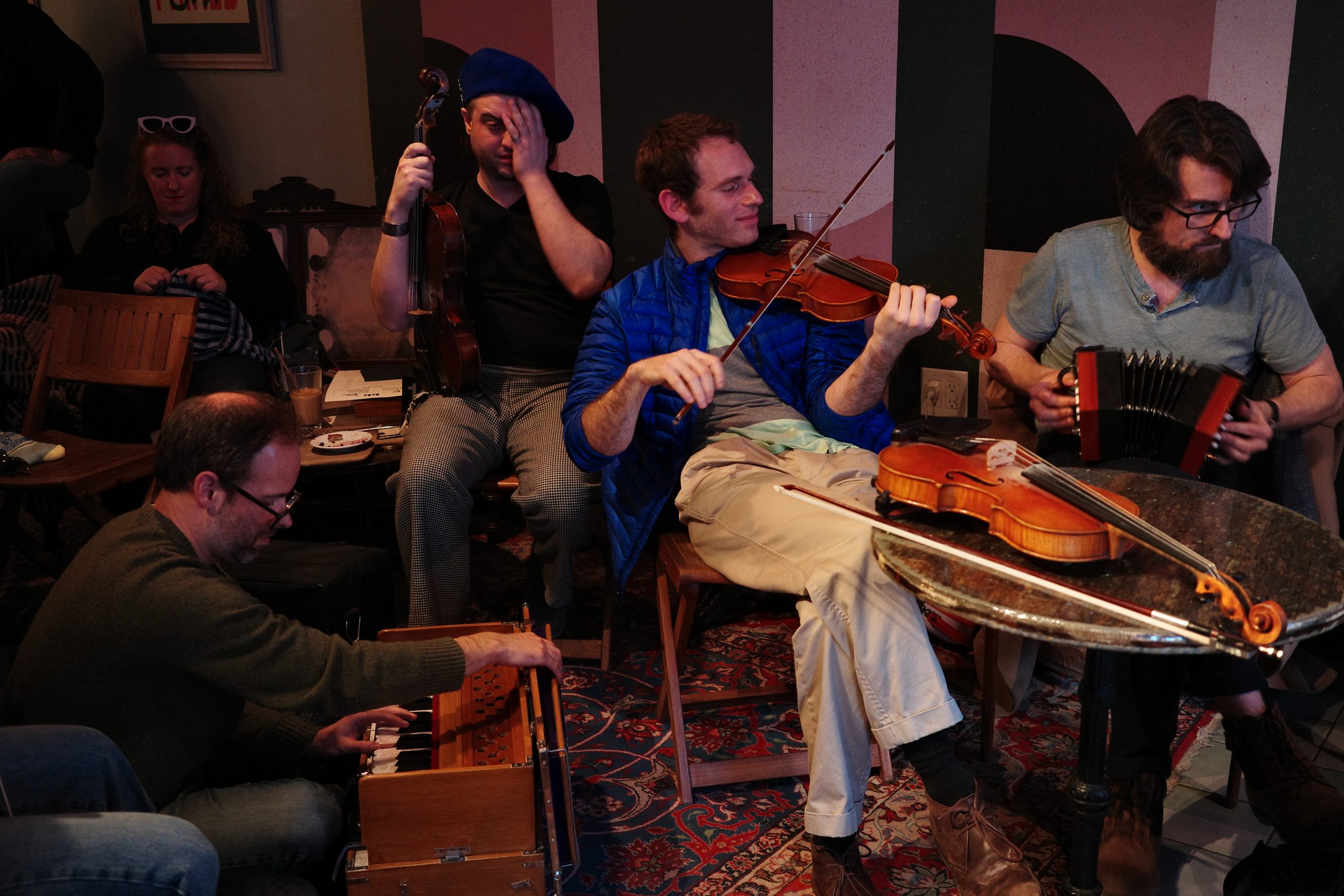
After a line-up of fast-paced dance tunes called “geantraí,” fiddlers begin to show signs of happy exhaustion.
Each participant was drawn to this musical community for a different reason. For the solo guitarist of the group, that reason was a chance encounter between a tipsy girlfriend—formerly an Irish dancer—and a pub emanating Irish folk tunes. She popped in and had so much fun dancing along that she dragged her musically-savvy partner to another session where he was roped into playing the guitar. Another participant, a classically trained flautist and flute teacher turned Irish folk musician, was indoctrinated through the contra dance community. Contra dance is a type of folk dancing — “a mix between swing dancing and square dancing” — that has a lot of overlap with the Irish folk music community.
One of the hosts of the session, Myra Smith, played classical violin growing up and returned to the instrument in the COVID era. “I was drawn to the instrument that I had from my childhood as a tool for making music and for art, and I wanted some sort of way to develop a deeper relationship with the instrument,” Myra told me, “and that timed up nicely with a family trip that I went on to Ireland. That trip was a moment of remembering that traditional Irish music both exists and communities around it are still very active. I had an ‘aha’ moment of like, oh, this is the path I want to go down as I work on playing violin.”
That’s how Myra’s Irish folk music journey began, but the main thing that’s kept her in has been “forming friendships and relationships through making music with people.” She’s also developed a fondness for the melodies as she continually expands her repertoire. She calls herself a “collector of melodies.”
If you are interested in getting involved in the New York Irish folk music scene, Myra suggests you “go out and find places that have regular sessions. Talk to the musicians there and ask them about their recommendations.” There are a lot of great places to learn that are welcoming for people who are just beginning, and Myra hopes her sessions will always be an open place for these curious crowds. A great place to start would be her weekly Wednesday night sessions at The Swan in Bed-Stuy, 7PM!