

Courtesy REBNY
MOHAMED FARGHALY
mfarghaly@queensledger.com
New York City is falling well short of its ambitious goal to add 500,000 new housing units by 2034, according to a new report from the Real Estate Board of New York that warns current policies and incentives are not producing homes fast enough to address the city’s deepening housing crisis.
The report, REBNY’s New Housing Development Pipeline, analyzes permit and construction data from the city Department of Buildings from the first quarter of 2024 through the third quarter of 2025. It also offers an early assessment of major housing initiatives, including City of Yes, the 485-x tax incentive and the 467-m program, which encourages office-to-residential conversions.
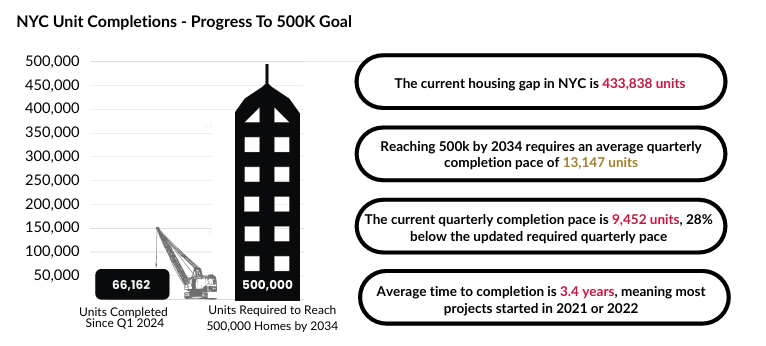
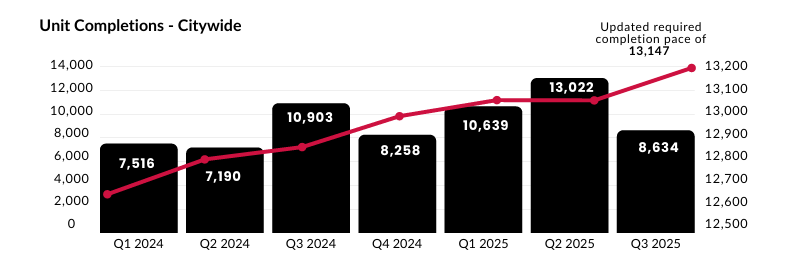
Since the start of 2024, just 66,162 housing units have been completed citywide, about 13 percent of the decade-long target. To stay on track, the city would have needed to produce an average of 12,500 units per quarter starting in 2024. Instead, construction has averaged about 9,452 units per quarter.
As a result, the pace of building required for the remainder of the decade has risen sharply. REBNY estimates that the city would now need to complete roughly 13,147 units per quarter through 2034, an increase of nearly 39 percent from the current rate, to meet the goal.
That shortfall has created what the report describes as a 433,838-unit housing gap, a challenge made more daunting by slow-moving development timelines. Projects with 10 or more units now take at least four years to complete, reflecting rising costs, regulatory hurdles and financing challenges.
“The current tools for housing production are not adequate to meet the needs of New York City, and without the creation of significant new incentive programs and comprehensive rezonings there is no way we will meet our goal to build 500,000 new homes by 2034,” said James Whelan, President of the Real Estate Board of New York. “This city needs a much more aggressive set of proposals to drive new housing production, lower costs and deliver a New York City that works for everyone. Our industry is ready to work with our leaders in City Hall and Albany to do just that.”
The report also examines the Affordable Neighborhoods for New Yorkers Tax Incentive program, known as 485-x, which replaced the long-running 421-a program in 2024. REBNY found that 485-x accounts for just 3 percent of all housing units currently in pre-development or under construction across the five boroughs, raising questions about whether the program is strong enough to spur large-scale development.
Further concerns emerge in the pre-development pipeline. While 47,124 units are technically in pre-development, about a third of them, or 14,419 units, were pre-filed more than five years ago and are considered unlikely to move forward. The number of projects stuck in pre-development for more than five years has grown by more than 7 percent on average each quarter since early 2024, representing thousands of units that may never be built.
At the same time, REBNY credits recent policy wins with preventing an even steeper decline in housing production. The report estimates that there would be at least 38 percent fewer units in the pipeline had the real estate industry not successfully advocated for a deadline extension of the 421-a program and for the creation of 467-m, which allows commercial buildings to be converted into housing with permanently affordable units.
Brooklyn leads the city in active construction, with 29,361 units under construction as of the end of the third quarter of 2025, accounting for 39 percent of all units being built. Manhattan follows with 15,767 units, or 21 percent, while Queens has 14,883 units, the Bronx 13,664 and Staten Island 1,122.
A similar pattern appears in completed housing since the start of 2024. Brooklyn again ranks first with 26,563 units completed, about 40 percent of the citywide total. Queens follows with 16,767 units, the Bronx with 13,456, Manhattan with 8,039 and Staten Island with 1,229.
The report situates these findings against the backdrop of an acute housing shortage, marked by a citywide rental vacancy rate of 1.41 percent, the lowest since 1968, and a record number of families living in shelters. While state and city leaders have enacted tax incentives and zoning changes aimed at boosting housing supply, REBNY argues that far more aggressive action will be needed if New York City hopes to close the gap and ease pressure on renters in the years ahead.