

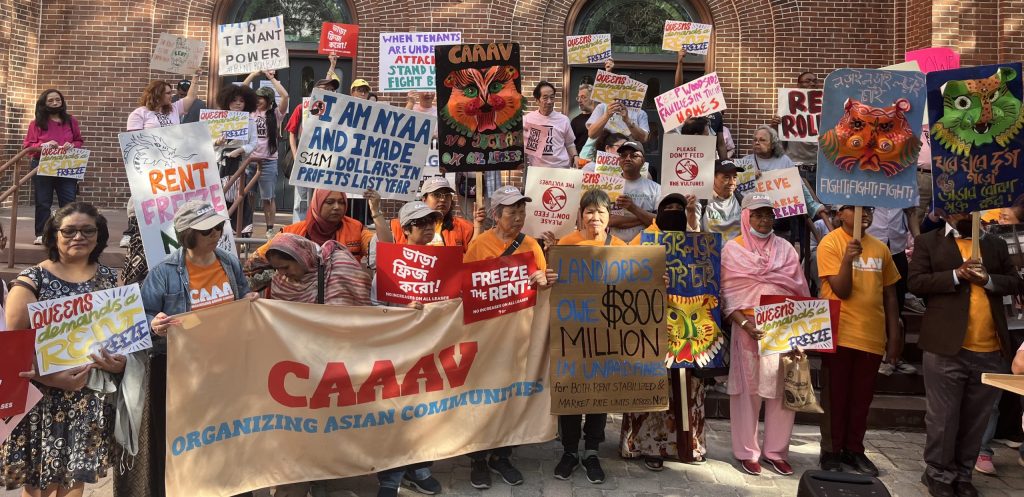
BY COLE SINANIAN | cole@queensledger.com
JAMAICA — For many of the Queens tenants who showed up at a Rent Guidelines Board (RGB) hearing on Thursday, June 4 at the Jamaica Performing Arts Center, the Mayor’s promise to freeze the rent for the city’s roughly one million stabilized units doesn’t go far enough.
Representatives from several Queens and citywide tenants groups showed up in force at Thursday’s event, which marked the last public hearing in Queens before the board’s final vote on June 25 at El Museo del Barrio in Manhattan. Dozens of tenants aired their landlord grievances before the board and called for a rent freeze, while others went a step further and called for a rent “rollback” — or rent reduction.
At the preliminary vote in May, the RGB voted on a range of 0 to 2% rent increases on one-year leases and 0 to 4% for two-year leases, setting the stage for the rent freeze Mayor Zohran Mamdani campaigned on. The hearings are part of the board’s research and engagement phase, during which board members review data and public testimony in preparations for the vote. Tenants’ representatives make up five of the board’s nine seats, while landlord representatives hold the remaining four.
The RGB last approved a rent freeze for one-year leases under former Mayor Bill de Blasio, doing so in 2015, 2016, and 2020. A rent rollback, meanwhile, has never happened in RGB history.
Speaking on behalf of the Queens Tenant Coalition at a rally outside the venue Thursday, one tenant accused the board of helping corporate landlords get richer at the expense of the working-class tenants who live in their buildings.
“This is not the story of a few big bad actors,” she said. “More than 50% of New York City’s rent-stabilized apartments are owned by corporate landlords with more than 20 buildings, and the board has been making them richer and richer for decades.”
“We are calling on the board to take tenant testimony seriously as data, and to commission a study to analyze both historical and present member profits, and understand what rental adjustments are needed to truly make New York City affordable, which we all know is a rent rollback.”
Inside the performing arts center, tenants doubled down on their rollback demands, while owners called attention to financial strains out of their control.
Ann Korchak, whose family owns a 10-unit building on the Upper West Side, said she was speaking on the behalf of owners who “are not feeling brave enough to be here” and asked the board to consider rising energy costs in their vote.
“It was roughly $4,000 more to keep the building heated this winter,” she said. “The preliminary range of raises that you’re considering are falling far below what we’re seeing our expenses increase at.”
Speaking in Bengali through a translator, a tenant organizer named Firdousi with the CAAAV Astoria Tenants Union described spending nearly all her money on rent despite living in an apartment that seemed to fall apart around her.
“They have been increasing my rent every year but my repairs are not done,” she said. “The kitchen doors, the ceiling, everything is broken. I don’t see landlords of the maintenance guys ever come to our apartment. Everything is broken, but they are neglecting us. It is very difficult to continue to live in our current apartment.”
“My only demand is that the RGB freeze the rent,” she continued. “We have been organizing tenants for a long time so we can win affordability in New York City. Please freeze the rent.”
Sunnyside resident Christina Rodriguez, who introduced herself as a member of the Democratic Socialists of America’s Tenant Organizing Working Group, told a story of her rent-stabilized neighbors at 41-20 46th St, who have dealt with collapsing ceilings and water damage for years due to her landlord’s neglect, and yet still receive major yearly rent raises.
“We need them to open their books and to not be allowed any rent increases when violations exist,” she said. “So I’m asking that the board commission a study analyzing both present and historical profits made by landlords and what rental adjustments are needed to truly make the city affordable.”
“And a rollback of rent,” she added.
According to CAAAV Communications Manager Irene Hsu, it was the coordinated and enduring grassroots organizing of numerous tenants groups — many of which were present at Thursday’s hearing — that brought the possibility of a rent freeze into mainstream political discussion. She explained that her organization — which organizes Asian American communities against gentrification and real estate speculation — adopted the rent freeze campaign after many meetings with organizers and tenant leaders, who, oftentimes speaking through language barriers, arrived at the conclusion that a rent freeze is what working-class tenants need.
“Today we’re here to carry that out,” Hsu told the Queens Ledger outside the hearing Thursday. “We’re here to see it across the finish line after a historic election last year, where the rent freeze demand went from like one candidate endorsing to nearly all of the Democratic candidates endorsing.
But she added that her organization’s work won’t stop if a rent freeze is approved.
“Everyone here today has a shared enemy, and that enemy is organized real estate,” she said. “So the rent freeze is actually a vehicle right now for us to create public pressure, to create a vehicle where tenants are activated and excited to fight and are going to go back to their buildings and say, ‘I want more.’”