

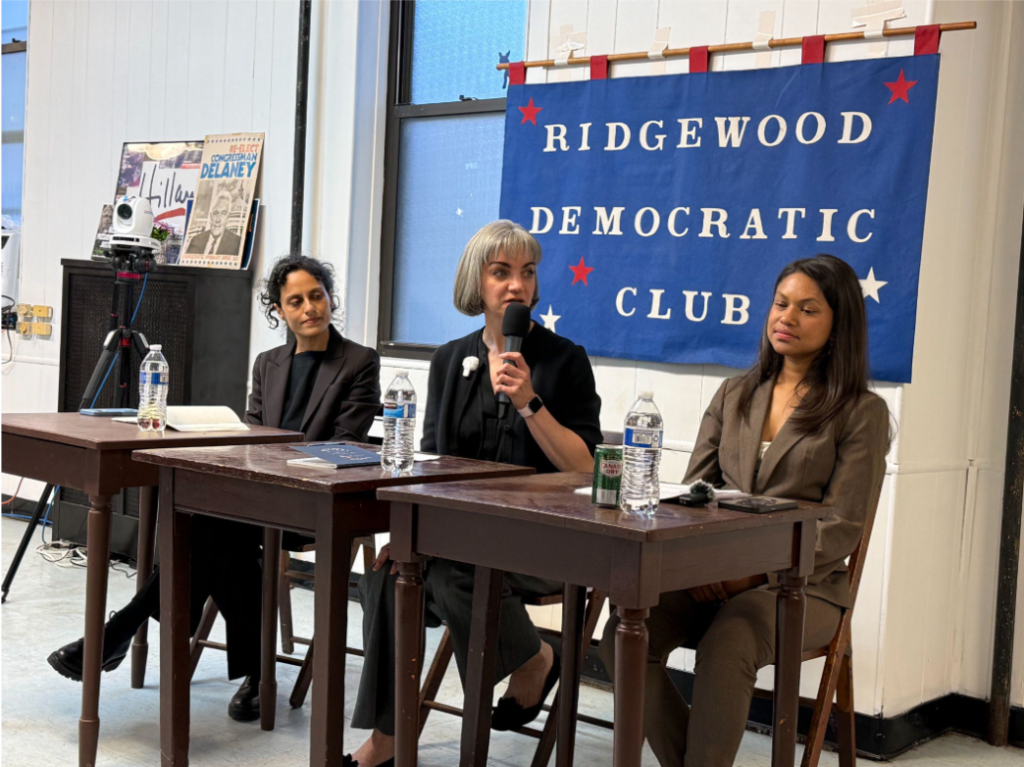
Queens State Assembly candidates largely agreed on key issues, but differed in their approaches to tackling them.
BY CAROL CHEN
news@queensledger.com
RIDGEWOOD — Assembly District 37 is an open seat for the first time in two years, and the June primary to fill it is shaping up to be one of Western Queens’ most closely watched races.
Current Assemblymember Claire Valdez, who took office in January 2025, is leaving to run for the congressional seat being vacated by Nydia Velázquez in New York’s 7th District. That has opened the door for three candidates: tenant organizer Samantha Kattan, community board member and former healthcare worker Pia Rahman, and tenant advocate and former Sunnyside Chamber of Commerce President Melissa Orlando.
AD37 covers a wide swath of Western Queens, encompassing Sunnyside, Ridgewood, Long Island City, Woodside, Maspeth, and portions of Astoria. The district has seen rapid turnover at the top in recent years: Valdez herself defeated a controversy-scarred incumbent just last year, and before her, the late Kathy Nolan held the seat for decades. Valdez is backing Kattan, her fellow Democratic Socialist, and Kattan has also received endorsements from the NYC-DSA, the Working Families Party, 32BJ SEIU, Make the Road Action New York, and City Councilmember Tiffany Cabán. Rahman and Orlando are running more independent campaigns, each drawing on deep roots in community service across the district. Registered Democrats in AD37 can vote in the primary on Tuesday, June 23rd.
Three Candidates Face Off
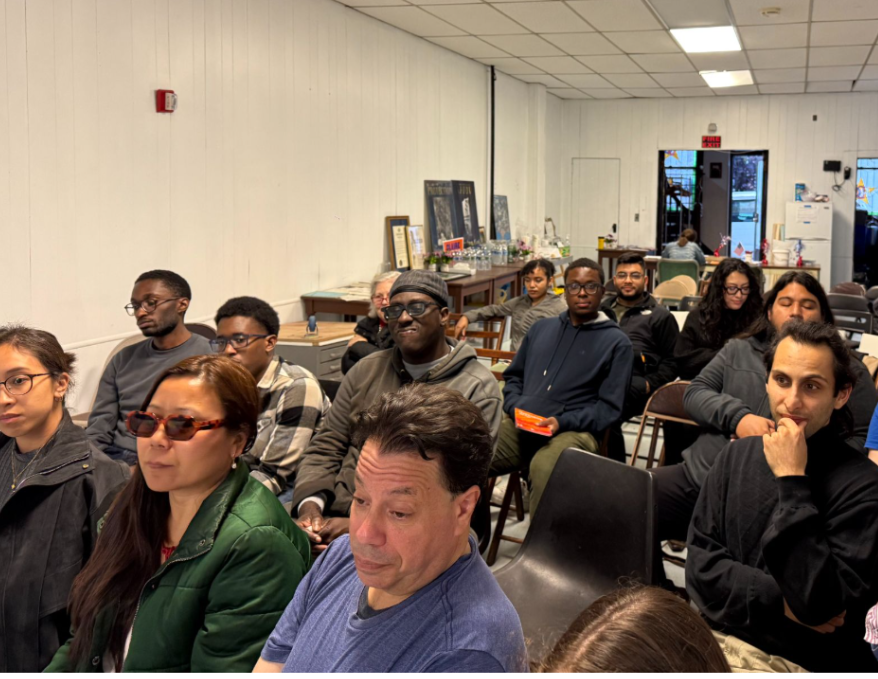
On Friday, May 15th, the Ridgewood Democratic Club hosted a candidate forum co-sponsored by the Queens County Young Democrats, the Latino Democrats of New York City, and several independent Democratic clubs. Inside the Club’s main conference room, a few plates of bread and mozzarella balls were set out as the evening’s refreshments, cameras streamed the proceedings to viewers at home, and a modest but engaged crowd settled into their seats.
The forum started with the candidates’ opening speeches, a round of lighter rapid-fire questions: favorite MTA lines, go-to restaurants, mottos to live by, and then moved to the district’s thornier issues like immigration, transit and housing. If there was a single issue that defined the night, it was housing. All three candidates supported stronger tenant protections and were critical of the pace and structure of existing affordable housing programs. But their approaches differed.
Housing
Samantha Kattan, who has spent over a decade organizing tenants and working-class co-op owners across New York City, made the case for two ambitious state-level bills. The first is the Tenant Opportunity to Purchase Act, which would give renters a right of first offer to buy their building when a landlord wants to sell. The second is the creation of a Social Housing Development Authority, which according to Kattan, would help the state build entirely affordable developments, without having to deal with developers.
“The tools we have at the city level are not meeting the needs that we have,” she said.
Melissa Orlando, unlike the two other candidates, was skeptical of Sunnyside Yards, the massive rail yard redevelopment frequently cited as a future source of housing relief.
“The estimate is 70 to 100 years for the development of the site. It’s not hyperbole,” she said in an interview with the Queens Ledger after the event, pointing to the environmental review process, the cost of decking over the yards, and uncertainty over capital financing. She proposed a mandatory, apartment-by-apartment database of rent-stabilized units to identify and hold accountable landlords who collect tax benefits while keeping apartments off the market.
“If we had a reliable way to track it, we could go back to the landlord and say, you’re getting tax breaks from this program, but you’re holding these apartments offline during a housing crisis.”
Pia Rahman, drawing on listening sessions she’s held across the district, said the issues she hears most consistently are seniors being priced out and not aging with dignity, as well as parents struggling to get individualized care for special needs children in schools. On housing specifically, she emphasized a “co-governing” approach, where she would be doing “broad surveys, maybe coming to senior centers and hearing what they’re lacking or what they need.”
Immigration
With more than 40 percent of the district foreign-born, all three candidates were unequivocal in their opposition to ICE enforcement and collaboration.
Orlando spoke about her own son. “My child is Latino, he does not have an Anglo last name, and I am terrified when he goes outside,” she said. Rahman called it what she believes it is: “At this point, it’s not an immigration issue. It’s a human rights issue.” She also spoke personally, noting that her father shared a name with one of the September 11 hijackers and had to write a letter to Homeland Security to clear his name. “I know that fear firsthand.”
Kattan called for the passage of New York for All, which would bar local law enforcement from collaborating with ICE including through informal data-sharing. She also named the Dignity Not Detention Act, access to legal representation in deportation cases, and Coverage for All, which would extend state-funded healthcare to undocumented residents. “ICE does not want to follow the law,” she said, “so we also need to support local organizing — know-your-rights trainings, informal neighborhood networks keeping an eye out.”
Transit
On transit, the candidates found the most common ground. All three backed the Queens Link proposal to restore rail service along the former Rockaway Beach Branch corridor, favoring it over the Queensway recreational trail alternative. “When we have an opportunity where there’s already tracks down, we should prioritize transit,” said Kattan. Orlando agreed: “It’s so expensive to create new rail. If we can use this to quickly solve a transit issue, we should.” Rahman noted that the Queens Link would also improve access to existing green spaces, not just create commuter options.
Voters Weigh In
Although there was no clear consensus from the audience over the preferred candidate, many named similar concerns, namely affordability and housing.
Isaiah Ovega, 24, who spent roughly half his life in the neighborhood before he was priced out and moved to Cypress Hill, felt compelled to show up for a district he cares deeply about. Affordability was his top concern, followed closely by immigration and transit. He named Rahman as his preferred candidate. “She’s the most experienced. She knows what she’s talking about, she can clearly articulate the issues, and she has plans for them.”
Joseph DiBenedetto, 30, a Ridgewood native and social worker, arrived already committed to Kattan. He came to the event in part to show support, and in part because he wanted to hear where the others stood. He said that he is voting for Kattan because of her affiliation with the Democratic Socialists of America (DSA), “It’s more powerful to be part of a broader movement than to just be one individual with good ideas.” He named affordability, the environment, and care work as his top priorities.
Kenton Ngo, from Woodside, was still undecided after the forum. He said he was most interested in finding someone who would offer strong pushback against the federal government: “I’m looking for an assembly person who will fight with backbone,” he said.
The June 23 primary will determine who makes that case in Albany.