

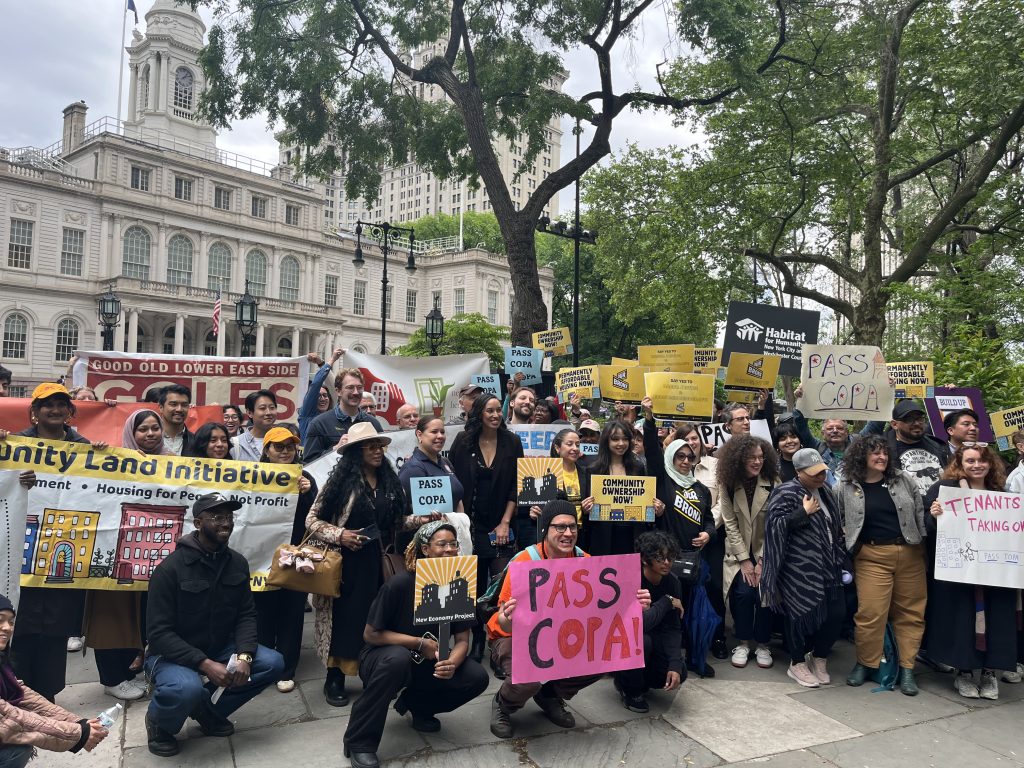
Supporters say (COPA) could help preserve deep affordability by putting distressed housing under community ownership.
BY COLE SINANIAN
cole@queensledger.com
CITY HALL — Big, bad landlords beware: large apartment buildings with serious housing code violations could soon come under community control, thanks to a City Council bill that was resurrected Wednesday.
Boosted by a city-wide coalition of legislators, community nonprofits and grassroots tenant activists, the Community Opportunity to Purchase Act (COPA) would help nonprofits and land trusts acquire apartment buildings that meet certain criteria before for-profit real estate companies can.
The goal, supporters say, is to empower trusted local organizations to take control of distressed buildings in their communities instead of real estate speculators headquartered far away that seek to turn a profit at all costs.
Chief sponsor Sandy Nurse reintroduced the bill at Wednesday’s Stated City Council hearing, marking legislators’ second attempt to make COPA law after it passed the Council last year but was vetoed by former mayor Eric Adams on his last day in office. While Adams and a vocal group of critics have decried the bill as an attack on the free housing market, supporters have hailed it as an essential tool for improving tenants’ living conditions in buildings with severe violations and halting the march of gentrification in the city’s most vulnerable neighborhoods.
“We have buildings that are in bad condition, where there are many hazardous violations,” said Greenpoint City councilmember Lincoln Restler and COPA co-sponsor at a rally outside City Hall Wednesday afternoon.
“We are simply asking the question— can we bring in nonprofit partners? Can we bring in trusted community-based organizations, who will take over these buildings, and deliver the high quality affordable housing we deserve?”
As currently written, the law would give an approved list of nonproft entities the exclusive right to make an offer on qualifying buildings before they’re made available on the open market. The law would only apply to buildings with four or more apartments, that have an annual daily average of three or more Housing Preservation Department (HPD) violations, and which are declared distressed by the city and subject to HPD enforcement programs, among other conditions. COPA would not apply to buildings with five or fewer units in which the property owner lives.
When they intend to sell their building, an owner would notify the City and all qualified nonprofits, who would then get 20 days to submit a statement of interest. Interested nonprofits would then get an additional 70 days to submit an offer at the seller’s asking price. If no viable offer is made during this 70-day period, the property would enter the open market. However, after this initial time frame has elapsed, the first qualified nonprofit that submitted the offer would maintain the “right of first refusal,” meaning that when a seller decides to accept an offer from a for-profit entity, that nonprofit would have a 15-day period to submit an offer that matches that of the for-profit company.
Compared to the original, the new version of COPA shortens the amount of time nonprofits would have to make an offer on qualifying properties, clarifies the kinds of properties that would be subject to the law, and enshrines community land trusts into the legislation as an option for ensuring properties acquired under COPA remain deeply affordable.
Though COPA would lengthen the sale process, it would not require owners to settle for less than their property is worth.
“For 20 days, a seller would have an exclusive buyers group that they could present to, and that group will have to entertain the asking price,” said Nurse, who represents Bushwick in the Council. “We’re not under-footing, we’re not devaluing.”
Backed by 25 City councilmembers, COPA is modeled after a similar bill enacted in San Francisco in 2019 and a Tenants Opportunity to Purchase Act (TOPA) — which gives tenant associations the first right to purchase certain properties — enacted in the 1980s in Washington DC. While in DC recent funding cuts and amendments have left the policy’s future uncertain, in the years since the passage of San Francisco’s COPA, over 400 homes have been acquired by the San Francisco Community Land Trust — according to Next City, a nonprofit news organization — preserving affordability for more than 1,000 residents.
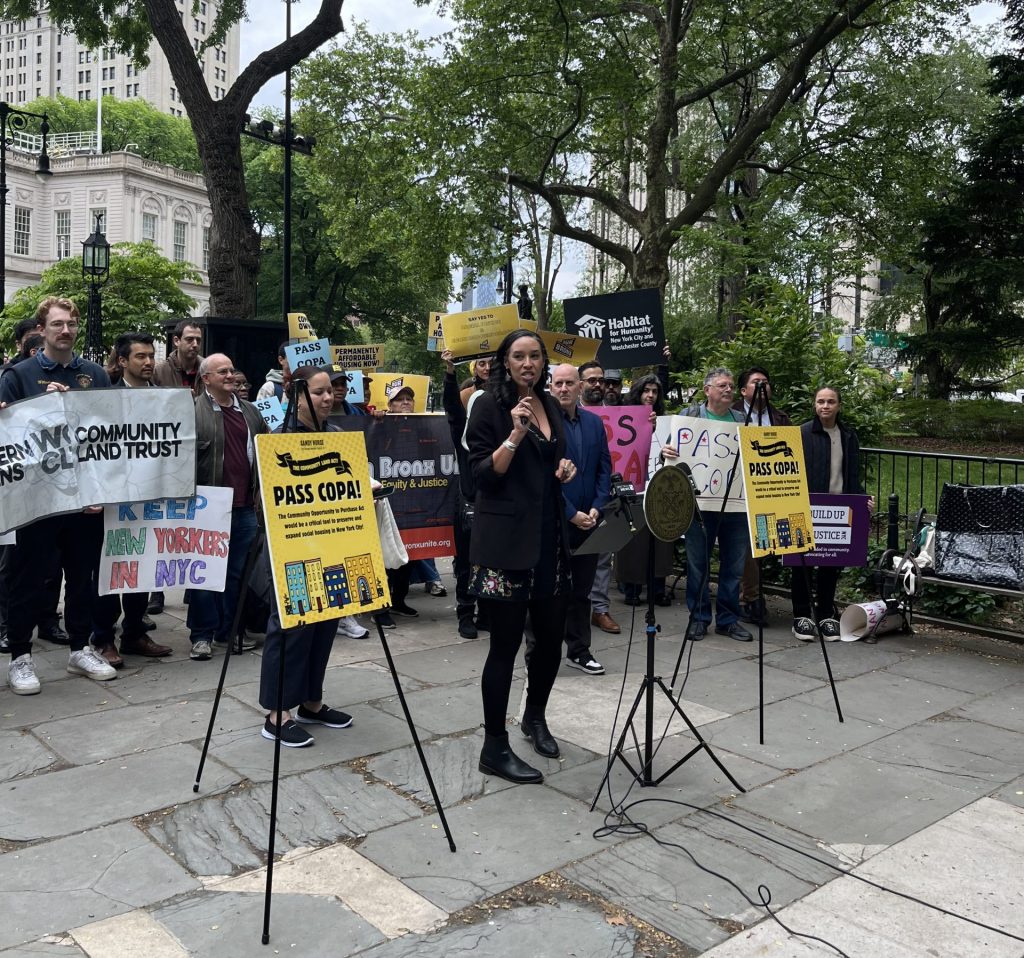
Critics of New York’s COPA, however, have slammed the bill as government overreach, claiming it would further bureaucratize the real estate sale process.
They say it would “present significant operational and administrative challenges for the City agencies involved in administering this law,” as former Mayor Eric Adams wrote in his veto message last December, and lead to “significant costs to the City in assisting nonprofit organizations with renovating and possibly even procuring certain properties.”
Meanwhile, City councilmember Darlene Mealy, who represents parts of Bed-Stuy, Brownsville, Crown Heights and Ocean Hill in Brooklyn, criticized COPA as part of a “radical socialist agenda.”
According to Mealy, the original bill would have “violated private property rights through a likely unconstitutional form of government overreach that would have required property owners to go through HPD in order to sell their homes,” as read a January press statement attributed to the councilmember — who has been noted for having among the worst attendance records in the Council, missing a third of City Council meetings in 2023.
Councilmember Mealy’s office did not respond to the Queens Ledger’s requests for comment.
Still, supporters say the added bureaucracy is necessary to preserve affordability in neighborhoods on the front lines of gentrification, where speculation has caused prices to surge in recent years. In gentrifying parts of Brooklyn like Bushwick, Bed-Stuy, and East New York, practices like house-flipping — where buyers often use deceptive tactics to acquire homes and quickly resell them at enormous profit margins — have been tied to what some analysts have described as a “mass exodus” of Black and nonwhite residents.
“A lot of professional flippers come in, slap some new sheetrock on, and then jack up the cost of those properties,” Nurse told the Queens Ledger. “They’re usually sold to single families, which removes a lot of our affordable rentals.”
In the East New York neighborhood of Brooklyn, meanwhile, a recent rezoning has led some residents to organize against what they fear is a coming wave of gentrification, in the hopes they can take affordable properties off the market before they can be acquired and flipped by for-profit real estate. COPA, they say, will help them do this.
Schoolteacher Boris Santos grew up in Williamsburg but now lives in East New York. He’s lived in East Brooklyn for the last 15 years, and says it’s this part of town — still relatively untouched by gentrification and its homogenizing tendencies — that feels most like the New York he grew up with.
“Williamsburg, for me, is no longer home,” Santos told the Queens Ledger in an interview. “But rather, it’s East Brooklyn, with that feeling of a Black and Brown community of Latinos, of people playing dominoes outside in the streets, of people bathing in an open hydrant during summertime.”
When he’s not teaching, Santos is president of the East New York Community Land Trust. A kind of nonprofit organization governed by a board of local residents, Community Land Trusts (CLT) acquire land to be managed collectively as a means of preserving long term affordability.
Having witnessed first-hand the gentrification of his native Williamsburg, and now rampant house-flipping in his new home of East New York, Santos described the fight for community ownership as personal. On Arlington Avenue, which runs between Jamaica Avenue to Norwood Avenue, a growing number of modern, newly renovated homes have popped amid the street’s older buildings, which Santos sees as a sign of the neighborhood’s coming upscaling.
“You can literally walk a quarter mile of a couple blocks anywhere in East New York and see a flipped home, he said.
To Santos, a bit more government oversight is a small price to pay for organizations like the ENYCLT to begin democratizing the housing market and putting power into the hands of tenants instead of corporate real estate.
“The two keys to me are fighting displacement — keeping people in their homes — and then people owning their homes and having a democratic say in them,” Santos said. “And to do it with love, right?” he continued. “COPA does that.”