
By Dan Rose,
Every year, more than 356,000 Americans experience a cardiac arrest outside of a hospital. The uncomfortable truth is that nearly 90% of those cases are fatal. But the numbers shift dramatically when someone nearby knows what to do. Bystander CPR can double or even triple a person’s chance of survival, and yet fewer than half of cardiac arrest victims ever receive it. In Queens, where dense neighborhoods mean someone is almost always within earshot of an emergency, closing that gap between bystander and trained responder has become an urgent priority.
That urgency is reshaping how Queens residents and professionals approach emergency preparedness. Across the borough, healthcare workers are renewing their credentials, daycare staff are meeting state mandates, and everyday residents are signing up for courses they once thought were only for paramedics. The shift is practical, not theoretical. When cardiac arrest strikes in Jackson Heights or Forest Hills, the ambulance response clock is already ticking. The people who fill those critical first minutes with chest compressions and defibrillator pads are the ones who change outcomes.
Why Certification Demand Is Growing Across the Borough
New York State has steadily expanded the list of professionals who need current life-support credentials. Nurses and EMTs have always needed Basic Life Support certification at the healthcare-provider level, but the requirements now reach well beyond clinical settings. Teachers, coaches, childcare providers, construction workers, fitness trainers, security personnel, and even school administrators all fall under various state and employer mandates. For high school students, CPR training is a graduation requirement. The ripple effect means that nearly every workplace in Queens has at least one role that calls for documented emergency response skills.
The American Heart Association sets the standard for most of these certifications, and New York City employers have become particularly specific about which credentials they accept. Fully online courses without a hands-on skills evaluation rarely satisfy employer or regulatory requirements. That emphasis on practical, in-person competency has made choosing the right training provider a real decision, not just a checkbox.
- Career Compliance: Hospitals, clinics, dental offices, and urgent care facilities across Queens require staff to hold current BLS or ACLS credentials before they can work patient-facing shifts.
- Workplace Safety: OSHA standards and New York’s own regulations push non-medical employers to keep certified responders on-site, especially in construction, hospitality, and retail.
- Community Readiness: With AED devices now required in schools, gyms, and public facilities throughout the city, people who know how to use them are more valuable than ever in their own neighborhoods.
What Sets the Right Training Program Apart
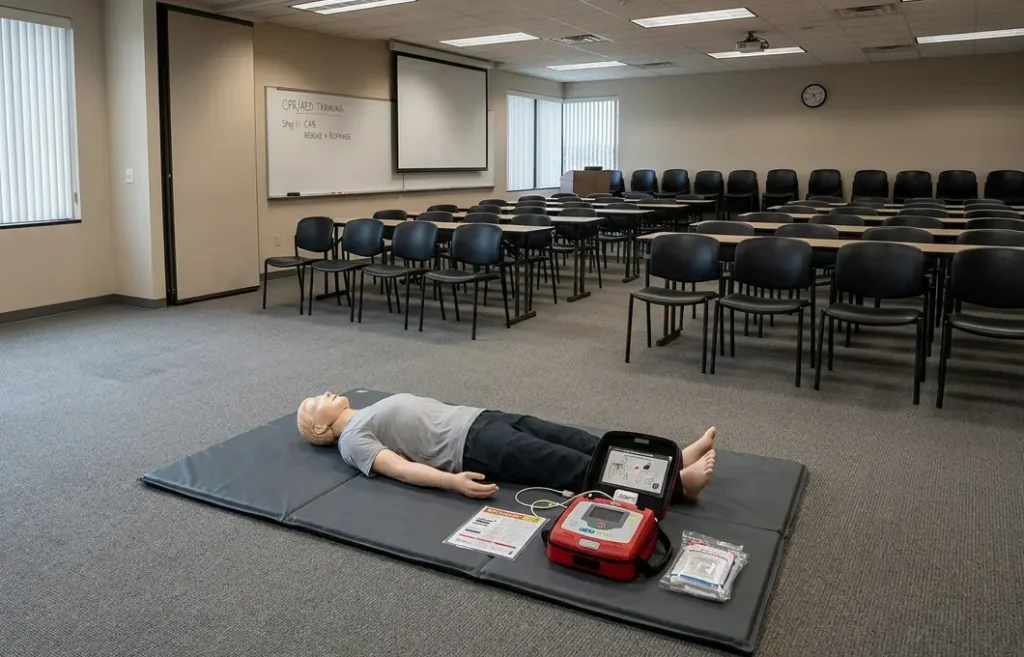
Not all certification courses deliver the same experience, and the differences matter more than most people realize. Class size is a big one. In a room packed with thirty students, your time on the manikin shrinks to a few rushed minutes, and the instructor can barely watch your technique, let alone correct it. Smaller sessions allow for the kind of hands-on repetition that builds actual muscle memory, not just test-passing familiarity.
Instructor quality matters just as much. Seasoned instructors bring real-world clinical and field experience into the classroom, which means they can answer the “what if” questions that textbooks skip. They know what a real compression feels like, how a panicked bystander actually behaves, and why the sequence of steps exists in the order it does.
Then there’s the practical side. Same-day certification means you walk out with your AHA eCard ready to submit to an employer or licensing board. No waiting period, no follow-up paperwork. For healthcare professionals juggling shift schedules or students racing toward clinical rotation deadlines, that speed is not a luxury. It is a necessity.
- Hands-On Depth: Programs that prioritize small groups let every student practice full adult, child, and infant CPR sequences with individual instructor feedback.
- Credential Recognition: AHA-issued eCards are directly verifiable and universally accepted by New York City hospitals, clinics, and regulatory agencies.
- Schedule Flexibility: Courses available across a full weekly schedule, including early mornings and evenings, accommodate the unpredictable hours that healthcare workers and first responders actually keep.
How the Right Skills Change Real Outcomes
The data on bystander intervention paints a clear picture. When a cardiac arrest happens in a public setting and someone with training steps in, the survival rate climbs above 33%. When that same event goes unwitnessed or unaided, the rate drops to single digits. Every minute without CPR reduces the chance of survival by roughly 7 to 10 percent. The math is stark, but it is also motivating. A four-hour course can quite literally place you on the right side of those numbers.
For healthcare professionals, staying current on ACLS protocols means being ready for the cardiac emergencies, stroke scenarios, and acute coronary events that walk through the doors of Queens hospitals every day. ACLS builds on BLS foundations with advanced airway management, cardiac arrest algorithms, and team-based resuscitation dynamics. It is the certification that emergency departments, ICUs, and cardiac care units treat as non-negotiable.
Queens is a borough defined by its neighborhoods, and the people in those neighborhoods are increasingly choosing to be prepared rather than hopeful. Whether it is a nurse maintaining credentials, a restaurant manager meeting OSHA requirements, or a parent who simply wants to know what to do if something goes wrong at a birthday party, the decision to get trained is one of the most practical investments a person can make. For Queens residents ready to earn or renew their CPR certification through an American Heart Association training site, the path from registration to eCard is shorter than most people expect.
Contributed by Dan Rose, A Senior Local Business Guide Specializing in Emergency Response Training and CPR Certification.
Ready To Get CPR Certified in Queens?
Whether you need a first-time certification or a renewal, finding the right course makes all the difference.
Visit us at https://www.gocprny.com/ to explore upcoming class schedules and register for your next life-saving training session.
Get Directions Below!
Go CPR NY, 40-47 95 St, Suite B, Elmhurst, NY 11373, (718) 785-5559