
Sunnyside’s Irish Olympic Powerhouse

The secret history of the Irish American Athletic Association and its Sunnyside home. 

GEOFFREY COBB | gcobb91839@Aol.com

Author, “Greenpoint Brooklyn’s Forgotten Past

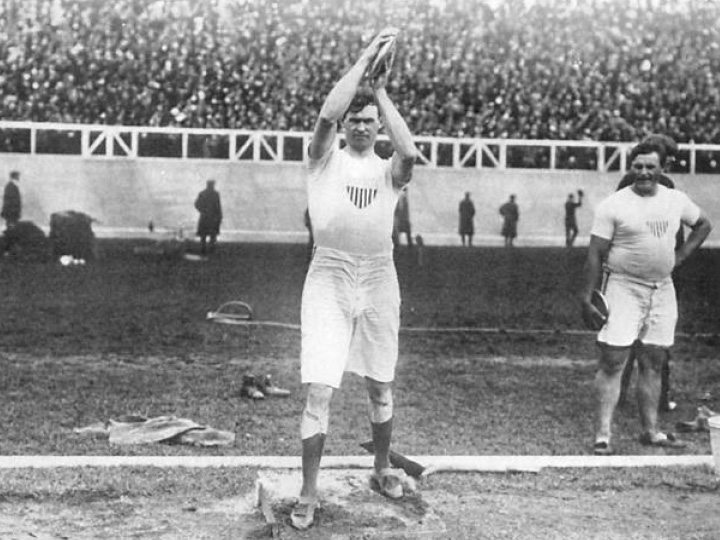
Every four years tens of thousands of residents of Queens, New York watch the Olympic Games, unaware that the borough wrote a glorious chapter in early Olympic history and that a group of Olympians who trained in a sporting complex between Woodside and Sunnyside became the first superstars of the Olympics. It’s a history every Queens resident should know and take pride in. Few people today, however, know the fascinating, but little-known story of the Irish American Athletic Association and its Queens home Celtic Park.

In the 1890s, when the modern Olympic movement was just beginning, few people could afford the luxury of competing as athletes, and those who did were almost exclusively white Protestant male members of New York’s Upper Class. Many of these blue bloods belonged to New York’s oldest sports club, the elitist New York Athletic Club, which looked askance at working-class and immigrant athletes who wanted to join the club, and often denied them membership.

In 1897, Irish immigrant P.J. Conway founded the Irish American Athletic Association and purchased land in what was then called Laurel Hill, Queens, near Calvary Cemetery. Though most of the members of the club were Irish American, anyone was free to join the club, unlike the New York Athletic Club. The I.A.A.C. quickly became one of the most ethnically diverse organizations in America and served as a “working man’s” athletic club, regardless of race of religion, in an era of fierce prejudice and discrimination.

The I.A.A.C. built a state-of-the-art track in Queens that opened in 1898 and the club would produce an astounding twenty-six Olympic gold medals, twenty-two silver medals and eight bronze medals for the American Olympic team between 1908 and 1924. The I.A.A.C. also won a total of 17 Amateur Athletic Union (AAU) national team championships—10 outdoor and 7 indoor. Additionally, club athletes won 81 individual national outdoor titles and 36 individual national indoor titles.

In the 1908 London Olympics alone, the club’s athletes won a remarkable twenty-four medals, including nine individual gold medals and two more in relay events. The I.A.A.C. won more medals alone in track and field than Great Britain, considered to be the world’s best track and field nation. The club’s Olympic medalists became the first Olympic athletes ever invited to a reception by the President. Theodore Roosevelt welcomed the I.A.A.C. Olympians to his summer home, where he was presented with a gold medal a club member had won and Roosevelt became an honorary I.A.A.C. member.

The I.A.A.C welcomed working class athletes of any backgrounds, and the first Jewish American and African American gold medal winners were members of the club. Myer Prinstein, a Polish-born Jewish immigrant who later practiced law in Queens, competed for the I.A.A.C at the 1904 St. Louis Olympics and won both the long jump, while setting an Olympic record, and the triple Jump on the same day, the only athlete ever to win both events in the same games. In Athens in 1906, he again won the long jump competition, beating the world record holder, Peter O’Connor.  In 1908, African American John Baxter Taylor became the first African American gold medalist while competing for the I.A.A.C. in the men’s medley relay team. Tragically, Taylor contracted typhoid and died shortly after the games at age twenty-seven.

The I.A.A.C. also produced the first superstars of the games, a group of Irish immigrant weight throwers known as “The Irish Whales” for their huge size and enormous appetites. Between 1900 and 1924, with an interruption because of World War I, these athletes won an astounding twenty-three Olympic medals, including twelve gold medals. Perhaps the finest of the group of legendary athletes was New York City Police Detective Martin Sheridan, a five-time Olympic gold medalist who won two golds in the 1906 Athens Games and three silvers. Greek King George was so impressed by Sheridan that he had a statue erected in his honor and sent him a gold goblet. In his obituary the New York Times hailed him as “one of the greatest athletes the United States has ever known.”

Located in Queens between 48th and 50th Avenues and 42nd to 44th Street, Celtic Park was more than an athletic training grounds. It was ground zero for Irish events, labor meetings and political rallies, but it closed during World War I and problems arose during prohibition when alcohol raids by federal agents led to donnybrooks and arrests.  In the 1920s, the Irish community opened a new sporting venue, Gaelic Park, in the Bronx, making Celtic Park, a secondary sports venue. Finally, in the 1930s, the land was sold to a developer and today an apartment building occupies the once hallowed sports ground.

For decades, the City of New York did nothing to commemorate the amazing achievements of the Irish American Athletic Association, but finally in 2012, thanks in large part to City Council Member Jimmy Van Bramer, the city designated 43rd street in Woodside Winged Fist Way, after the I.A.A.C.’s official emblem.
Memetic Warfare: Gotham Goose’s Campaign for Civic Engagement

Through his satirical hyper-local news outlet, Nick Stergiou uses memes to get Astorians engaged in their community. 

BY COLE SINANIAN

cole@queensledger.com

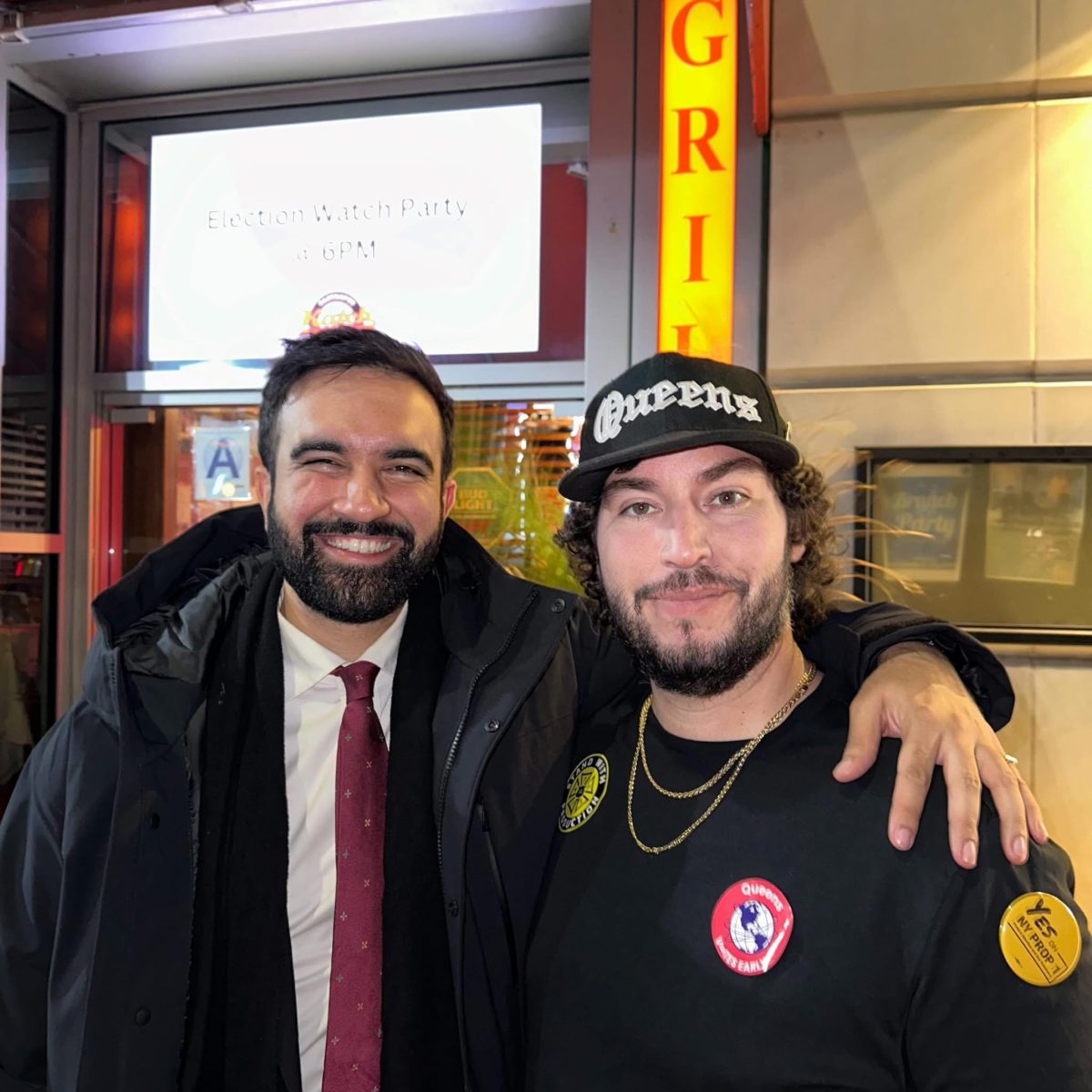
Nick Stergiou is in many ways the archetypal Astorian everyman. He is half Greek, half Colombian, both a transplant and a native. The commercial producer and social media manager was born in New York but raised in Bakersfield, California, where his family ran a bagel business. The West Coast, however, was not Stergiou’s vibe, so at 18 he booked it back to the only place that felt like home: Astoria.

“It gave me a unique perspective on being a New Yorker, because I’ve always felt like a native and also a transplant at the same time,” Stergiou said.

Now 38, Stergiou is the brains behind the Gotham Goose, a popular hyper-local satire Instagram page that doubles as Stergiou’s ploy to get more Astorians engaged in local politics. As a teen, Stergiou developed his sense of humor watching late night hosts like Conan O’Brien and spent lots of time on the internet, growing fluent in the language of trolling. As an adult, he’s developed this fluency into a potent catalyst for civic engagement.

While running the social media accounts for his labor union, the Production Workers Guild IATSE Local 111, Stergiou deployed a strategy called “memetic warfare” to get members to sign union cards. A kind of propaganda technique, memetic warfare involves propagation of internet memes as a means of influencing public opinion. Anyone who follows the local Karaoke Shout Instagram page — which Stergiou runs — should be familiar with his irreverent brand of self-referential humor. With Gotham Goose, this looks like the merging of the local and national cultural zeitgeists through satirical, Astoria-centric Instagram memes.

One recent headline reads “Queens Pride Committee Votes to Flip ‘IA’ this year in LGBTQIA+ to include Community with AI Bot Relationships.” Another is headlined “Photos of Mayor Mamdani with Epstein are Real – Not AI Generated.” The Epstein in question, of course, is not the convicted sex-trafficker, but Manhattan City councilman Harvey Epstein. According to another post, the City unveiled a “monster truck-style ambulance” that can crush the parked cars on the notoriously congested 31st Ave with its giant wheels.

“There’s a problem with people believing everything they see on the internet and taking it seriously,” Stergiou said. “If you read and pay attention, you’ll be in on the joke. So it is sort of  revealing who is actually paying attention and who is not.”

In other words, if you know, you know. An attentive Astorian should be informed enough about the neighborhood and local politics to know whether or  not a post is satire, Stergiou explained. Sometimes, Stergiou posts real Astoria happenings, albeit with a satirical spin. One morning while walking down Ditmars Blvd, he watched as a worker put up a sign on a vacant storefront on the corner of 31st for a new restaurant called “Astoria BBQ.” Using a combination of photoshop and AI, Stergiou quickly crafted a post declaring that “BBQ” in Astoria stands for “Balkan  Breakfast Quesadillas,” a concept that might include on its menu “feta chilaquiles” and a “shakshuka morning melt.”

“Yes, I do post misinformation, but it’s obviously a joke,” he said. “It’s to make people laugh and realize, like, things are stupid and funny.”

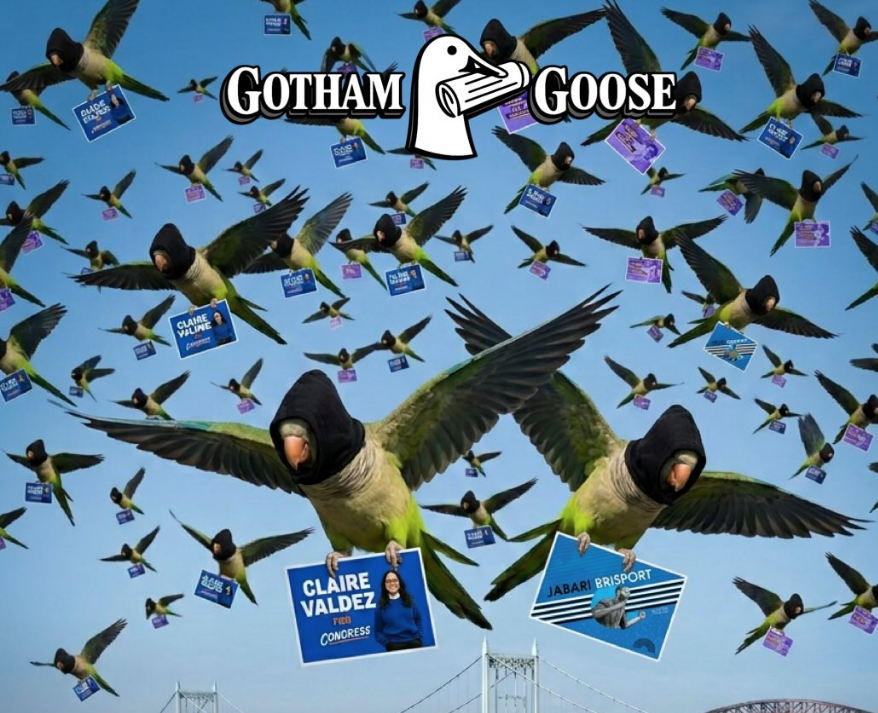
Longtime Gotham Goose fans will also notice the recurring bird motif. The name was inspired by Stergiou’s lifelong affinity for birds; he is pigeon-toed and had pet cockatiels as a kid. “Honky the Snow Goose,” Gotham Goose’s official mascot, was allegedly seen chatting up “Astoria the Turkey” at Hallett’s Cove Beach, according to a March 11 post. Then there’s the shadowy cabal known as the “Council of Monk Parakeets,” whose enigmatic doings are — in Stergiou’s Gotham Goose universe — largely responsible for Astoria’s recent embrace of democratic socialist politicians.

In the Gotham Goose universe, the enigmatic “Council of Monk Parakeets” is the silent force driving Astoria’s left-wing politics. Photo via @gothamgoose on Instagram.

Monk parrots in New York are a real thing; observant New Yorkers may have seen their bright green wings flashing among the treetops across Brooklyn and Queen’s green spaces. Legend has it they’re descendants of a flock destined for pet stores that escaped from JFK in the 1970s. They’re now one of NYC’s thriving invasive bird populations, often nesting atop air conditioners, electrical poles, and lighting fixtures.

But in Stergiou’s satirized Astoria, the hooded Council of Monk Parakeets nests atop an electrical pole on 23rd Ave, and convenes in a conclave-esque ceremony whenever there’s a local election. In February, they “elected” Diana Moreno, who replaced Mamdani in Assembly District 36. Most recently, the Gotham Goose reported that the parakeets were seen “dropping political flyers” for Democratic  Socialist of America (DSA)-endorsed NY State Legislature candidates Phara Souffrant-Forrest and Jabari Brisport, and Claire Valdez, who’s running to replace Nydia Velázquez in New York’s 7th Congressional District.

“It’s basically the Parrot’s Republic of Astoria,” Stergiou wrote in a post, referring to the neighborhood’s nickname, “the People’s Republic of Astoria,” which alludes to its status as a hub for left-wing politics. “The volunteers knock doors, but the parrots quietly confirm what they decided weeks ago.”

But beneath Stergiou’s satire, there’s nuanced commentary on the unending New York City struggle between old timers and transplants and how that struggle affects local governance.

“The point is there’s some kind of driving force of nature that is affecting our politics,” Stergiou said. “The DSA seems so strong here it seems like sometimes people don’t have a choice because they’re just so active that it’s like, there’s gotta be something that’s keeping all these candidates coming. It’s the monk parrots.”

On a more serious note, Stergiou, who describes himself as democratic socialist-leaning, has little sympathy for Astorians who complain about transplants bringing their politics to the neighborhood but then refuse to engage in politics themselves. Whether these socialist newcomers are transplants or not, the kind of canvassing and grassroots campaigning that has become NYC-DSA’s trademark is a highly effective strategy for political mobilization, Stergiou points out. The old timers could take note.

“Native New Yorkers who are fed up with things, they complain a lot but they don’t participate,”  Stergiou said. “If everyone participated then maybe the change you want would happen, instead of just saying, like, oh,  the transplants are here and they ruined everything. It’s like, well, they just participated.”

Fill the Form for Events, Advertisement or Business Listing