

Beyond the Market: Alternative Ways to House New York


By TAYLOR MACEWEN
While most New Yorkers are not housing experts, navigating the city’s housing market necessitates knowing your options, as well as the factors limiting those options — limitations feeding the city’s affordability crisis and inspiring organizers and activists to find another way.
“We now actually have more housing per capita per person than we have in decades,” said Memo Salazar, co-chair of the board of the Western Queens Community Land Trust. “How can the crisis be that terrible and yet the numbers don’t reflect that? It’s because people are looking at housing as a commodity and not a place to live.”
Beyond the open market exists an ecosystem of alternative housing models. Here are several models housing advocates say could bring sustained affordability by deprioritizing profit.
Public Housing
Subsidies create pathways for the construction of these housing facilities — like Long Island City’s Queensbridge Houses — while local agencies provide operational support. Rent is proportional to a tenant’s income, usually 30%. A 2020 report by the Community Service Society (CSS) of New York describes how on-site punitive policies and stigma towards historically low-income residents of color weakens their social network in the community, exacerbating political disempowerment.
The aim of perpetual affordability depends entirely on government stewards resisting market influence when funding is threatened, as corporate owners can opt out when contracts expire. The 2017 Tax Cuts and Jobs Act also significantly reduced corporate tax rates, weakening incentives for building investors. According to its 2025 Fact Sheet, the New York City Housing Authority (NYCHA) — the largest in the United States, housing 1 in 16 New Yorkers — is consistently billions of dollars behind funding goals.
Rent Regulation
Rent regulated units are common amongst low-income renters as legal safeguards to protect affordability from direct market pressures. Indirectly, the market’s pressure on landlords can stall necessary maintenance, who may see no financial return on unit improvements due to limitations on raising rent. Prioritizing providing housing, rather than turning a profit on housing, is a central goal for tenant organizers and analysts. A goal many call ‘decommodification.’
“Rent stabilization is a move lessening the commodity status of housing, while not fully decommodifying it,” said Samuel Stein, a Housing Policy Analyst at CSS. “Think about decommodification as a process in a spectrum rather than a binary.”
Limited Equity
Limited Equity Housing Cooperatives (LEHCs) provide lower rents and self-determination of a community’s living conditions. Residents purchase shares in a nonprofit-owned property, pay low monthly maintenance fees and elect a building operations board.
“If we need to raise our own maintenance fee, we decide when. It’s not just because somebody wants to make more money,” said Stein, himself an LEHC resident. “I don’t have this thing in my head about property values where if my neighborhood gentrifies then maybe I can sell for more money. I can just think of it as a place to live, not as a long-term investment. That frees me up to not practice any of the class politics of homeownership.”
Residents of Mitchell-Lama co-ops, a common LEHC for example, cannot sell on the free market, only back to the co-op. The apartment goes to the next person on a waitlist, removing the building from speculative circulation.
The 1959 inclusion of rentals to the program offered additional oversight but no ownership, and established a privatization pathway that has pulled many buildings back into the market. Increased investment interest and building costs mean no new Mitchell-Lama buildings have been established since 1981.
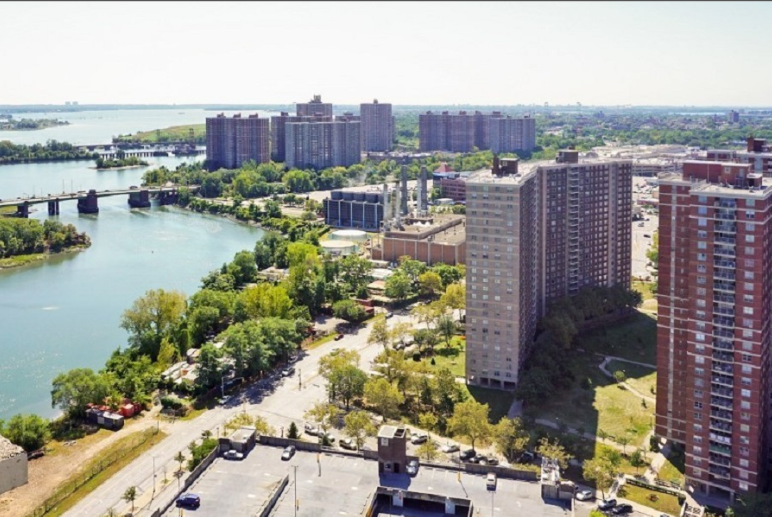
Co-op City in the Bronx. Photo via NYC.gov
HDFCs and CLTs
According to analysts and urban planners, Housing Development Fund Corporations (HDFCs) and Community Land Trusts (CLTs) represent the most structurally robust approaches to permanent affordability.
Initially a response to the strategic disinvestment across lower-income neighborhoods of color in the 1970s and ‘80s, HDFCs buy buildings and sell affordable shares to tenants, much like LEHCs. Tenants may later sell on the free market at unrestricted prices to buyers below a certain income range. Without additional provisions, tenants may sell at high prices to buyers with low-incomes but massive assets.
CLTs are nonprofits separating land from building ownership entirely, buying land and leasing it to organizations like HDFCs. Effectively removing land costs — one of the primary engines of property appreciation — from the affordability equation altogether.
“It’s the only model I can see where there’s an actual affordability element built in,” said Salazar. “And not just for today, but for years — like, hundreds of years from now.”
Their primary obstacle is long-term operational funding, ideally from a government yet to consistently commit.
A Starting Point
The Tenant Opportunity to Purchase Act and the Social Housing Development Authority bill are currently being considered by the state senate. The former establishes tenants’ right to purchase their building as an LEHC when owners sell. The latter establishes a corporation for the sake of purchasing affordable housing. The Community Opportunity to Purchase Act was recently brought back to the New York City Council, and would give nonprofit community groups priority to purchase housing.
“This is happening right now, even though we need new laws to scale it up,” said Stein. “It can feel impossible to a tenant who’s stuck paying rent to some LLC they’ve never actually encountered. But it is a real thing, and with the right laws we can make it a much more common experience.”