
Lunar New Year at MoMA PS1

Politically powerful dancing rings in the Lunar New Year at MoMA PS1
By ANDREW KARPAN
LONG ISLAND CITY — Queens is perhaps the only place you’ll find people celebrating Lunar New Year by salsa dancing.
Since 2017, MoMa PS1 has been putting on public celebrations of the Chinese diaspora’s Lunar New Year inside the century-old shuttered public school in Long Island City now occupied by the museum. A month after PS1 stopped charging admission, this year’s celebration was its most crowded yet, per Molly Kurzius, a museum spokesperson.
“We’re expecting over 1,000 guests,” said Kurzius. “I think it’s going to be our most popular one ever. The last one we did, we had about 800 people. So, clearly there’s an interest and demand.”
Some of those thousand people would end up crowded inside a MoMA exhibition series called “Homeroom,” which “features artists related to our community partners,” as Kurzius puts it.
The current community partner in the space was a group called “LA ESCUELA___, who have been operating a show, closing the next week, called “Education as Resistance,” described in press materials as a “collective learning project… charting pedagogies from across Latin America.” Drawn on the walls was an immense map of the Latin American dysphoria– the South American continent flipped upside down.
Meanwhile,Talisa Velazquez and Carlos de la Rosa taught salsa dancing on a central platform. Starting with the traditional style, then Colombian, then Puerto Rican, before finally merging them in New York style, as a kind of conceptual metaphor for the last few centuries of history.
“I’ve been dancing salsa since I was a baby,” said Velazquez, who regularly picks up teaching work from MoMa. The idea to employ her to teach salsa dancing came from Miguel Braceli, one of the co-founders of LA ESCUELA___.
“For me, it’s politically powerful to end this exhibition with a salsa class,” said Braceli, “The political power of dance and salsa is a form of resistance.”
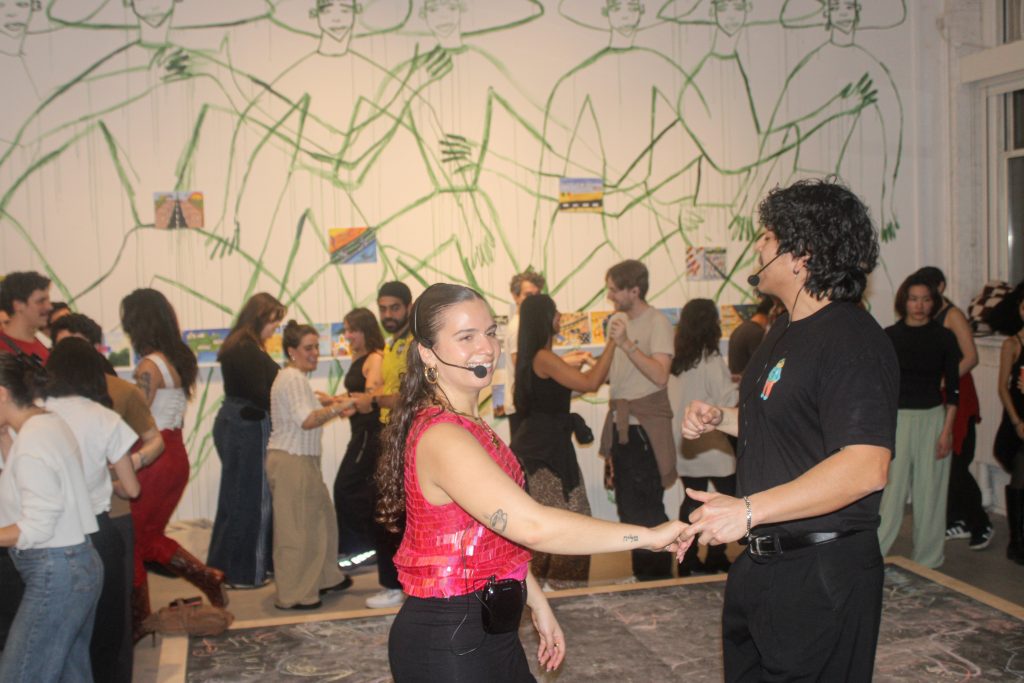
The evening’s salsa dancing class ended with a presentation on “New York style,” Photos by Andrew Karpan.
Upstairs, lines busily formed inside the one of the museum’s expansive gallery spaces, which was filled by a food court, where one could find at least seven different restaurants and bakeries giving out miniature sliders and wobbly slices of mille crêpes cake from Japanese patisserie Lady M.
Funding for the food and the event as a whole had come from the city through a $10,000 grant furnished by City Councilwoman Julia Won (D-Long Island City), said Ren Lee, who works government affairs for the museum. Won has been delivering the museum this funding for the last three years, Lee said.
“We hope to do more of these kind of ‘Neighborhood Night’ events that are free, and support local businesses in LIC,” said Lee, who was volunteering at a table keenly shaped like the barren concrete courtyard outside. People were invited to sit down and draw their vision for what the museum should do with it, part of what Kurzius, the museum flack, had described as a five year project.
“It’s in the very early stages, but this is a great moment for our neighbors and the community to share their thoughts and ideas for the future of this space,” said Kurzius. “We’ve been doing about five years of community feedback on this project. We’re hoping to see that our new neighbors and community members are interested in the same things that our neighbors were five years ago.”
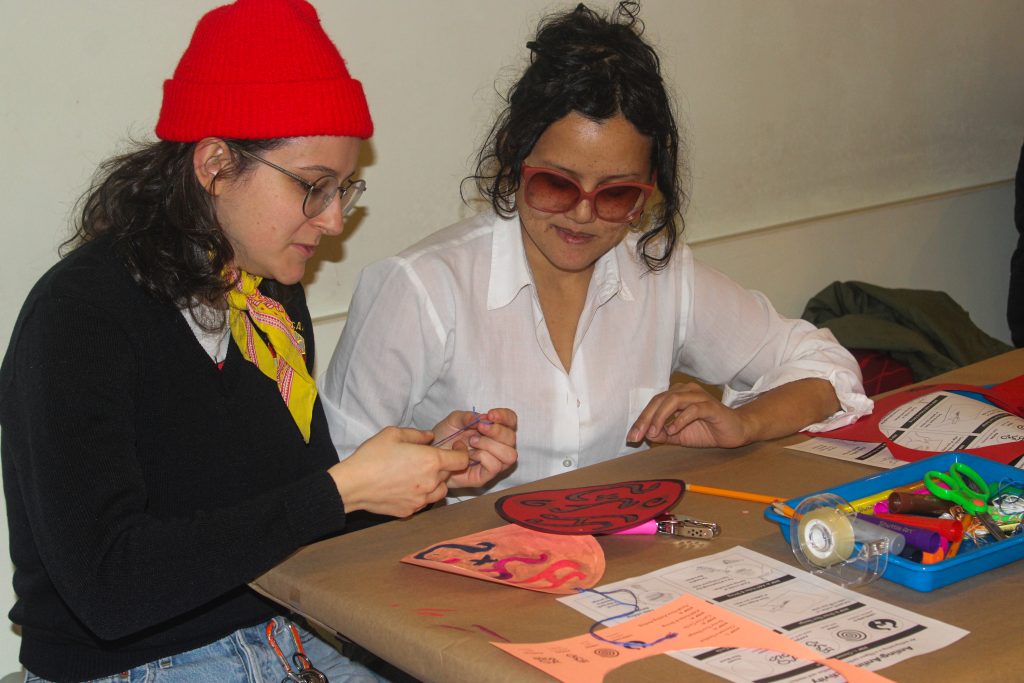
Katie Mayo and Ysabella Genato doing crafts. Photos by Andrew Karpan.
Lee, working the table, said contributions at the coloring table were divided about “70% kids and 30% adults.”
“We didn’t know about this before. It was shared in a Mom’s group on What’sApp, that’s how we found out about it,” said Ei Mon, a market risk manager who lives around the corner in Long Island City with Nader Shirazie, a software engineer. Their one year-old child, Lin, was busily contributing her ideas for the space.
“We get really good ideas from kids,” said Lee. She was far from the only newcomer.
“It’s my first ever time at MoMA PS1,” said Katie Mayo, who recently moved to Crown Heights, from London, and works in fashion and who had arrived with Ysabella Genato, who moved to Crown Heights from LA and teaches French. Both came to the museum to catch the tail end of the museum’s show on Vaginal Davis, the punk-era icon.
They ended up at a different crafts table, making larger paper medallions at the instruction of Jaclyn Reyes, a member of the Little Manila Queens Bayanihan Arts, an arts collective based in Woodside that had put on their own show at the museum in 2024. The pieces were handmade, affixed on a celebratory string like the kinds of traditional lanterns used to celebrate the Lunar New Year.
On the other side of history, floors above, enormous screens were broadcasting Ayoung Kim’s Delivery Dancer trilogy, a video installation at the museum that “collide geopolitics, synthesize mythologies, and interrogate technologies,” a story about delivery drivers in a futuristic city called Novaria. One imagines it was Lunar New Year there too.