
NY Irish Center Calls LIC Home

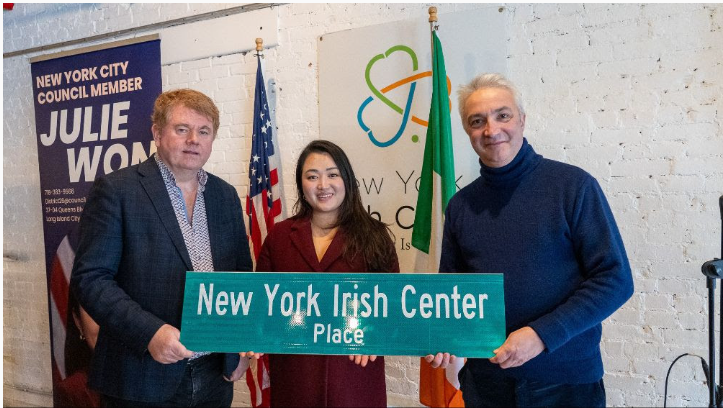
A section of Jackson Avenue was renamed ‘New York Irish Center Way’ in honor of the generations of Irish that have called NYC home. 

GEOFFREY COBB | gcobb91839@Aol.com

Author, “Greenpoint Brooklyn’s Forgotten Past

LONG ISLAND CITY  — It was a bitterly cold day on Saturday February 7th for the celebration of the renaming of the stretch of 1040 Jackson Avenue as New York Irish Center Place, but the Irish are a hardy bunch. About seventy brave souls defied the seven-degree day and subzero wind chill to watch City Councilmember Julie Won unveil the new street sign.

Won spoke of how her family, which immigrated from South Korea, was warmly greeted by the Irish community when she arrived in Queens as an eight-year-old. She related how Irish mothers passed on educational advice to Won’s mother and how supportive and welcoming the Irish community was to newcomers to Queens.

“It is important to honor the Irish who have done so much to build our community,” Won told me. Won has helped the center receive over $500,000 in grants. She said that last year alone a mind boggling 25,000 people came to the center, including many outside the Irish community.

The Center hosts three annual programs. In March it stages 40 Shades of Green, a Saint Patrick’s Day cultural marathon celebrating Ireland’s patron saint.  Along with Culture Lab LIC & McManus Irish Dance, the center presents the Queens Irish Heritage Festival as well. A world music series called Crossroads Concerts blends and juxtaposes Irish folk traditions with music from many other cultures.

Forty-three different organizations use the center for programming like Irish dance classes and Gaelic language and literature events, but the center’s outreach also includes non-Irish groups that serve the larger community including suicide prevention services, alcoholic anonymous meetings, immigration counseling and an ever-expanding list of others. The center welcomes people of all races, ethnic backgrounds and faiths. Last year, for example, eighteen Indian American events took place at the center. The center also teamed up with  Councilmember Won to raise more than $14,000 in a Christmas toy drive for underprivileged children.

For Twenty-one years, the Irish Center has served as the beating heart of New York City’s Irish community. The idea for the center was conceived by Belfast native Fr. Colm Campbell who saw a need for a place for the Irish community to gather. Angela Reily, the widow of legendary Irish folk singer Paddy Reilly addressed the audience on Saturday: “My husband would be happy to see how successful the center has become,” she said. The singer was instrumental in raising money for the center and helping to found it. Following a long and hard structural renovation and generous gifts from local Irish building contractors, the Center opened its doors in 2005.

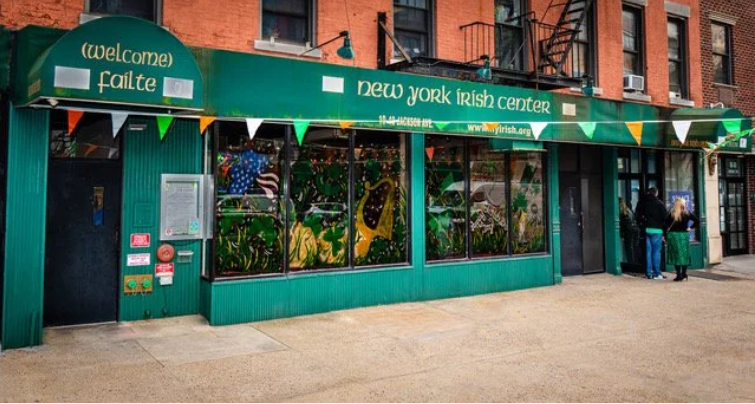
The Irish Center first opened its doors in 2005, and has since become a crucial gathering place for the city’s Irish community. Photo via newyorkirishcenter.org

The director and beating heart of the New York Irish center is Limerick-born George Heslin, who has run this multi-purpose community center for five years. Prior to his appointment, Heslin served for 19 years as founding Artistic Director of off-Broadway’s Origin Theatre Company. Warm, personable and capable, Heslin is also a recipient of the Irish Examiner/New York Man of The Year Award.  Though Heslin is modest, he proudly noted, “No other Irish organization does what the New York Irish Center does.”

Heslin says that first and foremost the center is a social service organization. The center radiates a typically Irish ability to welcome people, which Heslin demonstrates in his love for people, especially many of the Irish senior citizens for whom the center is a social lifeline.  He describes his work helping Irish seniors living out their lives overseas as a “privilege,” and said that the center plans to create more programs to cater to the needs of older Irish people including new programs in grief counseling and befriending seniors. Many of these seniors now have no living relatives in Ireland and the center is their only true connection to the land of their birth.  Dozens of these Irish seniors look forward to the lunch the center serves them each Wednesday.

Heslin and his small staff have worked hard to expand the cultural offerings the center stages, including traditional Irish music, dance and theater. Last year the center staged an astounding 160 events, which paid some four hundred artists who performed at them. Stageandcinema.com described the vibe at performances there as “ a bit like stumbling into a well-kept secret; it’s an intimate gathering place and an unassuming, cozy, cultural enclave.” The New York Irish Center is much more than a home to the New York Irish community. It is a home for thousands of New Yorkers, many of whom are not even Irish.  As former Executive Director of the New York Irish Center Paul Finnegan remarked, “It is fitting that this section of Jackson Avenue will now be called the NY Irish Center Place because it is home to an inclusive, caring community in a building built lovingly with the hands of its past and present generations.”

Church Restoration and IBX Project Stir Debate in Middle Village

MOHAMED FARGHALY

mfarghaly@queensledger.com

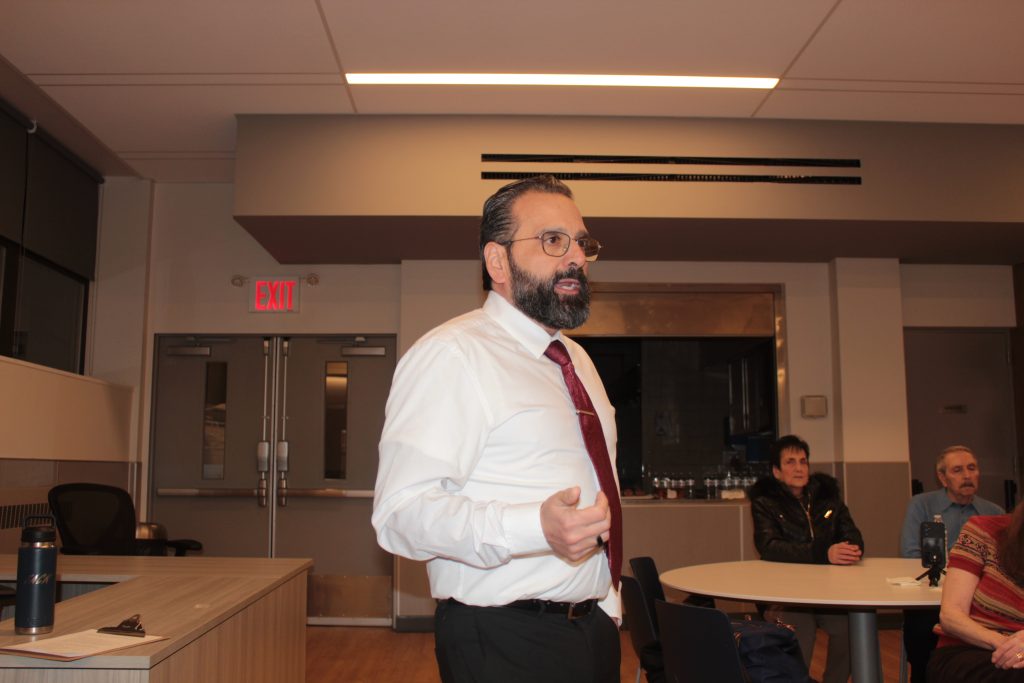
Residents of Middle Village gathered at Our Lady of Hope for the first meeting of the year on February 3rd to discuss longstanding community concerns, including the potential rebuilding of Saint Saviours Church, the impact of the proposed Interborough Express (IBX) project, and local infrastructure issues.

Paul Pogozelski, president of the Middle Village Residents Association, opened the meeting with the customary Pledge of Allegiance, welcoming attendees.

The first talking point regarded the reconstruction or revitalization of an abandoned church at a local cemetery. Saint Saviours Church, a long-dormant landmark in Middle Village, has sat unused for decades on the grounds of All Faiths Cemetery, its remnants housed in deteriorating trailers. The church has become a symbol of both local history and civic frustration, as repeated efforts to restore it have stalled due to funding and logistical challenges. Recent coverage reignited interest in the church, bringing it back to the forefront of the neighborhood’s collective consciousness. The Landmarks Conservancy visited the site to inspect its remains, underscoring the urgency of determining whether the historic structure can be rebuilt.

At the meeting, James McClelland, a board member at All Faiths Cemetery and district manager for Community Board 9, provided an update on the project, describing it as “difficult and costly” and noting that the cemetery could not fund construction on its own. “Before we determine whether it can be done, we have to lay out the material on the lot,” McClelland said. “We can’t have the cemetery laying around with all this material to determine the structural integrity.”

He addressed residents’ concerns directly, including the cemetery’s pledge not to house lithium batteries on-site and its willingness to provide land within the district for reconstruction. The church’s remnants must be removed from the trailers and laid out on a covered quarter-acre of land for inspection, according to the Landmarks Conservancy, before any rebuilding can proceed. McClelland estimated the project could cost “6 to 7 million dollars” and emphasized that the church could eventually be opened to all faiths once safety and structural integrity are assured.

McClelland also addressed the IBX transit project, which has raised concerns among residents about traffic and neighborhood disruption. “Engineers have met to look at tunnels,” he said. “They mentioned widening the tunnels for this to work. They only mentioned this, never elaborated, may need to move the existing mausoleum.”

Some younger residents voiced mixed opinions. “It seems promising, but at the same time I don’t want to see Middle Village roaming with people who want to cause harm,” one attendee said.

Walter Sanchez, chair of Community Board 5, discussed local priorities and infrastructure issues, including the board’s first collaboration with Council Member Phil Wong on budget priorities. Historically dominated by sewer projects, the board has been advocating for the area’s aging infrastructure.

A public hearing on Feb. 11 allowed residents to comment on a proposed seven-story, 54-unit building on Fresh Pond Road, prompting questions about population growth and urban density. “Why do politicians want to flood this city with more and more people?” one resident asked during the discussion.

Charlie, from Council Member Wong’s office, reviewed Wong’s first month in office, noting meetings with the mayor, City Council Speaker, Department of Transportation, sanitation officials, MTA, parks department, Con Edison, local precincts, and the district attorney to address public safety, transit, and infrastructure issues. “He’s met with all three NYPD precincts that we serve,” Charlie said. “When our constituents call, we want to make sure we go out there and do something about it, not just close out the 911 calls.”

Miles, representing Assemblyman Steven Ragas’s office, highlighted community programs, including free tax preparation workshops and legal clinics held in late January. Mobile office hours for constituent services will continue throughout February.

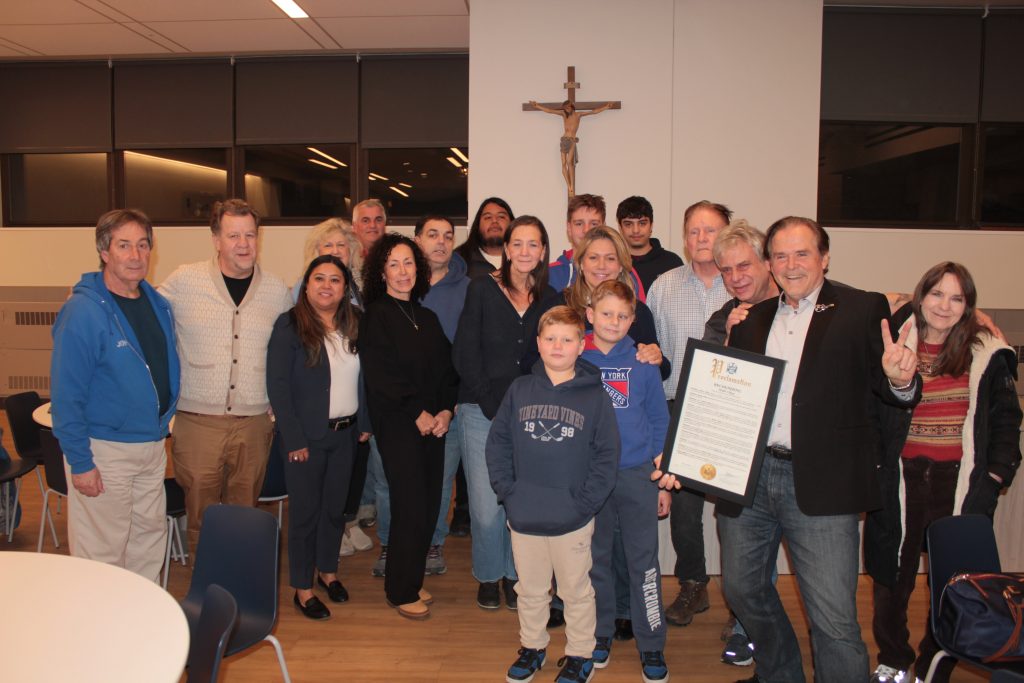
The meeting concluded with John from Senator Addabbo’s office presenting a proclamation honoring Middle Village’s 210th anniversary. “I proudly recognize and celebrate the 210th anniversary of Middle Village, honoring its rich history, resilient spirit and bright future,” he said. Upcoming community events include paper shredding and e-waste recycling drives, as well as a big band concert and Veterans Day barbecue.

Jamaica Colosseum Mall Vendors Told to Leave in 20 Days After Property Sold With No Heads-Up

By Christian Spencer

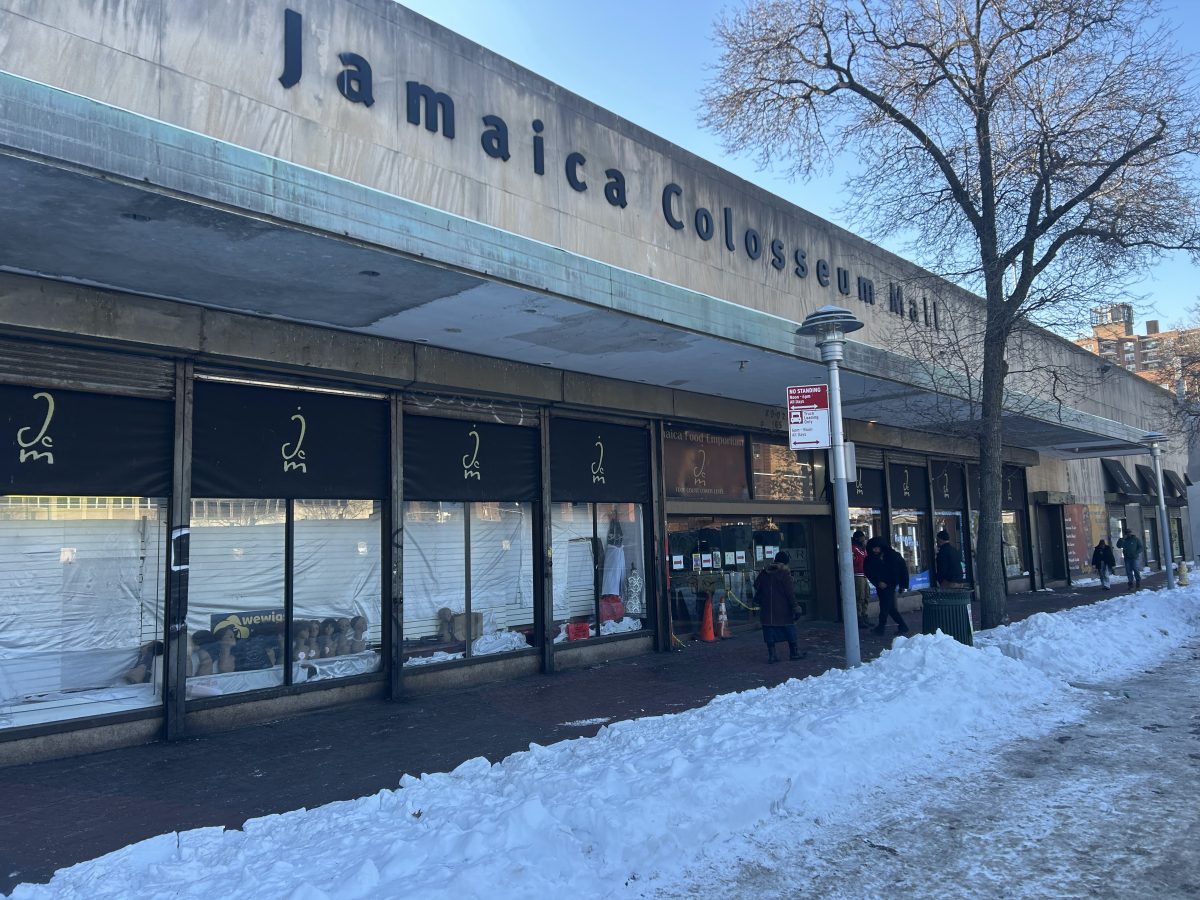
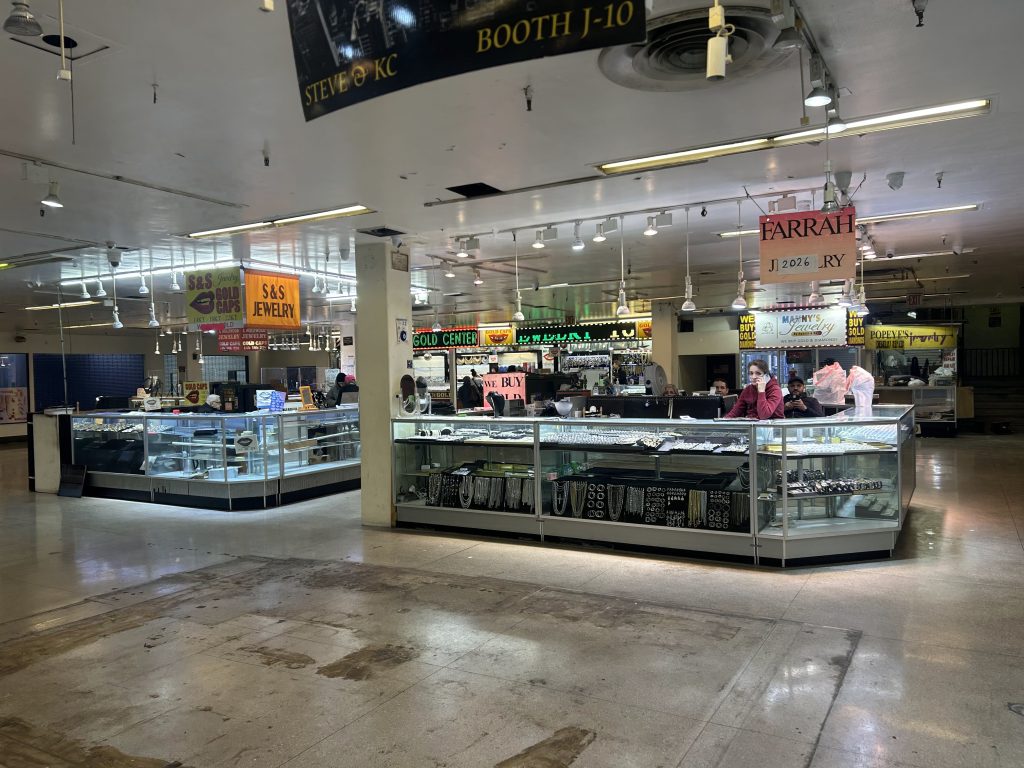
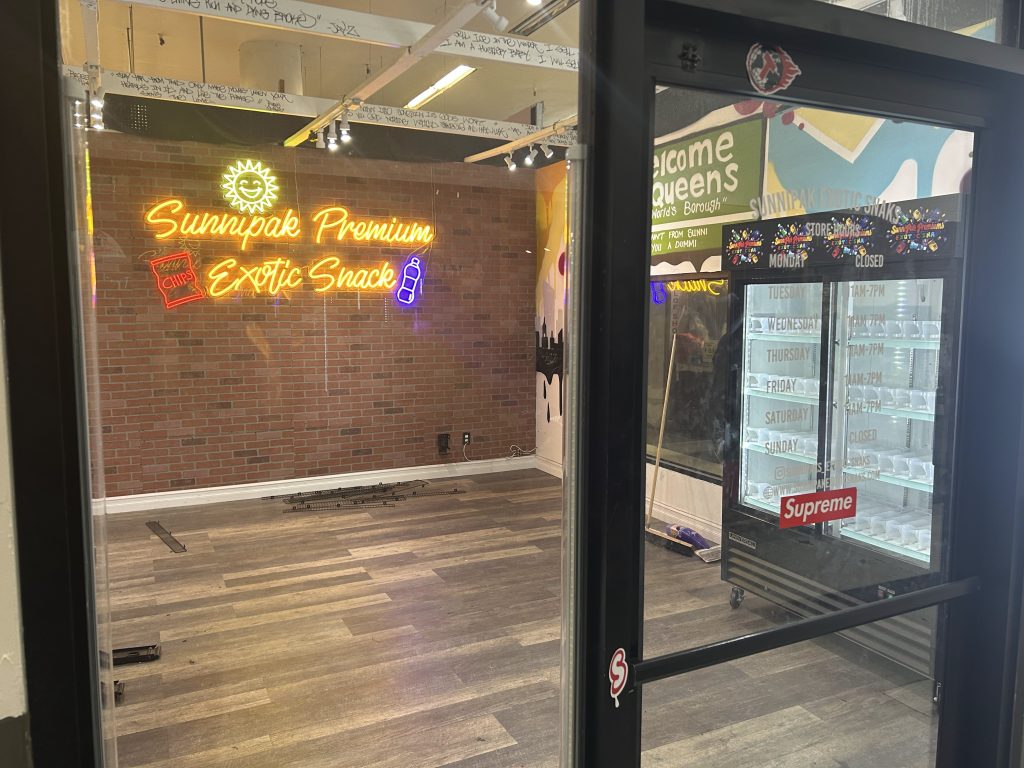
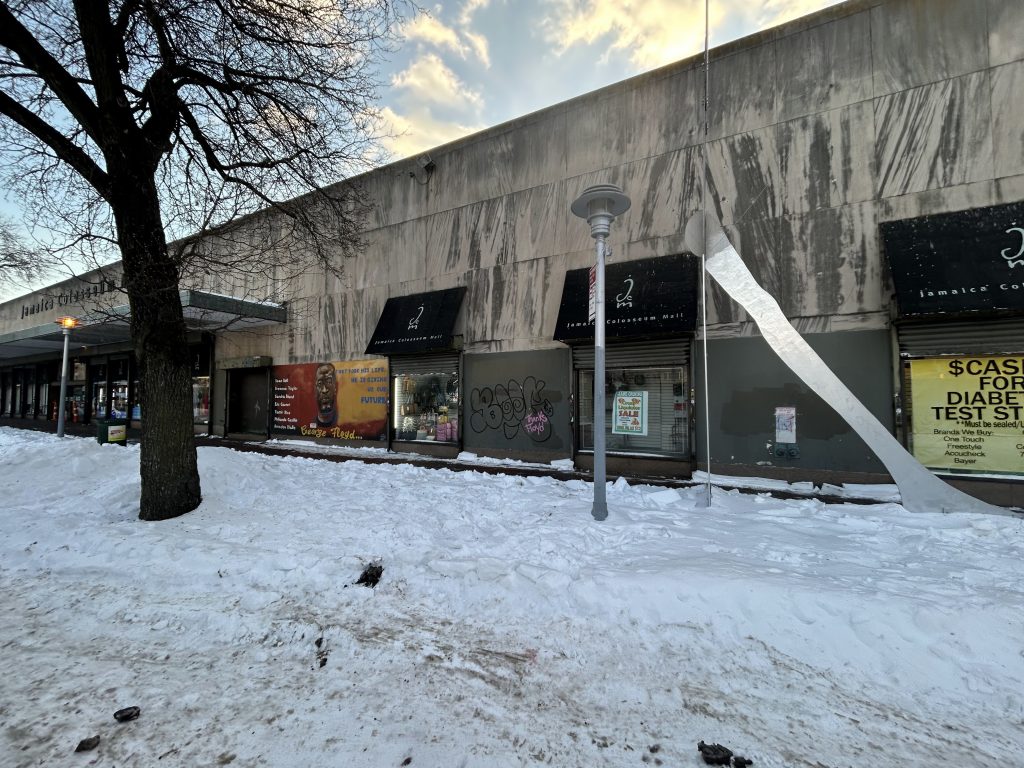
The sudden closure of the Jamaica Colosseum Mall has left longtime vendors—some of whom have operated there for more than three decades—confused, saddened, and angry after being given less than 20 days to relocate.

Once a former Macy’s in Downtown Jamaica, the Jamaica Colosseum Mall opened in 1984 as a retail destination for up-and-coming Black, Asian, and Jewish merchants.

Over the decades, it became a hub for small businesses and a cultural landmark where entrepreneurs built livelihoods, customer bases, and generational businesses near Jamaica Avenue.

According to several business owners, the mall’s owner, Allied Jamaica LLC, delivered a verbal notice on Jan. 6, informing tenants that the mall would be shutting down and that all businesses would be required to vacate by the end of the month.

Vendors said no formal written notice was provided.

That identity, vendors say, has steadily eroded in recent years as redevelopment projects reshaped the surrounding neighborhood and redirected foot traffic away from the mall.

Several merchants told The Queens Ledger that the MTA’s decision to relocate service from the old 165th Street Bus Terminal to a temporary terminal on 168th Street delivered a major blow to the steady stream of commuters who once sustained the mall’s shops.

“The Colosseum has been a beacon for small businesses for the last 40 years,” said Peter Lohani, son of Prakash Lohani, owner of Hitech Jewelers, which has operated inside the mall for 15 years. “Every business that you have patronized in the Colosseum has been a mom-and-pop and mostly immigrant business. This is a dying breed in New York City.”

“He’s absolutely right,” said William E. Salmon, owner of Bill Boutique, which has operated a clothing and fur business in the mall for the past 10 years. “They relocated all the traffic to Archer Street, to the Archer train station. So nothing comes this way.”

For years, Salmon said, commuters exiting nearby transit hubs would naturally spill into the mall, creating steady business throughout the day and into the night. “Many years ago, everything used to come down 169th Street and would just trickle into here,” he said. “They used to have nightlife. They don’t have that no more.”

The demolition of nearby buildings to make way for a large private redevelopment project further accelerated the mall’s decline, leaving once-busy corridors increasingly quiet.

The mall was already facing uncertainty during the pandemic, when shifting traffic patterns caused some loyal shoppers to drift away.

As foot traffic continued to fall, the property at 89-02 165th St. was listed for purchase or lease in July 2025, as reported by The Queens Chronicles, signaling the owner’s intent to transition the site to new uses. The mall had previously been listed for sale in 2015 at $45 million.

For vendors, the downturn created an impossible equation: how could they continue paying rent on time when fewer people were walking through the doors each day?

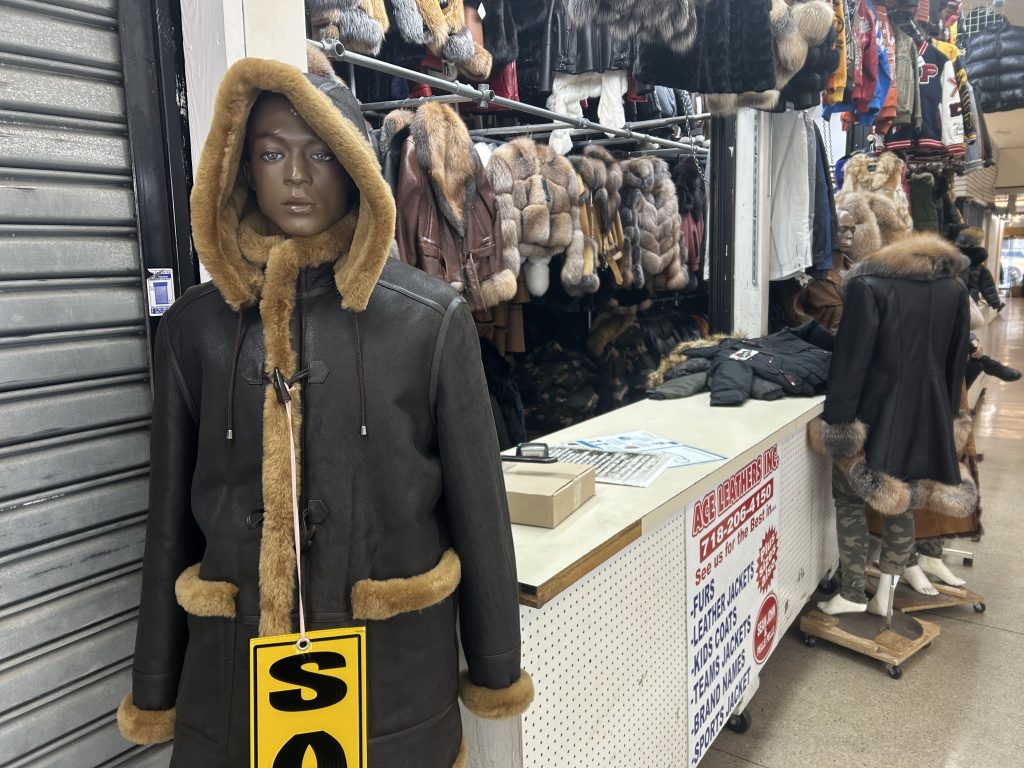
Brij Nayyar, owner of Ace Leather Inc., said the sudden shutdown came after years of mixed messages from management.

Despite persistent rumors that the mall might be sold, vendors were repeatedly reassured it would remain open.

“Every year we asked, because there were rumors,” Nayyar said. “They always told us, ‘No, it’s not sold. Don’t worry.’ And then all of a sudden, they give us 20 days and tell us to leave.”

Nayyar, who has operated his leather business in the mall for more than 33 years, said the timing of the closure was especially damaging.

Ace Leather’s business is seasonal, with winter traditionally bringing the strongest sales.

“The whole year I pay the rent, and this is the time I make money. Now they are throwing us out in the winter. We have nowhere to go in 20 days.”

Despite the mall’s reputation among some as a flea-market-style shopping center, Salmon said his business operated at a higher end and attracted customers from across the region.

“I sell furs from $2,000 up to $20,000,” he said. “Rappers have bought stuff from me. I never really felt that effect because I had high-end merchandise.”

Salmon said he had no direct relationship with the building’s owners and was contacted only by management regarding the closure.

He was told Jan. 31 would be the final day of sales, followed by a 60-day window to remove merchandise.

Now preparing to relocate his business to Lynbrook on Long Island, Salmon said he is focusing on what comes next rather than dwelling on what’s being lost. “Everything comes to an end,” he said. “They’re changing the whole climate around here. There’s really nothing you can do.”

“Some of the vendors I spoke to have announced that they’re going to retire from the business altogether,” Lohani said. “Others have already found new locations. And then there’s people like myself who have no clue where we’re gonna go.”

As the Jamaica Colosseum Mall prepares to shutter its doors, the space that once revitalized Downtown Jamaica after widespread disinvestment and abandonment in the 1970s and contributed to the borough’s hip-hop legacy, The Amsterdam News reported.

The mall played a notable role in hip-hop culture, hosting music videos by LL Cool J and Wu-Tang Clan, serving as a hangout for locals like 50 Cent and Run-DMC, Jay-Z was known to shop at the mall with his rap mentor Jaz-O, launching FUBU (For Us By Us, founded by Daymond John).

As the Jamaica Colosseum Mall prepares to shutter its doors, the space is expected to play a role in the broader redevelopment of Downtown Jamaica under the Jamaica Neighborhood Plan.

According to Tom Grech, president and CEO of the Queens Chamber of Commerce, the rezoning initiative will transform 230 blocks into 12,000 housing units and other infrastructure projects.

“I would not be surprised if it had a component of first-floor retail, but also some housing in that area,” Grech told the Chronicle.

The Queens Ledger has reached out to Jamaica Colosseum Mall administrators for comment.

Mayor Mamdani Announces New Immigrant Safeguards


Courtesy NYC.Gov

NYC Mayor Signs Order Strengthening Sanctuary Laws

By MOHAMED FARGHALY

mfarghaly@queensledger.com

Mayor Zohran Mamdani signed an executive order on February 6 reinforcing New York City’s sanctuary policies and launching a large-scale immigrant rights campaign, announcing the measures before hundreds of faith leaders at his administration’s first annual interfaith breakfast.

The event at the New York Public Library in Bryant Park brought together nearly 400 religious and community leaders from across the five boroughs. The breakfast, an annual tradition first established in 2002 under then-Mayor Michael Bloomberg, is intended to foster dialogue between City Hall and faith communities. This year’s program included prayers, musical performances and remarks from clergy representing multiple faith traditions, with a strong focus on immigration and federal enforcement actions.

Mamdani framed the order as a response to escalating immigration crackdowns nationwide and said the city would strengthen protections for immigrant residents while limiting cooperation with federal authorities.

“Across this country, day after day, we bear witness to cruelty that staggers the conscience. Masked agents, paid by our own tax dollars, violate the Constitution and visit terror upon our neighbors,” Mamdani said. “That is why this morning, I am signing an executive order that will strengthen our city’s protection of our fellow New Yorkers from abusive immigration enforcement. This order is a sweeping reaffirmation of our commitment to our immigrant neighbors.”

The executive order, known as Executive Order 13, establishes an interagency response committee to coordinate city actions during immigration-related crises and creates a centralized structure for communication across agencies. City officials said the committee is designed to ensure a whole-of-government response in the event of major federal immigration actions or other emergencies affecting immigrant communities.

The order also strengthens privacy protections intended to safeguard personal information collected by city agencies and requires audits to ensure compliance with existing sanctuary laws. Under the directive, information gathered by city agencies for city purposes cannot be shared with federal immigration authorities except when required by law. Each agency has 14 days to appoint a privacy officer, conduct training and certify compliance with rules limiting information sharing.

Executive Order 13 further states that federal immigration authorities may not enter city property without a judicial warrant. That includes schools, shelters, hospitals, parking facilities and other public spaces. Core agencies including the NYPD, Department of Correction, Department of Probation, Administration for Children’s Services and Department of Social Services must review their internal policies governing interactions with federal immigration authorities and publicly disclose any resulting changes.

“As ICE fosters a culture of suspicion and fear, let this city of strangers set an example for how to make the sorrows of others our own,” Mamdani said. “Let us offer a new path — one of defiance through compassion.”

Alongside the executive action, Mamdani announced a citywide “Know Your Rights” push aimed at educating residents about their legal protections during encounters with U.S. Immigration and Customs Enforcement. The campaign will distribute nearly 32,000 flyers and booklets in 10 languages through faith institutions across the city, targeting communities most affected by immigration enforcement.

The materials outline key rights, including the right to remain silent, the right to speak with an attorney and the right to request an interpreter. They also explain New York City’s sanctuary laws and provide information about the Mayor’s Office of Immigrant Affairs legal support hotline, which offers referrals to immigration legal assistance.

“We have also prepared 30,000 guides to New Yorkers’ rights in ten languages spoken by some of the most heavily targeted populations in our city, teaching our neighbors what to do if ICE comes for them,” Mamdani said. “I urge you to share these with your congregants — even those who are citizens, even those whom you think ICE may not target.”

Faith leaders in attendance were encouraged to distribute the materials widely and help ensure immigrant residents understand their rights when interacting with federal authorities. Mamdani told attendees that protecting vulnerable communities is a shared moral responsibility that extends beyond government.

He described the order as part of a broader effort to maintain trust between immigrant New Yorkers and city institutions, saying residents should not fear accessing services because of their status. City officials said the measures are intended to reinforce New York’s longstanding sanctuary framework and signal continued resistance to federal overreach in local immigration matters.

“ICE is more than a rogue agency — it is a manifestation of the abuse of power,” Mamdani said. “And it is also new. It was founded only in 2002. Four Mayors ago, it did not exist. Its wrongs need not be treated as inevitable or inherited. In fact, there is no reforming something so rotten and base.”

New York City Mayor Zohran Mamdani hosts the first annual Interfaith Breakfast of his administration at the New York Public Library on Friday, February 6, 2026. Michael Appleton/Mayoral Photography Office

LaGuardia Wins Innovation Grant To Boost Adult Student Success


Courtesy Laguardia Community College

MOHAMED FARGHALY

mfarghaly@queensledger.com

LaGuardia Community College has received a new grant aimed at helping adult students stay on track toward graduation, part of a broader citywide effort to remove barriers that disproportionately affect historically underrepresented college students.

The Long Island City-based campus was awarded $94,342 from the College Completion Innovation Fund, a collaborative education fund that partners with community-based organizations and colleges to improve student persistence and degree completion. The money will support the creation of an Adult Learner Evening Hub, a centralized space offering academic and support services tailored to students who attend classes after traditional business hours.

Since 2015, CCIF has invested more than $8 million in 34 projects across 17 City University of New York campuses and 11 community-based organizations. Most students served by the initiatives are low-income, first-generation college students, students of color and others traditionally underrepresented among degree holders.

The fund’s vision calls for a New York City where students can attain a postsecondary degree regardless of race, ZIP code or socioeconomic status.
At LaGuardia, college leaders say the Evening Hub is a response to shifting student demographics and longstanding access gaps. Adult learners are becoming the majority of the student population, according to administrators, many of whom balance coursework with jobs and family responsibilities.

Dr. Marsha Oropeza, director of Adult Learner Success and Credit for Prior Learning in Academic Affairs and principal investigator for the project, said the idea grew directly out of conversations with adult students.

“While this initiative is focused on adult learners enrolled in degree programs, the concept for the Adult Learner Evening Hub emerged directly from the CPL Office’s work with adult students across both degree and workforce pathways,” said Dr. Oropeza. “Through this work, we have consistently heard from adult learners, especially those transitioning from workforce training and certificate programs, that once they enter degree programs, they struggle to access critical services because most supports are not available in the evening.”


She said the demographic shift, combined with the implementation of the New York State Opportunity Promise, requires colleges to adapt quickly.

“This shift, coupled with the implementation of the New York State Opportunity Promise (NYSOP), creates both an opportunity for the college to respond differently and immediately,” she said. “Students must be supported in ways that reflect their lived realities.”

The Adult Learner Evening Hub is designed to reduce structural barriers that often cause students to stop out before completing their degrees. By aligning advising and student services with evening schedules, the college aims to improve persistence and strengthen enrollment among working adults.

“By intentionally aligning evening academic and student support services with adult learners’ schedules, the Hub will strengthen enrollment, improve persistence, and reinforce LaGuardia’s role as a college built for working adults not just in principle, but in practice,” she said.

Planned services include academic advising, credit for prior learning evaluations, tutoring, faculty office hours, career counseling and basic-needs assistance. The college also hopes to provide rotating evening access to offices such as the registrar, bursar and financial aid.

“Services we hope to include in the work through this planning grant will include academic advising, Credit for Prior Learning (CPL), tutoring, faculty office hours, career counseling, basic needs support, and rotating access to student services such as the registrar, bursar, and financial aid,” Dr. Oropeza said.

Although the hub focuses on degree-seeking adult learners, administrators say it builds on LaGuardia’s workforce-to-credit pathways, where students often begin with training or certificate programs before transitioning into associate degree tracks.

“Many adult students begin at the college through ACE workforce training and certificate programs and later transition into degree programs through our articulation to credit agreements,” she said. “The CPL Office has recognized that these students require continued, holistic support once they cross into the credit side, and the Hub is designed to ensure that continuity.”

CCIF officials say projects like LaGuardia’s reflect the fund’s broader mission to dismantle institutional barriers, promote innovation and strengthen collaboration across New York City’s educational ecosystem. In addition to supporting new programs, the fund advocates for policy changes and encourages data sharing to improve transparency and student outcomes.

LaGuardia Community College, a Hispanic-Serving Institution founded in 1971, offers more than 50 associate degree programs and over 65 continuing education options. Part of the City University of New York system, the college serves students from Queens and across the city, with a longstanding focus on advancing socioeconomic mobility for underserved communities.

Music for the Community

During a frigid January, a collaboration invites locals to come together and enjoy an affordable outing.

By Malak Kassem

A magical scene unfolds every Thursday night in Brooklyn this January. Underneath the Brooklyn Bridge and directly across a glittering Manhattan skyline, dozens of people gather at Roebling Rink at Brooklyn Bridge Park from 7 p.m. through 9 p.m.to skate and listen to live performers.

Brooklyn Bridge Park and Sofar Sounds collaborated to put on pop-up concerts that feature rising New York-based artists.

“We [at Brooklyn Bridge Park] always think of ourselves as a local park and a park for New York City,” said Rachel Karpf, the chief programming officer. “[It] is also a park where people visiting New York City come to, [and] we always want to be offering things for all of them.”

She is particularly proud that the rink is low-cost. A skating ticket goes for $16. Attending the pop-up concerts throughout January is free.

It [the collaboration] brought in some new people,” explained Roebling Rink’s general manager Scott Cudmore. He believes that all tickets have been sold out for the past three Thursdays. “We have had several walk-ins, people are outside enjoying their stroll and they hear the music and they decide to go upstairs and also enjoy it.”

Sofar Music’s New York City curator, Lexie Lieberthal explained that the company operates in more than 400 global cities to put on live performances in local areas.

“We are in small businesses and residential areas,” said Lieberthal. “Sometimes we have partnerships and brand collaborations–and this was one of them.”

“It’s a way to bring music back into these kinds of spaces where we all gather and make community,” Lieberthal explained.

All Sofar Music artists apply to get into the company’s system. Curators then select the right artist for each individual gig.

On Jan 22., Caroline Sky and Brandon Volel each played 20-minute sets for the intimate and energetic Brooklyn crowd.

“Getting performer [s] like the ones tonight make it a really magical evening,” said Karpf. “That is what we are all about.”

As attendees cheered on performances while putting on their skates, some say they didn’t even know who would be performing, but decided to show up anyway.

Brooklyn residents Rebecca Lumbantobing and her skating partner, Chris Clark had originally planned to skate at Prospect Park, but they got off work too late to catch their hours. Clark explained that he knew there would be music, “I didn’t know who it was but I thought it would be nice to have the view of the city while skating.”

“I think it makes the experience more special and it’s great to support local artists and have that be the backdrop of the experience,” said Rebecca Lumbantobing, a Brooklyn resident.

The next and final event will be held on Jan 29. Roebling Rink closes on Feb 1.

Queens Sen. Michael Gianaris Will Not Seek Reelection


MOHAMED FARGHALY

mfarghaly@queensledger.com

Queens state Sen. Michael Gianaris, the chamber’s deputy majority leader and one of New York City’s most powerful lawmakers in Albany, announced Sunday he will not seek reelection in 2026, ending a legislative career that spans more than 25 years.

Gianaris, who represents western Queens neighborhoods including Astoria, Woodside, Sunnyside, Elmhurst, Maspeth and Ridgewood, first won election to the state Assembly in 2000 and later the Senate in 2010. He has served as the highest-ranking New York City member of the Senate for the past eight years and helped lead Democrats to a durable governing majority.

In a statement, Gianaris said the decision was driven by a desire to focus on his family after decades in public life.

“After more than 25 years representing the people of western Queens in the Senate and Assembly, I have decided not to seek re-election in 2026,” he said.

He described his time in leadership as the highlight of his career, pointing to his role in the Senate’s largest-ever Democratic majority.

“Serving as Deputy Leader of the State Senate’s largest-ever majority, and as the highest-ranking Senator from New York City for the past eight years, has been more rewarding than I could have possibly imagined,” Gianaris said. “Being part of the leadership team that made these achievements possible will certainly be the greatest highlight of my career.”

Gianaris recalled entering the Senate when Democrats were politically weakened and financially strained.

“When I was first elected to the Senate, the conference had just lost the majority and the Democratic Senate Campaign Committee was more than $3 million in debt,” he said. “Eight years later, alongside Senate Leader Andrea Stewart-Cousins and my amazing colleagues, we overcame obstacles that most believed insurmountable, including opposition from leaders of our own party.”

After Democrats secured the majority in 2019, lawmakers pushed through a sweeping legislative agenda.

“Beginning in 2019 when we secured the majority, we embarked on an unprecedented and unrelenting rush of legislative achievements unlikely to be repeated — celebrated advancements on issues such as voting rights, tenant protections, immigrant safeguards, reproductive rights, the environment, criminal law reforms, animal rights, and support for working people, to name just a few,” Gianaris said.

He said the demands of legislative leadership and campaigning left little time for family life, which ultimately shaped his decision.

“While the State Senate’s future is in good hands with the current members of the Democratic conference, it is time for me to embrace a new role as the best father I can be,” he said. “Children grow in the blink of an eye and mine are no exception.”

“The fact is that working in my district, leading the majority’s efforts on the floor of the Senate, and steering our conference’s campaign arm are intensely time-consuming tasks. But so is being a husband and father,” Gianaris added. “I cherish my time with my family as much as any political success I have experienced, and after a quarter century as a legislator I simply do not want to miss another moment.”

During his tenure, Gianaris also backed legislation recognizing Middle Eastern and North African residents as a distinct demographic category in New York’s data collection, a change advocates said would improve visibility and access to services for MENA communities. He championed the measure alongside Assemblymember Jessica González-Rojas, arguing that more accurate demographic data would allow the state to better tailor policy. The law separated MENA residents from the broader “white” category in state records, addressing what supporters described as years of underrepresentation.

Gianaris worked closely with fellow Queens lawmaker Zohran Mamdani on issues affecting immigrant and working-class communities, including support for the MENA data bill and transit affordability efforts. Mamdani framed the demographic change as a civil rights issue. “For far too long, Middle Eastern and North African New Yorkers have been afforded data disaggregation only in matters of surveillance and suspicion,” Mamdani said at a rally last year. “The time has come for that to be applied for the purposes of state support, instead of the policy of erasure that we have today.”

Reflecting on public service, Gianaris acknowledged the personal toll of elected office.

“Public service is a tremendous and often thankless sacrifice, even more so in today’s divisive climate,” he said. “I honor all those who dedicate their lives to making things better for their neighbors.”

He thanked colleagues, staff and constituents, singling out Senate Majority Leader Andrea Stewart-Cousins and the voters of western Queens.

“All my thanks to the many legislators and friends in both legislative houses with whom I served over the years, to the talented staff who have worked with me, to Andrea Stewart-Cousins — the greatest Majority Leader the Senate has ever known, and especially to the people of western Queens who placed their faith in me even as the neighborhood went through multiple evolutions over many years,” Gianaris said.

“Most of all I am grateful to my family, who also bear the burdens associated with having a loved one in elected office,” he added. “Leaving public service is obviously a bittersweet moment, but it is made better knowing I will now have more time with them.”

His departure is expected to trigger a competitive Democratic primary in a district where the party’s nominee is heavily favored in the general election.

Fill the Form for Events, Advertisement or Business Listing