
Cold Never Bothered Them Anyway

Meet the Astoria Trash Club, a group of neighbors that spends their Sundays cleaning Astoria’s Streets.

By MARYAM RAHAMAN

A dozen people walked like a group of polite grade schoolers down Steinway Avenue with mechanical trash grabbers in hand. With the slightly melted snow banks narrowing the sidewalk, they were forced to walk single file—pausing and shuffling to the side at times to let passersby through. For over an hour, they weaved onto roads lined with grey slush and on top of ice patches all to collect stray pieces of trash. 

Each piece went into a garbage bag-lined cart, displaying the name Astoria Trash Club and a small garbage can logo on the front. One volunteer picked up a loose Hannah Montana pouch, pondered whether it counted as trash, and then gently placed the pouch in the cart. Another cracked into a hardened pile of snow to claw out an empty vodka shooter, and then returned to grab the cap which had initially escaped. A piece of plastic was so stubbornly buried that it took three trash grabbers plucking at it until it was successfully recovered. 

The group, inspired by the Greenpoint Trash Club, was founded last September by Victoria Chung as a low-stakes way to give back to the community and meet new people. “Pick up trash, pick up friends” is the tagline used to announce weekend clean-ups on Instagram. To support local business, the club meets up in front of restaurants and cafes to clean before sharing a meal or coffee together. New members need only show. All gloves and trash grabbers are provided. 

After blizzard conditions canceled last week’s meetup, organizers scrambled to solve the problem of still freezing temperatures and possible snowfall. 

“Sometimes when stuff like this happens, the momentum dies down,” organizer Paul Langis said. “A few weeks ago, we had 50 volunteers despite the cold. I think that it’s good to keep the momentum and give people options.” 
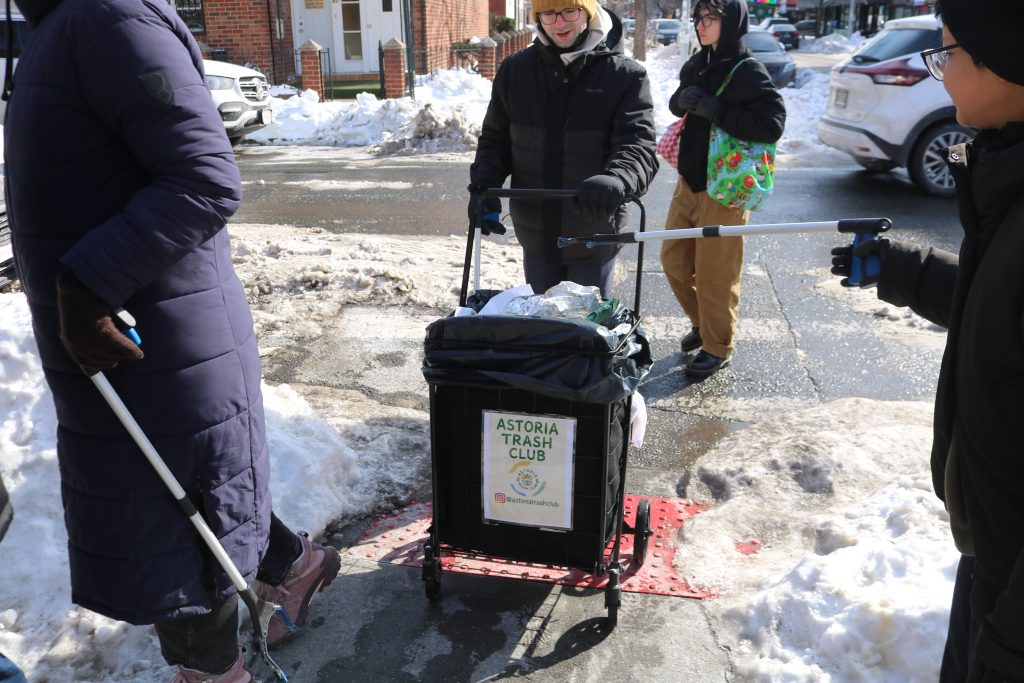
Volunteers use “trash grabbers” and have lunch together after the cleanup. Photo by Maryam Rahaman.

When polled, the majority of group members voted in favor of a trash clean-up. One polling option titled “I’m down for anything, the snow and cold do not bother me” gained eight votes. Since Langis and fellow trash club organizer Kevin Kim are both involved with the Astoria Food Pantry, they arranged for members to meet there. 

Langis greeted members working inside and explained their mission: sorting through twenty toddler-sized neon trash bags of donated winter coats. Outside the “adventurous” group, as Langis called them, started on their regular clean-up journey. Even though the “feels like” temperature was 2 degrees, a dozen volunteers showed up. 

The club counts among its ranks native New Yorkers and Astoria newcomers alike. Kim, who was born and raised in Astoria, pointed out the block he grew up on as volunteers relieved it of trash. A member of several different clubs in addition to Trash Club, Kim described himself as never being at home. 

“It’s given me a chance to reconnect to the place I grew up in,” Kim said. Nowadays, he says ‘hi’ to neighbors he knows from clubs, rather than just seeing Astoria as a place to come back to after work.

“We’ve had people cheer for us,” Kim continued. That’s no exaggeration. After a passer-by on a green bike saw the group, he struck up a conversation—telling them “That’s awesome,” and that he’d check out the club’s Instagram. While passing one building, a man on his doorstep asked if they could close his trunk for him. 

When the outdoors group got back to the pantry, about thirty women walked by. Some of them said, “Hi trash club!” It was Girls Who Walk Queens, another club with an aim of building connections in the borough. 

On average, the Astoria Trash Club usually collects three to four bags of trash with two carts in an hour. For this clean-up, staying out longer in the cold helped them to grab three bags with one cart. By the time the outside group returned, the inside group had sorted dozens of coats by size and stored them neatly into a closet. 

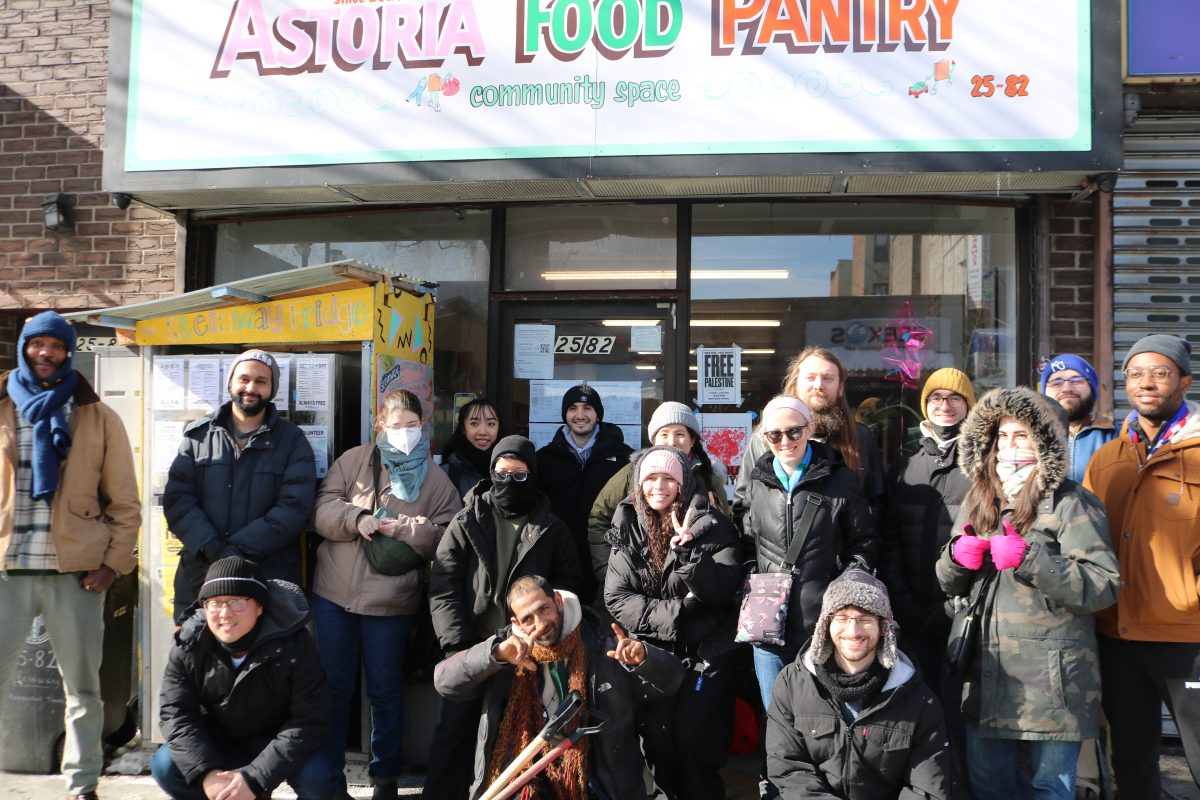
Before heading out to eat together, the groups combined to take a photo outside the pantry. A man shoveling the block thanked them for their work and asked them to also help shovel the neighborhood when they got a chance. He was invited into the photo, surrounded by a few members making hearts and peace signs. 

It’s unclear when temperatures will next be above freezing. Langis is currently taking feedback on whether the group should continue with the hybrid model. Organizers are looking forward to watching the group grow. Summer, they say, holds “endless possibilities.” 

“It’s really special to see Astoria feel more connected, almost like one big family,” Kim said. “At the end of the day, I just want to keep giving back to the community that raised me since birth and helped me become who I am today.”
Queens Boxing Gym Turns Training Into Family

Universal Boxing Gym Keeps A Community Moving

By MOHAMED FARGHALY

mfarghaly@queensledger.com

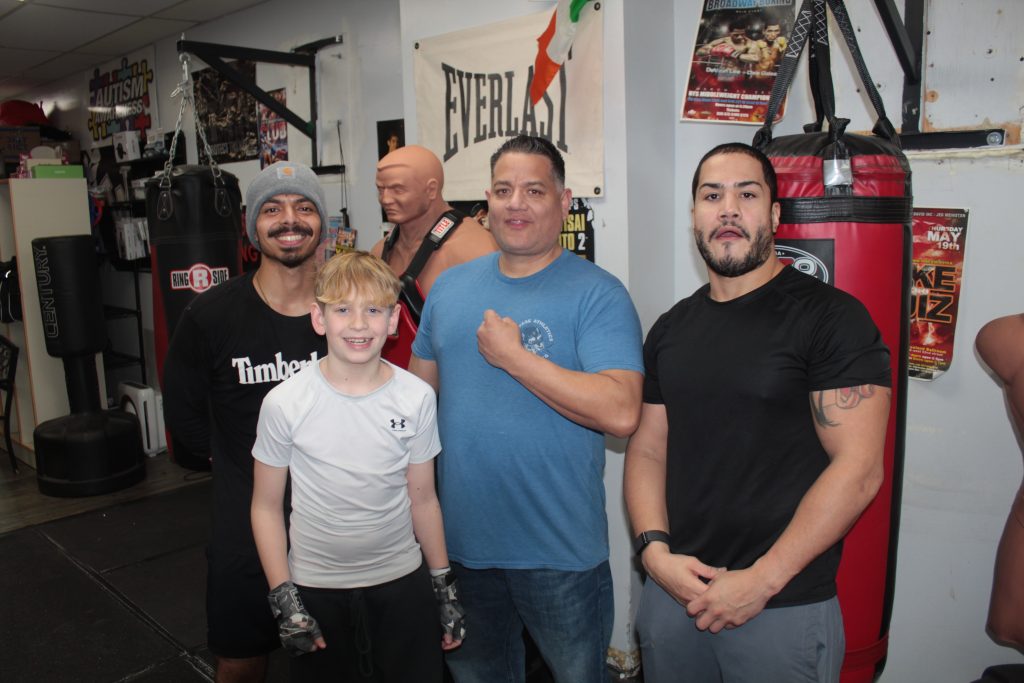
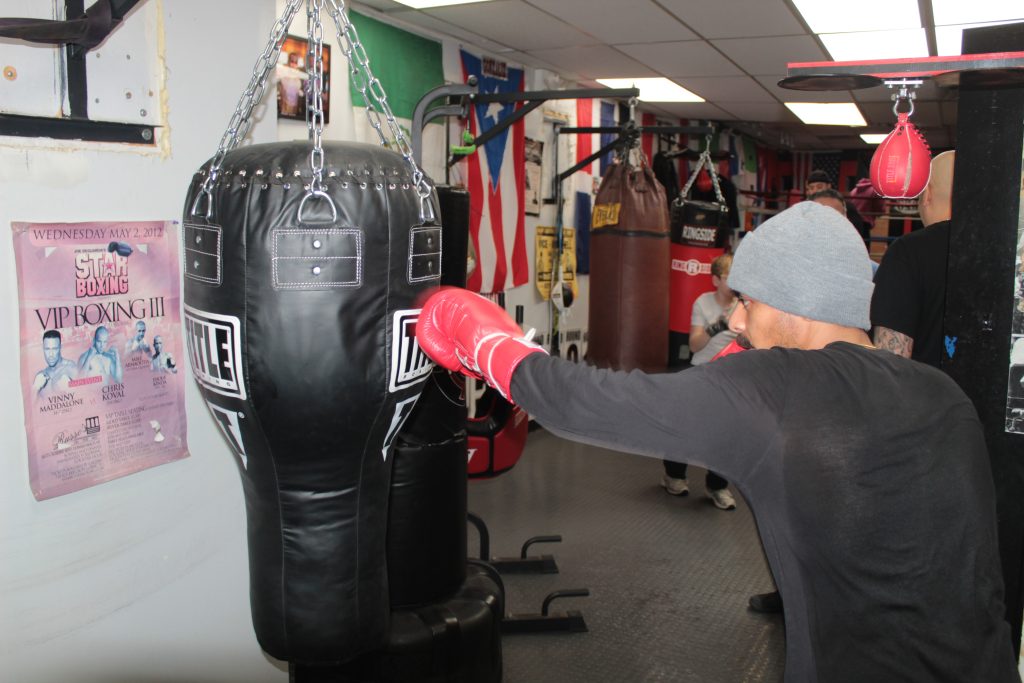
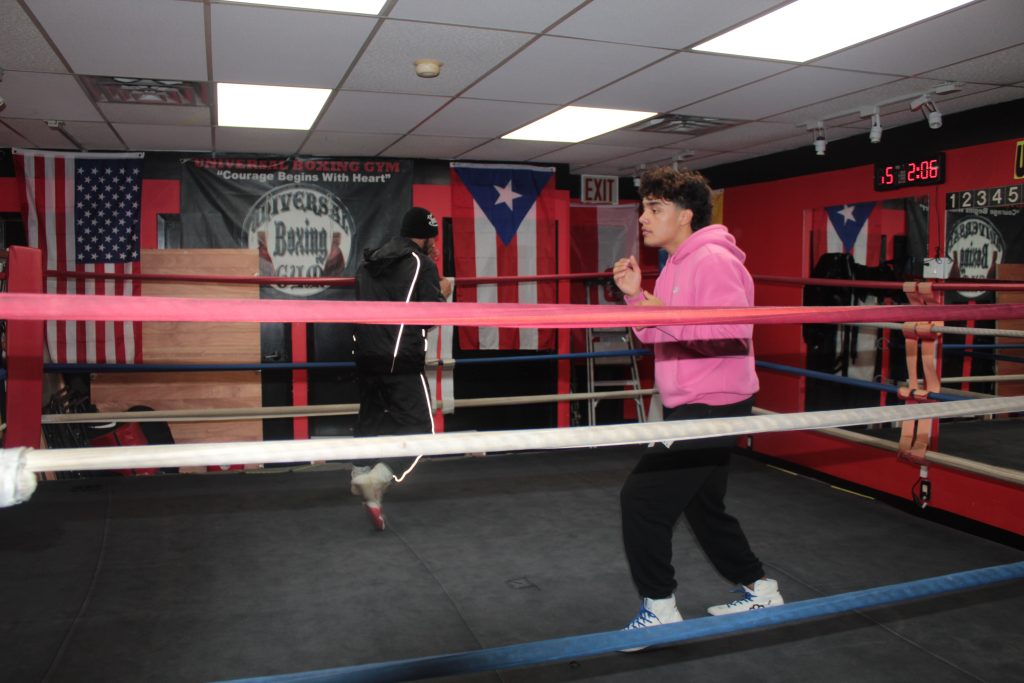
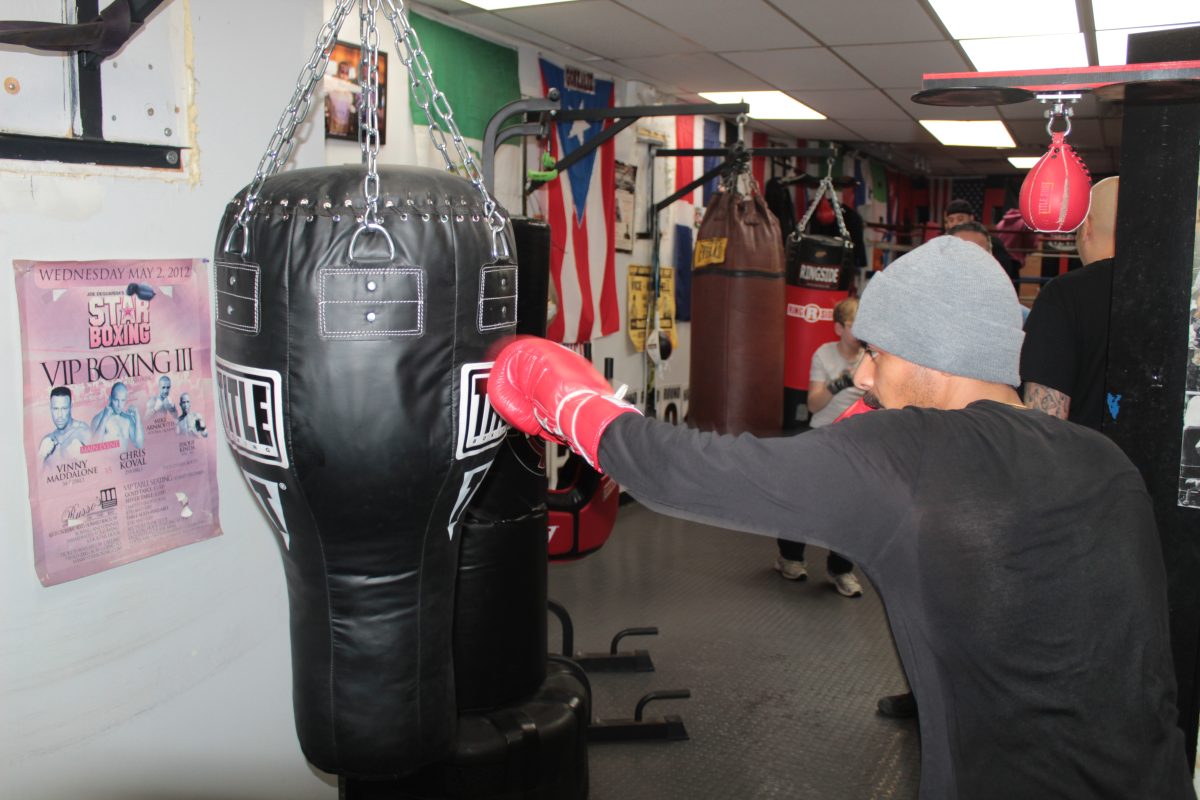
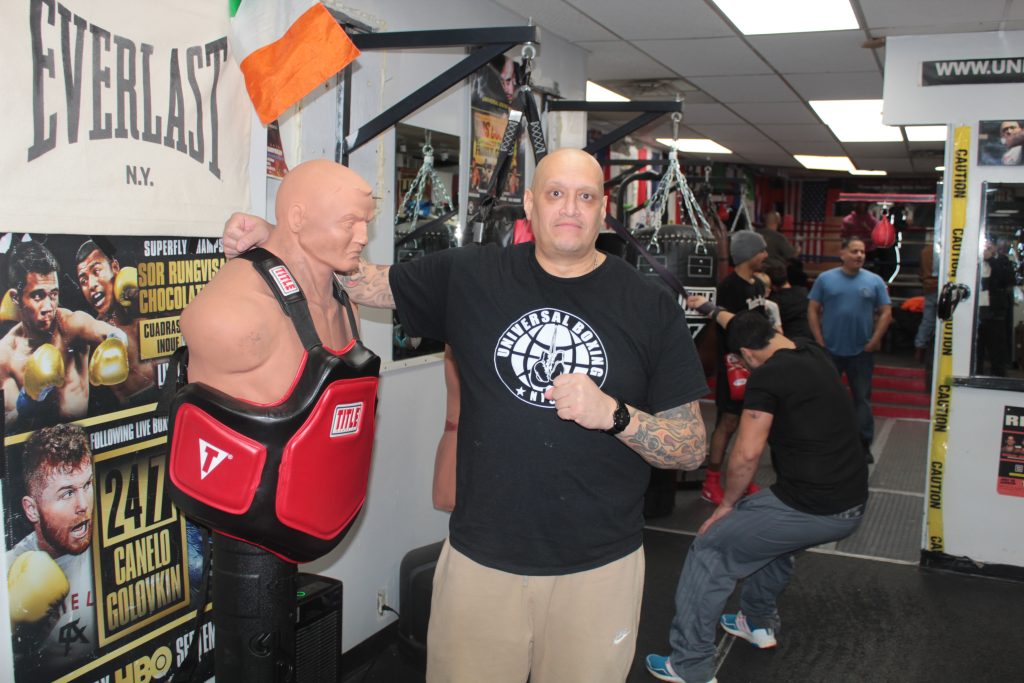
Inside a 2,500-square-foot storefront on Dry Harbor Road, the steady rhythm of gloves hitting heavy bags mixes with laughter from children and instructions echoing across a full-sized boxing ring. Universal Boxing Gym is equal parts training ground and neighborhood gathering space, drawing professional fighters, beginners and families from across Queens.

Owner Moises Roman says boxing has shaped his life since early childhood. Raised in Paterson, New Jersey, Roman grew up in a large Puerto Rican family where the sport was a constant presence.

“My brothers boxed,” Roman said. “I’ve been in the gym since I was five years old.”

After moving to New York and training locally, Roman began giving pointers to other fighters. Fellow boxers encouraged him to coach, a suggestion he said he “took and ran with,” eventually launching Universal Boxing in 2006. The gym has operated under the same name ever since, relocating over the years before settling in Middle Village about four years ago.

Roman chose the neighborhood in part because he lived nearby and wanted to build something local. With help from a fighter’s family in real estate, he found a landlord willing to take a chance on a boxing gym that promised after-school programs and youth training. The space was built almost entirely by Roman and his fighters.

“We did everything in-house,” he said. “I broke through the walls, reinforced them, put the floors down, built the desk, built the ring. It’s all out-of-pocket money. No funding, no loans.”

The gym now includes heavy bags, speed bags, double-end bags, an uppercut station and a basement outfitted for strength and conditioning with sleds, ropes, bikes and treadmills. Classes run for children as young as five, teenagers, adults and competitive fighters. On Saturdays, peewee sessions can draw dozens of kids from the neighborhood.

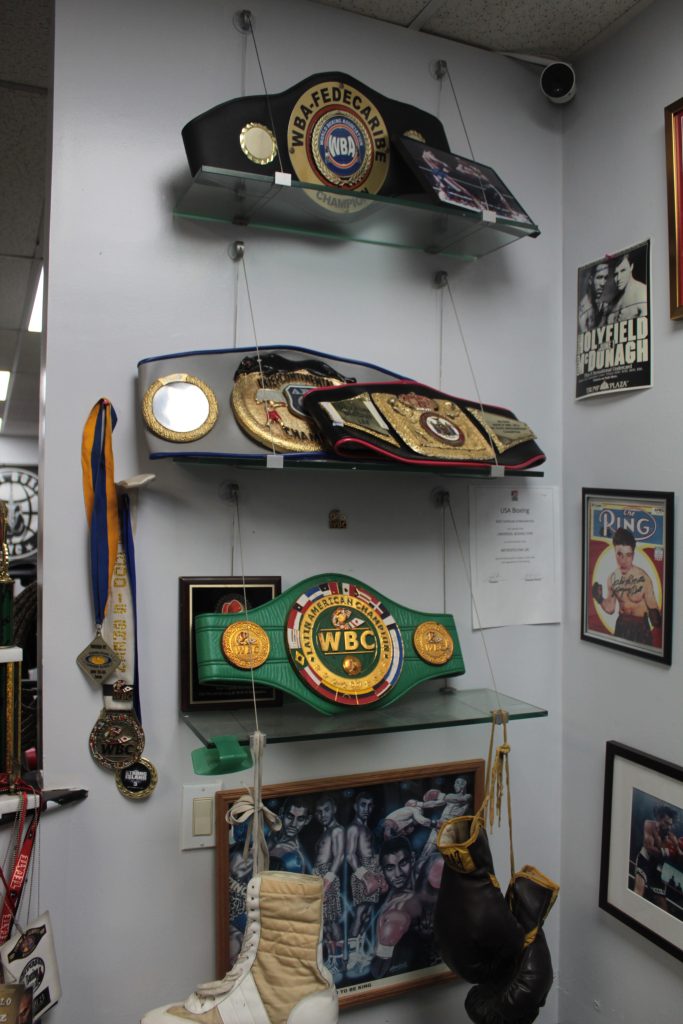
Roman describes the gym as a pipeline that has carried some students from childhood to professional careers.

“The amateur kids from 2007 are actually pros now, or they’re coaches,” he said. “Universal Boxing is literally a tight-knit family.”

One of those fighters, Danny Gonzales, joined at 16 unable to jump rope and unsure of himself, Roman said. Two decades later, Gonzales has fought on major cards, including at Barclays Center.

“Having a kid from 16 to now 36 — he’s been with me 20 years,” Roman said.

The gym serves a wide cross-section of the community, from professional fighters preparing for bouts to retirees looking for fitness. Roman said it’s common to see police officers, sanitation workers, students and parents training side by side.

Roman said boxing has long been rooted in blue-collar culture, a sport where working-class fighters see a rare chance to change their lives through discipline, toughness and opportunity.

“You’re not excluded,” he said. “If you’ve never boxed ever, you come in and we’re going to take care of you just like if you boxed 20 fights.”

For 17-year-old Leo, who has trained at the gym for about a year, the atmosphere made starting easier.

“It’s definitely friendly for people who want to start boxing,” he said. “I started boxing here, and it felt welcoming when I first came here.”

That sense of community was tested last summer when a four-alarm fire tore through a row of businesses on Dry Harbor Road, causing heavy smoke and water damage inside the gym and forcing a monthlong closure. Roman said the aftermath was overwhelming.

“The tiles collapsed, there was water damage, and the smoke was drawn on the floors and walls,” he said. “I’d never seen anything like it.”

He said neighbors and local businesses stepped in with donations to help rebuild. Fighters and coaches ripped out damaged materials, installed new flooring and rewired lighting themselves.

“There’s nothing like this neighborhood,” Roman said. “They held me with open arms here. I love this community.”

Roman balances running the gym with a longtime career working in a doorman building in Manhattan, relying on a coaching staff that includes retired police officers and teachers to keep classes running. Despite the long hours, he said the reward comes from watching shy children grow confident and connected.

“When you see a kid walk in shy, and by the third week he’s saying ‘What’s up, coach?’ and running with friends, it’s almost better than earning money,” he said. “You feel like you’re doing something for the community.”

Looking ahead, the gym is preparing fighters for amateur tournaments and upcoming professional bouts. But Roman says competition is only part of the mission. For many members, boxing is an outlet for stress and a path to discipline.

“You fuel your energy the positive way,” he said. “You have a stressful day at work, you burn out on that bag, you go home and feel like you averted some drastic drama.”

At Universal Boxing Gym, that release, and the relationships built around it, keep the doors open as much as any title belt.

Interested readers can visit Universal Boxing Gym in Middle Village at 64-64 Dry Harbor Rd for more information or contact the gym directly at UBGNYC@gmail.com.

Snowstorm Leaves Queens Streets Blocked and Cars Stranded

Queens Residents Frustrated After Storm Fern Buries Cars

By MOHAMED FARGHALY

mfarghaly@queensledger.com

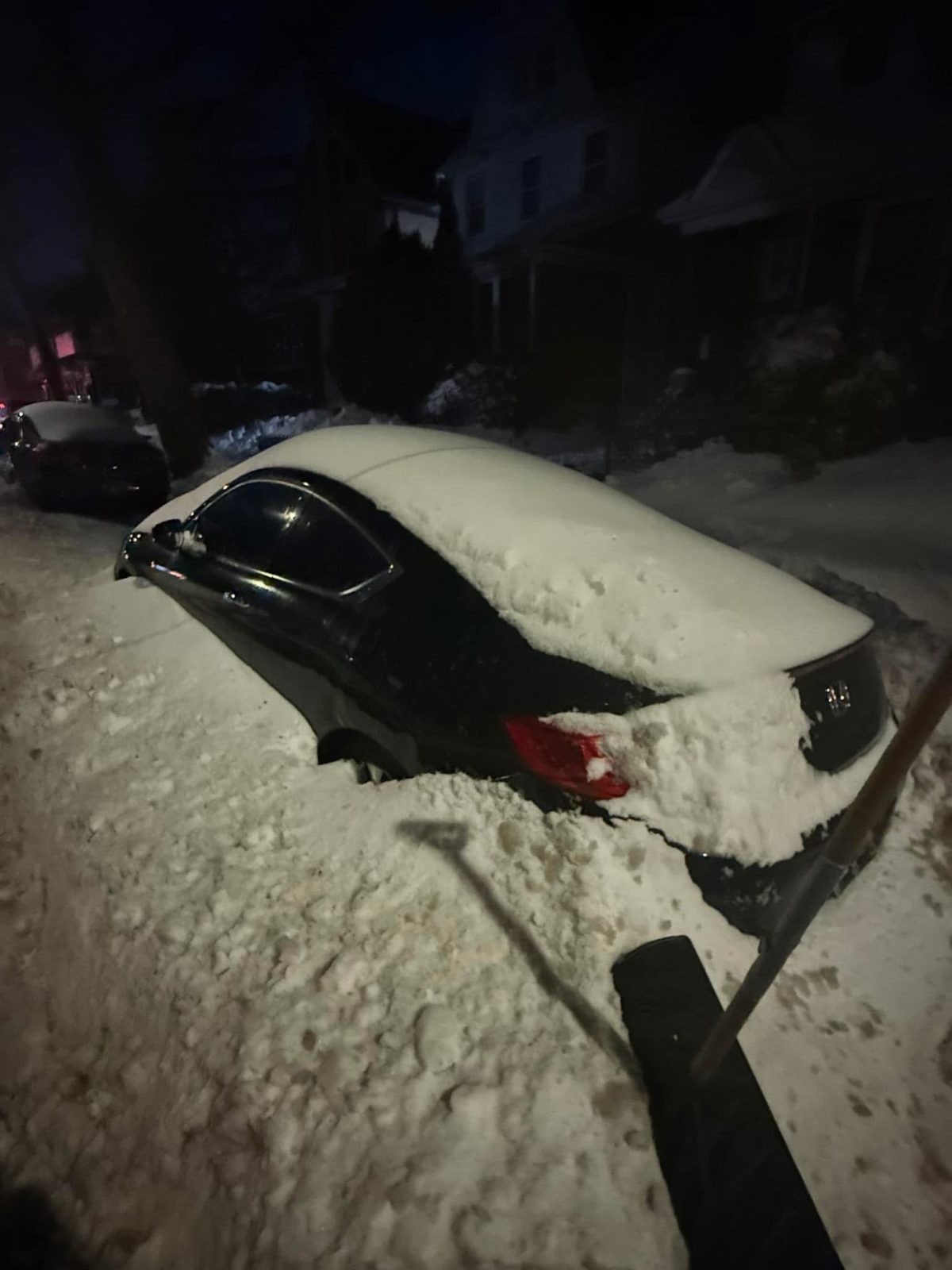
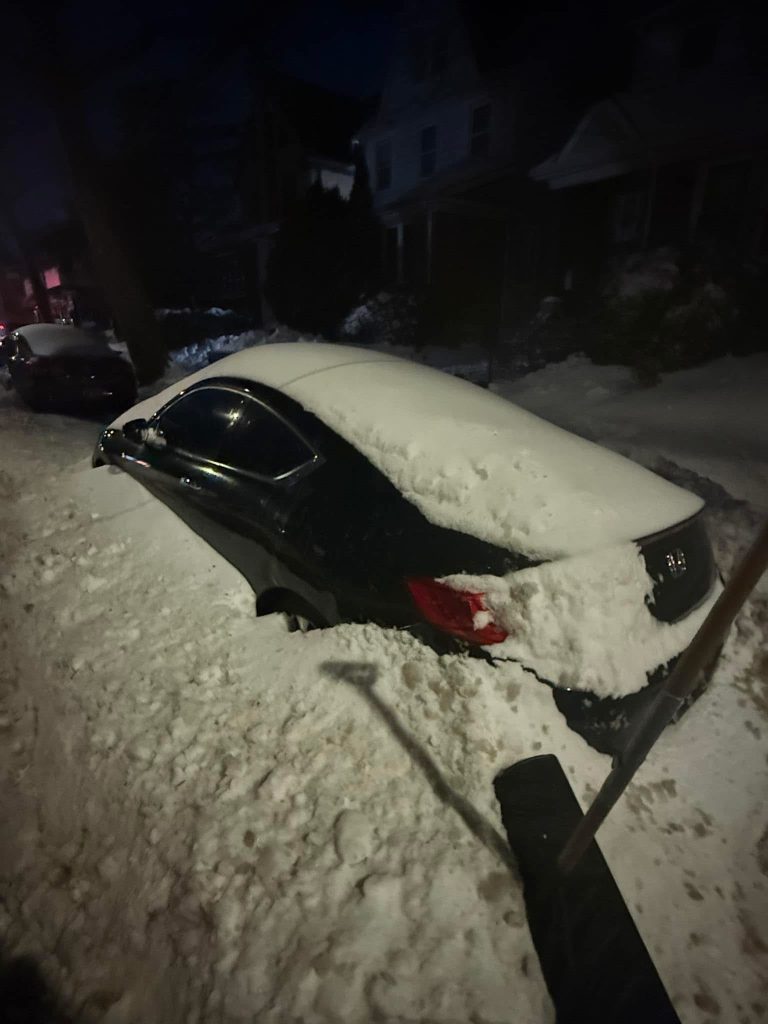
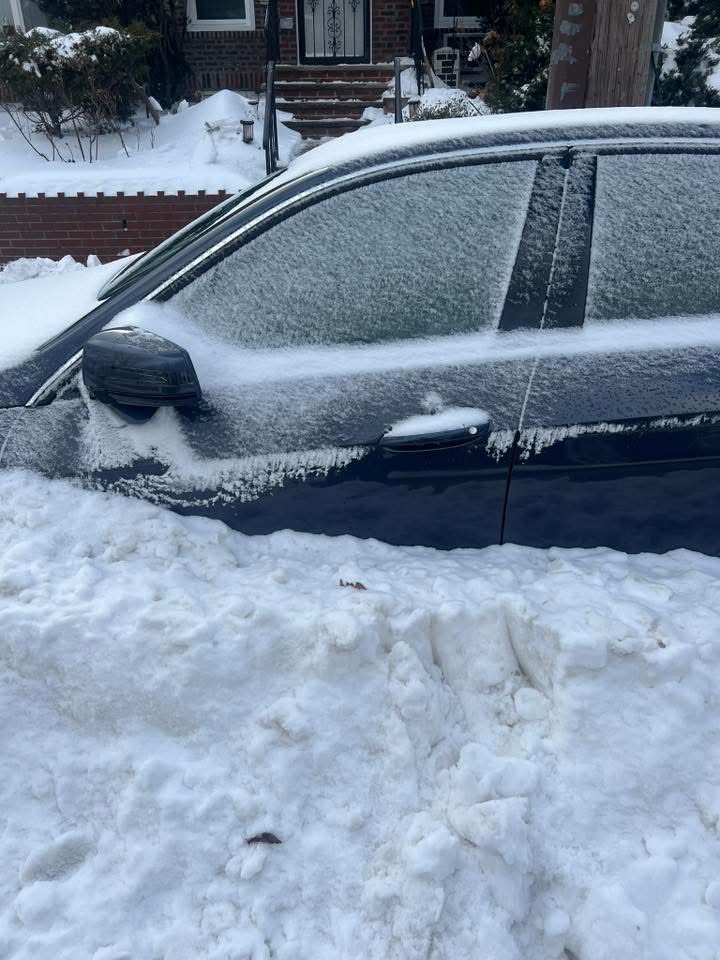
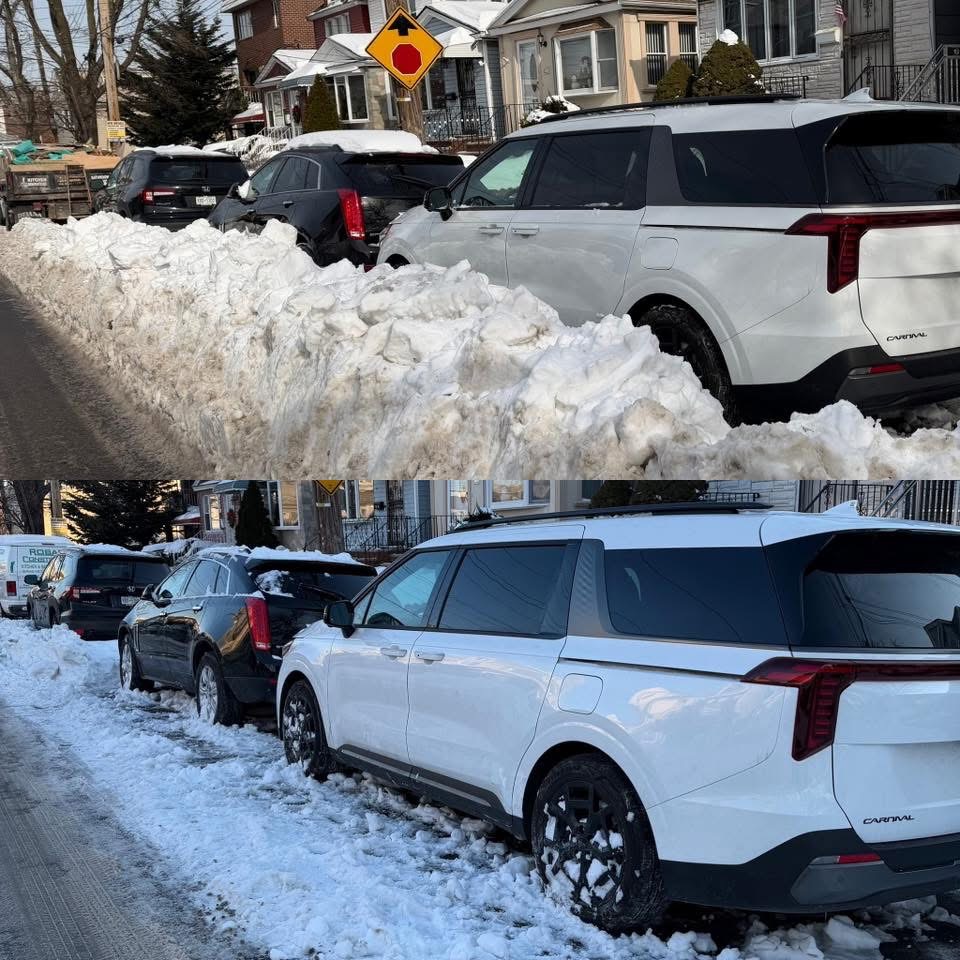
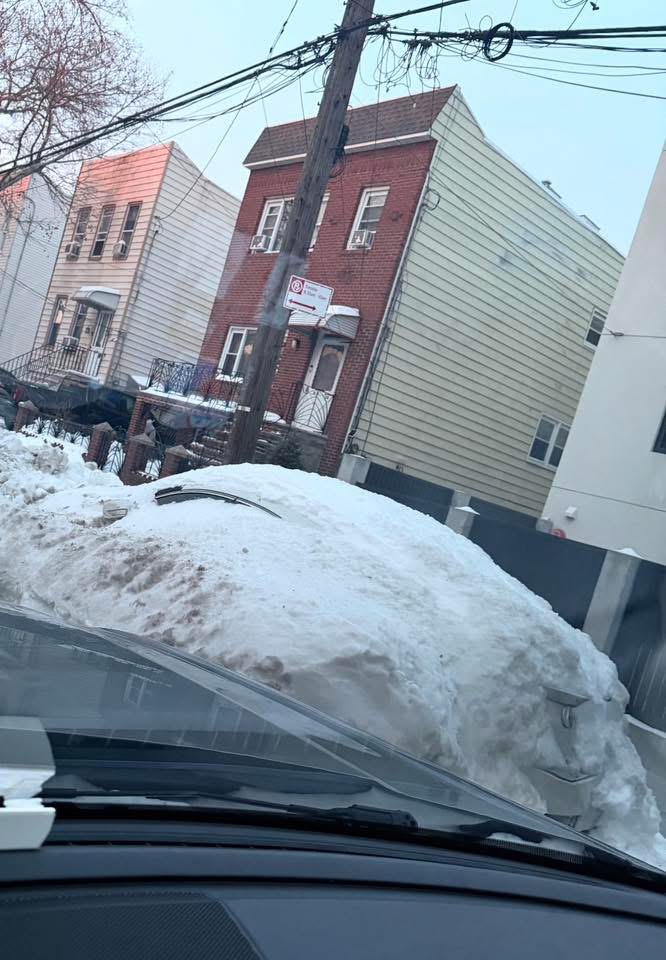
Local residents in Queens are struggling to dig out their vehicles and navigate streets blocked by mountains of snow after Winter Storm Fern blanketed New York City on Jan. 25, leaving neighborhoods buried under more than a foot of snow. The storm, the city’s heaviest in years, snarled transportation, shut down airports, and left cars stranded behind massive plow piles.

Whitestone reported 11.1 inches of accumulation, while Howard Beach saw 11 inches. John F. Kennedy International Airport recorded 10.3 inches and LaGuardia measured 9.7 inches, forcing temporary closures and widespread flight delays. City officials warned that heavy, wet snow posed risks for injuries, heart strain, and hazardous driving conditions.

Residents in Middle Village and Maspeth described frustration at streets that were either insufficiently plowed or blocked entirely by snow pushed from driveways and sidewalks.

“As someone who was born and raised in Queens, I have never been plowed in this much in my entire life,” said Christina Gonzalez of Middle Village. “I had to pay someone for the first time ever to come with a plow on their truck to plow me out of my spot because it was physically impossible for me to do.”

Mariangela Bentivegna, also from Middle Village, criticized the city’s response. “Many streets were barely plowed at all, and when plows did come through, they buried parked cars completely, making them inaccessible. This lack of coordination has left residents stranded and frustrated, and it deserves attention.”

Concerns extend beyond convenience. Donna Rini Demkowicz of Maspeth said snow had buried fire hydrants on her street, leaving residents anxious about emergency preparedness. “A few months back the house next to that caught on fire…so we are very afraid of this happening again. But no one seems to help or want to get involved,” she said.

Natalia, a Middle Village resident, described a unique challenge on her block, which borders a cemetery. “Every storm, we call the Dept. of Sanitation and request a left-facing plow and every storm we are given exactly that. Now all of a sudden this past storm…we were sent right-facing plows. There’s snow built up and barricaded everyone on the block. Their driveways and houses were walls of ice,” she said. After hours of shoveling alongside her brother, a bulldozer finally cleared the hydrant, but she said the situation could have been avoided with better planning.

Citywide, some residents acknowledged the difficulties of snow removal in a dense urban environment. “Where else can the snow be plowed to instead of blocking cars/driveways should be a question,” one resident noted, reflecting the challenges faced by both the city and its residents.

Despite frustrations, officials said plowing streets is essential for public safety. Residents must navigate the “damned if you do, damned if you don’t” reality of snow in New York City, as streets must be cleared even if cars are temporarily buried.

Hochul Pushes New Plan To Protect Kids Online


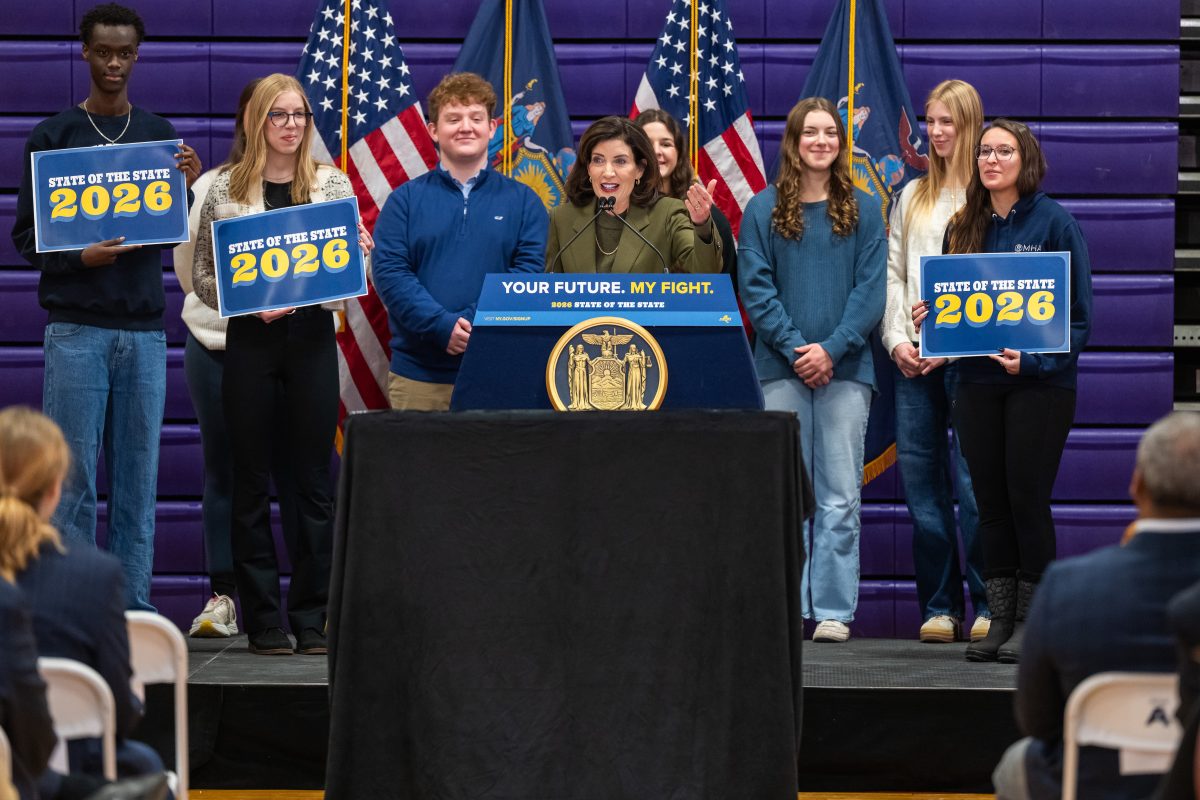
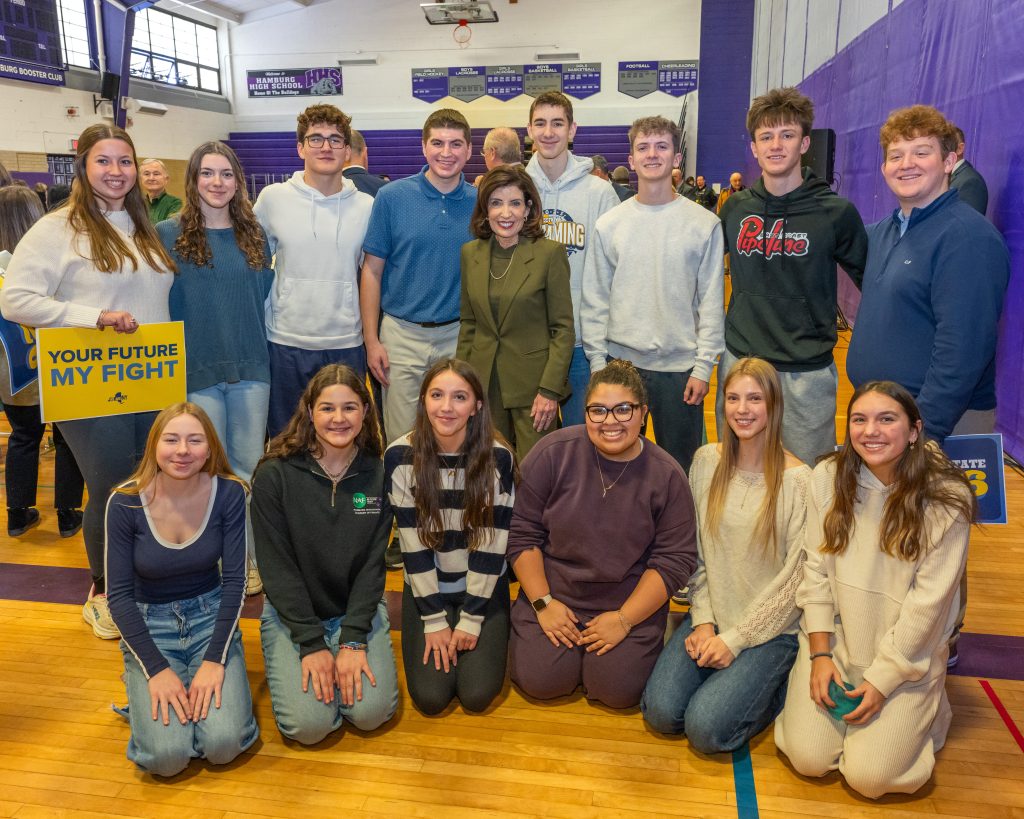
January 06, 2026- Hamburg, NY- Governor Hochul Unveils First Proposal of 2026 State of the State (Darren McGee/ Office of Governor Kathy Hochul)

New York Governor Advances Child Online Safety Package

By MOHAMED FARGHALY

mfarghaly@queensledger.com

Gov. Kathy Hochul hosted a roundtable with parents on Saturday to promote a legislative proposal aimed at strengthening protections for children and teenagers online, part of a broader push to address youth mental health and limit exposure to harmful digital content.

The proposal would expand age verification requirements on social media and online gaming platforms, require the highest privacy settings by default for minors, disable certain AI chatbot features for children and give parents more oversight of financial transactions. Hochul said the measures are designed to protect kids from predators, scams and harmful AI interactions while shifting responsibility from families to tech companies.

“With evolving technology and online platforms allowing people to connect from anywhere in the world, it is important now more than ever to keep our kids safe online from any and all potential harms,” Governor Hochul said. “This common-sense proposal will not only protect our children online, but also offer parents a peace of mind while their kids are gaming and scrolling on social media.”

The roundtable, held with parents affiliated with Common Sense Media, comes as Hochul prepares to unveil her 2026 State of the State agenda. The governor has made youth online safety a centerpiece of her platform, citing concerns about mental health, exploitation and addictive platform design.

Common Sense Media Senior Director of Advocacy Campaigns Liz Foley said, “Common Sense Media thanks Governor Hochul for her commitment to strengthening protections for kids online in New York. Headline after headline has shown us that our children’s favorite online games and social media sites have become prowling grounds for predators. Expanding age assurance, ensuring privacy by default, protecting kids from unsafe AI chatbots and giving parents more power to keep their kids safe are the safeguards families need and deserve. The governor is continuing to lead New York in the right direction for our kids.”

Hochul’s legislative package builds on prior laws enacted in New York that restrict certain social media features for minors and establish limits on data collection. Her earlier initiatives include the SAFE for Kids Act, which targets addictive social media features, and the Child Data Protection Act, which bars companies from collecting or selling children’s personal data without consent. Additional measures created safeguards for AI companion tools and required warning labels about social media’s potential mental health impacts.

Lawmakers who attended the event said the proposal continues a growing effort to regulate technology companies’ interactions with young users.

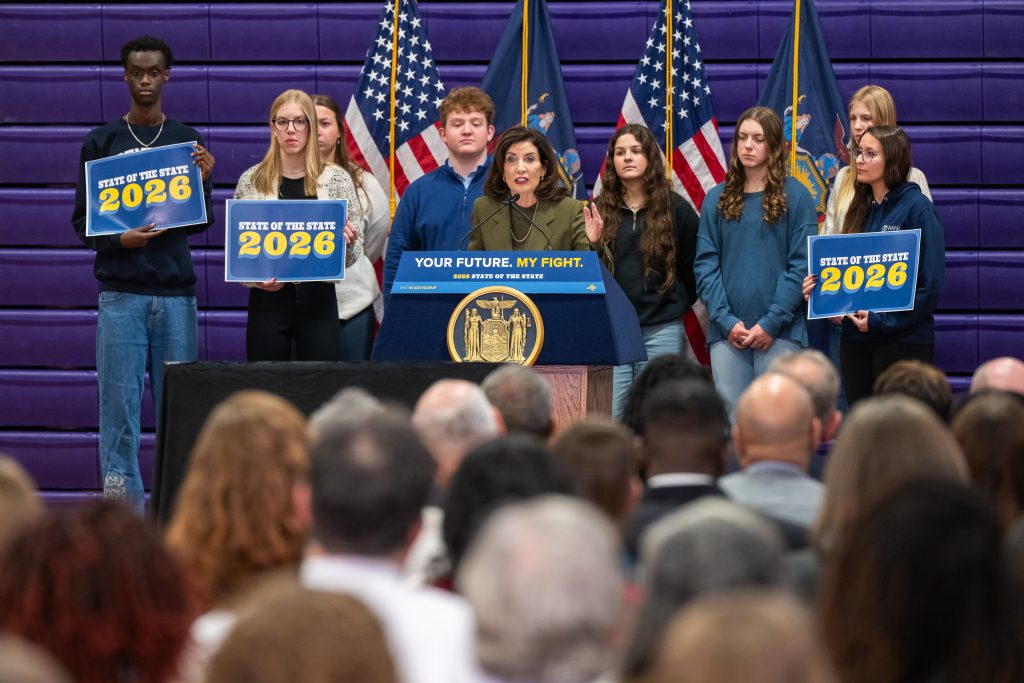
January 06, 2026- Hamburg, NY- Governor Hochul Unveils First Proposal of 2026 State of the State (Darren McGee/ Office of Governor Kathy Hochul)

State Senator Andrew Gounardes said, “The simple truth is the online platforms where our kids spend so much of their time are failing to keep them safe. If Big Tech won’t take action, we will. That’s why I fought so hard to pass the SAFE For Kids Act and Child Data Protection Act, and why we need to build on those successes with these proposals. Thanks to Governor Hochul for convening this important roundtable.”

State Senator Samra Brouk said, “As Chair of the Senate Mental Health Committee, I recognize that youth mental health is a crisis in New York State and we have to use evidence-based solutions to help our young people in need. Governor Hochul’s efforts to help parents protect our young people from predators, scammers and harmful AI Chatbots will help keep students safe while prioritizing learning and growth.”

State Senator Kristin Gonzalez said, “Today’s generation of children is facing an unprecedented threat of exploitation from Big Tech companies’ bad practices. We’re seeing headline after headline of tragic instances resulting from kids’ unregulated and often unknowing access to AI chatbots, addictive media, and data mining. I look forward to working with the Governor to pass legislation that puts the safety of our youth first, while holding online platforms and technologies accountable for their unsafe features.”

Assemblymember Steve Otis said, “Governor Hochul and the legislature have led the nation in enacting policies to protect children from technologies that can interfere, manipulate, take advantage of, or harm their education, growth, privacy, and autonomy. Children are especially vulnerable in a world where information about individuals is easily accessed by always evolving technologies. The Governor’s additional safeguards proposed this year are the next step forward in protecting children from these threats.”

Speaking at her former high school in Hamburg, Hochul framed the issue as part of a larger effort to restore in-person social development and reduce the pressures children face online.

Governor Hochul: “I want young people to be kids again. Life is hard enough later on down the road. Let’s let you embrace the freedom, the joy of, and the wonder of learning and understanding relationships and the power of the teacher to have an effect on you. Open your hearts and minds to that — not to these dark forces, which have been way too available and are seeking out our children and parents don’t even know.”

Hochul: “I’m proud that New York State is leading the way to protect our students once again online in 2026. And I’ll never stop fighting for a future where every child knows they have the freedom to play and smile and to thrive and just be themselves. That is my promise to every New York family.”

The governor also announced a proposed statewide expansion of Teen Mental Health First Aid training, which teaches students how to identify signs of distress among peers and connect them to support. The plan would scale up an existing pilot program that has already certified thousands of teens and adults.

Hochul said the new measures are intended to complement New York’s distraction-free school policies, social media warning label requirements and increased investments in school-based mental health services, which together form what she described as a nation-leading framework to protect children online and offline.

Swing Meets Mambo In One-Night Queens Jazz Event

Jazz And Dance Collide At Flushing Town Hall Global Mashup

By MOHAMED FARGHALY

mfarghaly@queensledger.com

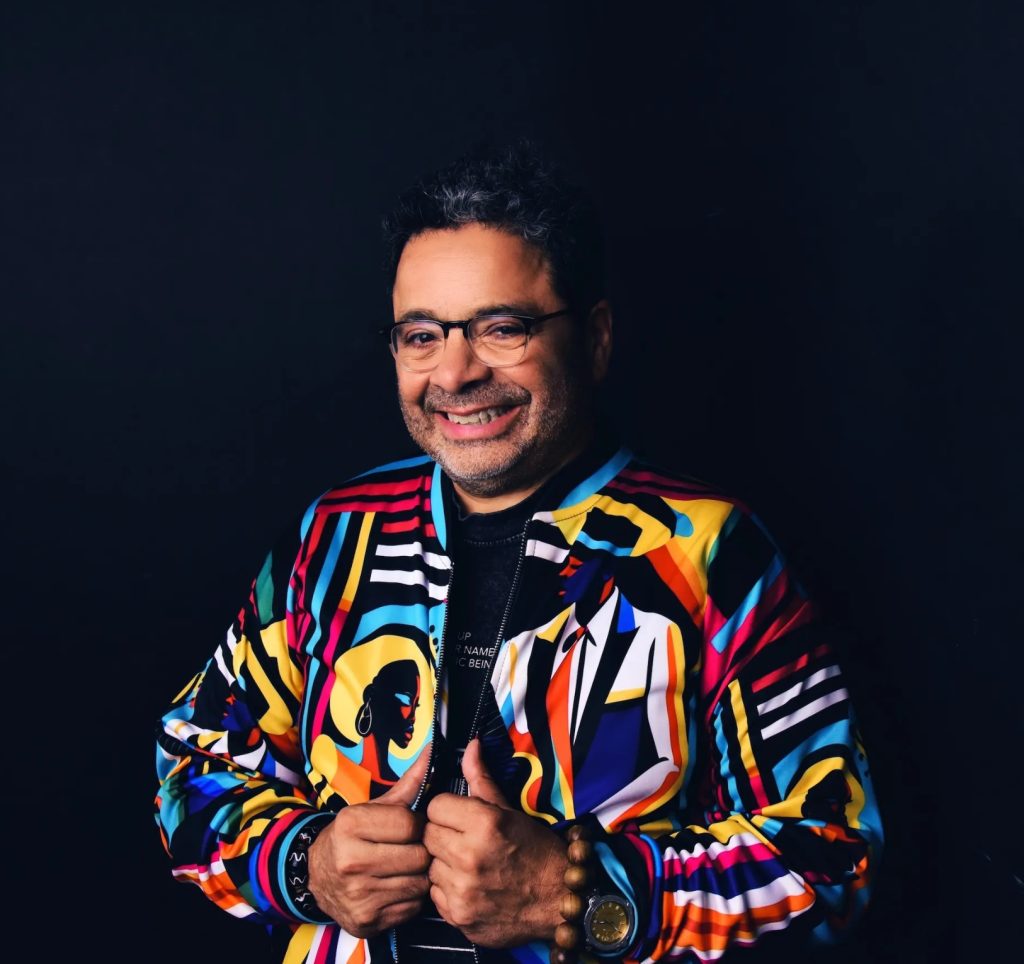
Flushing Town Hall will merge ballroom swing and Afro-Latin mambo in a rare, one-night collaboration Feb. 7, pairing the George Gee Swing Orchestra with Arturo O’Farrill’s Afro-Latin Octet in a concert designed as both performance and dance party.

The event is part of the venue’s long-running Global Mashup series, known for bringing together artists from different traditions and inviting audiences to participate through dance. Organizers say the program builds on more than a decade of mashups that have drawn large crowds by blending cultures and genres in unexpected ways.

“This is a historic global mashup,” said Clyde Bullard, Flushing Town Hall’s producer-in-residence, who curated the concert. “The concept of global mashups is always having two bands, usually from different geographical locations. In this instance, we have two bands not from two different countries, but from two different musical genres. It’s ballroom dancing meets mambo.”

The evening begins with a dance lesson at 7 p.m. led by instructor Vanda Polakova, welcoming dancers of all experience levels. At 8 p.m., each ensemble will perform a set showcasing its signature style before joining for a collaborative finale that blends swing and Afro-Latin rhythms. Audience members are encouraged to use the open dance floor, though seating remains available for those who prefer to listen.

“Surprisingly enough, a lot of people come out for the dance lessons,” Bullard said. “They want to dance, and they want to understand something about these different cultural nuances in the music. If someone doesn’t want to dance, you can still just sit in the audience and enjoy the music, because the music itself will be beautiful.”

Bullard said the mashup reflects Flushing Town Hall’s mission to present music as a living cultural exchange. Authenticity, he said, is a guiding principle when selecting performers.

“We try to bring musicians to the stage that can bring an authenticity to what they’re performing,” he said. “They’re not just learning it and memorizing it. These are people who grew up in these traditions. Music is culture expressed through sound.”

O’Farrill, who leads the Afro-Latin Octet, is a multi-Grammy Award-winning pianist, composer and educator widely recognized as a leading voice in Afro-Latin jazz. DownBeat magazine has called him “one of our greatest living pianists.” Born in Mexico and raised in New York, O’Farrill began his career with the Carla Bley Band and later collaborated with artists including Dizzy Gillespie, Wynton Marsalis and Harry Belafonte.

His work blends Afro-Cuban roots with contemporary jazz composition. He won Grammy Awards in 2016 for Afro Latin Jazz Suite, in 2018 for Three Revolutions, and in 2023 for Fandango at the Wall in New York. His most recent album, Mundoagua, received a 2026 Grammy nomination. O’Farrill is also founder and artistic director of Belongó, formerly known as the Afro-Latin Jazz Alliance, an organization dedicated to preserving and expanding Afro-Latin jazz traditions.

Sharing the stage is the George Gee Swing Orchestra, led by Queens native George Gee, whose big band sound draws inspiration from classic swing masters such as Duke Ellington and Lionel Hampton. Gee traces his professional turning point to a 1979 meeting with Count Basie, after which he committed to forming his own orchestra.


After refining his ensemble in Pittsburgh, Gee returned to New York City in 2000. His orchestra has since become a cornerstone of the city’s swing scene, most notably through its long-running weekly residency at Swing 46 in Times Square. The group is known for preserving the energy of traditional big band dance music while introducing it to new generations of listeners and dancers.

The Feb. 7 concert will place roughly 16 to 20 musicians on stage, culminating in a joint performance Bullard described as a musical experiment shaped in real time.

“That’s going to produce an interesting concoction of music that we’ve never heard before,” he said.

Bullard, who joined Flushing Town Hall in 1998, said his role involves conceiving concert concepts and matching them with artists capable of bringing those ideas to life. The ballroom-and-mambo pairing emerged quickly once he began considering options for this season’s mashup.

“There’s no one better to call” for Afro-Latin mambo than O’Farrill, Bullard said, and “no one better” for ballroom swing than Gee and his orchestra. “Both of these gentlemen have been doing this music for years. It’s second nature to them.”

He hopes audiences leave with more than just an appreciation for the technical skill of the performers.

“They’re going to walk away with joy. They’re going to walk away with happiness,” Bullard said. “When you are encapsulated with music, you forget about your problems and enter into an imaginary world of sound and feeling.”

For those unable to attend in person, Bullard said the performance will be available through Flushing Town Hall’s Culture Stream platform, allowing viewers to watch online for a nominal fee.

“Flushing Town Hall is honored to provide a stage where these outstanding jazz artists can perform together for the first time, continuing our long and celebrated tradition of presenting great jazz in Queens,” says Ellen Kodadek, Executive and Artistic Director of Flushing Town Hall. “Our Global Mashups concert series provides once-in-a-lifetime opportunities to experience unique performance pairings between your favorite artists. There’s truly nothing else like it in all of New York City! Put on your dancing shoes and get ready to dance the night away and enjoy these two powerhouse bands!”

General admission is $30 for adults and $25 for members. 7 PM Dance Lessons with Vanda Polakova, 8 PM Performance. Tickets and additional information are available at the Flushing Town Hall website.

Citywide Survey Seeks Input on Neighborhood Needs

Residents Asked to Weigh In on Local Service Gaps

By MOHAMED FARGHALY

mfarghaly@queensledger.com

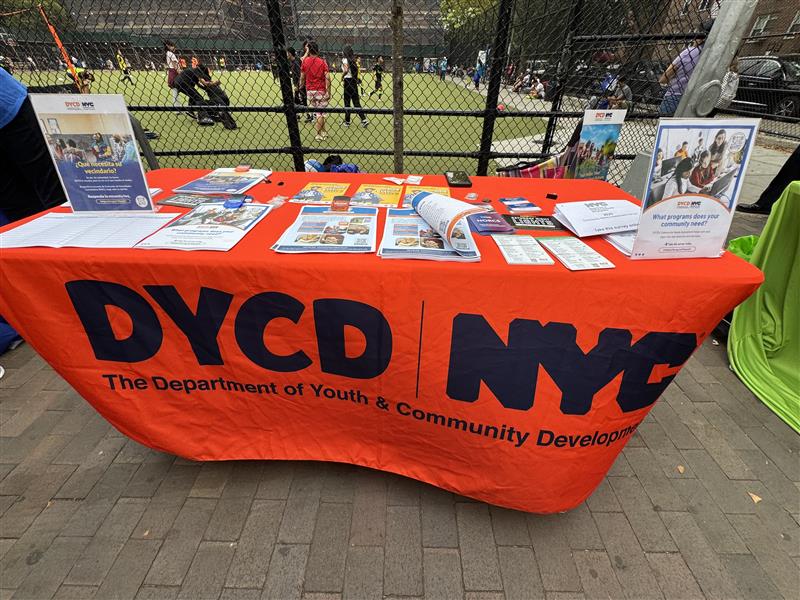
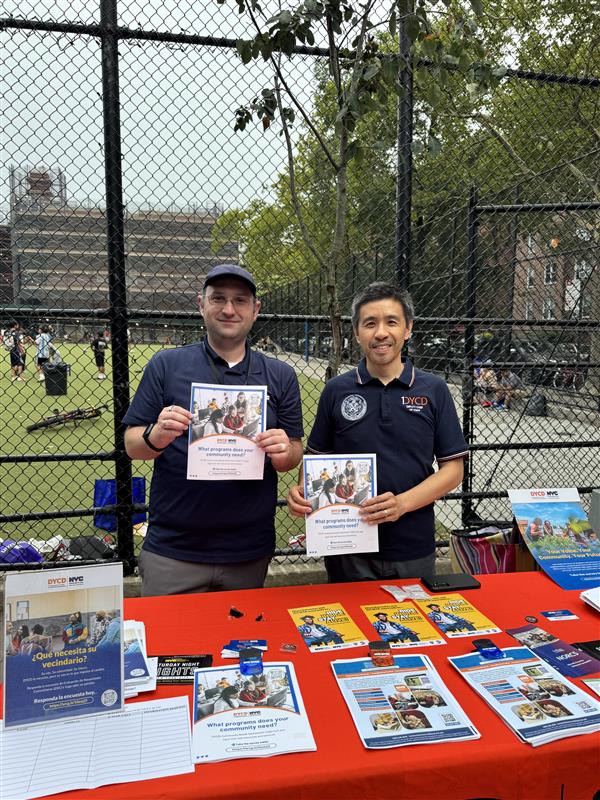
New York City officials are urging residents to take part in a citywide Community Needs Assessment, an effort designed to give communities a direct voice in how public resources, programs and services are prioritized across neighborhoods.

The assessment, led by the Department of Youth and Community Development, is conducted every three years and plays a central role in guiding funding decisions, particularly in communities experiencing high levels of poverty. City officials say participation from residents is critical to ensuring programs reflect real, local needs.

“This is an opportunity for us to ask New Yorkers who live and work in different neighborhoods what the highest presenting needs are in their community,” said Mike Bobbitt, DYCD’s deputy commissioner for community development.

DYCD oversees a broad range of youth, workforce and community development initiatives, working extensively through nonprofit organizations across all five boroughs. Bobbitt said the agency funds thousands of nonprofits and delivers services ranging from after-school programs and workforce development to literacy, entrepreneurship and support for older adults.

“We work extensively through nonprofits to get the job done,” Bobbitt said. “We believe nonprofit organizations understand local needs, and when they apply for programs like after-school or workforce development, they have people who really understand, in a very hyper-local way, the populations they serve.”

As the city’s designated community action agency, a role dating back to President Lyndon B. Johnson’s War on Poverty, DYCD is required to conduct the assessment to help determine how federal and city funds are allocated. Bobbitt said the process is central to the agency’s anti-poverty mission.

“We are always trying to listen very carefully and respond directly and helpfully to individuals and families experiencing poverty,” he said.

Residents can participate through street canvassing, public hearings in 41 high-poverty neighborhoods, or an online survey that takes about 10 minutes to complete. Public hearings are offered in a hybrid format, allowing participants to attend either in person or virtually.

“The most important question residents can answer for us is what they needed but haven’t been able to get,” Bobbitt said.


That feedback is analyzed to identify what DYCD calls “needs gaps,” which directly influence where funding is directed through programs such as the Neighborhood Development Areas initiative. If a neighborhood shows high unmet demand for food assistance, housing help or employment services, DYCD works to ensure funded programs in that area are positioned to respond.

“When we see many people in a particular neighborhood saying they needed something and didn’t get it, that informs our funding decisions,” Bobbitt said.

DYCD has expanded outreach in recent years by partnering with other city agencies, faith-based organizations and the private sector to reach residents who may not otherwise participate.

“We want to hear from the educational sector, the faith sector, the private sector, as much as we want to hear from New Yorkers generally,” Bobbitt said. “The more feedback we get, the clearer it becomes which needs should rise to the top.”

Participation is open to all New Yorkers ages 14 and up, and Bobbitt emphasized that individual responses collectively lead to tangible outcomes.

“It’s about 10 minutes of your time,” he said. “When we tally the results, we can align programs we already know work with the needs residents are telling us matter most.”

Once completed, the assessment results will be published on DYCD’s website and shared with other city agencies. The findings will also guide future requests for proposals, allowing nonprofits to apply for funding based on clearly identified neighborhood priorities.

“This is a tool we can use to direct resources where they are needed most,” Bobbitt said. “It helps ensure programs are fair, transparent and focused on serving New Yorkers.”

The survey can be found at tinyurl.com/DYCDSurvey.

It’s Time for Real Election Reform in New York

Robert Hornak

Robert Hornak is a veteran political consultant who has previously served as the Deputy Directvor of the Republican Assembly Leader’s NYC office and as Executive Director of the Queens Republican Party. He can be reached at rahornak@gmail. com and @roberthornak on X.

New York talks a good game about supporting democracy and letting the voters decide, but still has some of the most complicated, restrictive, and anti-democratic election laws in the nation.

There are many parts to running for office, including opening a committee, getting on the ballot, raising money, and the election itself. NY has been very aggressive when it comes to providing taxpayer matching funds for political candidates, all in the name of empowering average voters and small dollar contributions over wealthy special interests and political insiders.

But the reality is that the major party organizations still have tremendous influence over who gets on the ballot, and therefore the choices the voters actually have come election day. And the partisan election system is set up to make sure that come November it’s still basically a two-person race, Democrat vs. Republican, in our entrenched two- party system.

New York has some of the most complicated and technical election laws in the nation. Most candidates get on the ballot by circulating petitions and collecting the signatures of eligible voters in a process that can only be described as hyper-technical, often resulting in minor errors that are fatal to the campaign.

For example, each signer writes in the date they are signing, their signature, maybe their printed name (it’s not required), their address and their town or county (in NYC). If the date is hard to read and it is crossed out and rewritten, that “alteration” must be initialed or the signature can be invalidated. A witness must print their personal information at the bottom of each page and then sign, but below that they must also include their town or city and their county, what is called witness verification information. Even if it is included above, if this is missing or incorrect in this section, the entire page is invalidated.

It is mistakes like this that get novice candidates who don’t have the help of people experienced in this process kicked off the ballot, ending their campaign before it begins. And this is how the process is rigged, for lack of a batter word, in favor of party leaders and experienced players while throwing up as many roadblocks to newcomers as possible.

Signature requirements are also a barrier. For example, to run for congress in NY, a candidate run- ning for the nomination of a ballot- qualified party must get 5% or 1250 signatures, whichever is less, from voters of the same party only. And every one of those signatures will be scrutinized for a way to invalidate it.

In comparison, to run for congress in NJ you need to collect 200 signatures from either members of your party or independent voters, using a much simpler petition form that the Board of Elections provides, and candidates just fill in the blanks. In CA, candidates can file petitions or pay a filing fee. In Florida it’s a combination of signatures from 1% of the registered voters and a $10,440 filing fee. Most states have an option to just pay a filing fee or to submit a fee along with a token number of signatures.

All this, of course, leads to each of the party primaries, that each party has great control over when it comes to who the voters get to vote for in November. Sure, you can still run as an independent, but major party candidates win 99% of the time.

It’s time for NY to consider a more simplified process where party is not the main factor and party organizations don’t control our choices. NYC’s non-partisan elections to fill municipal office vacancies is the way to go. No primary, make it easy to get on the ballot with minimal signature requirements of just a filing fee, to help offset the cost of the election, and then a November general election in what many states call a jungle election, where the best candidate wins.

One set of matching funds, instead of funding both partisan primaries and then the general. One election day with one week of early voting. One simple process where everyone who wants to run can run, and then the voters decide. Sounds crazy, doesn’t it.

Fill the Form for Events, Advertisement or Business Listing