

Two brothers-in-law have designed a structured and inclusive soccer program for kids on the autism spectrum. By COLE SINANIAN | news@queensledger.com
The grown-ups didn’t stand a chance.
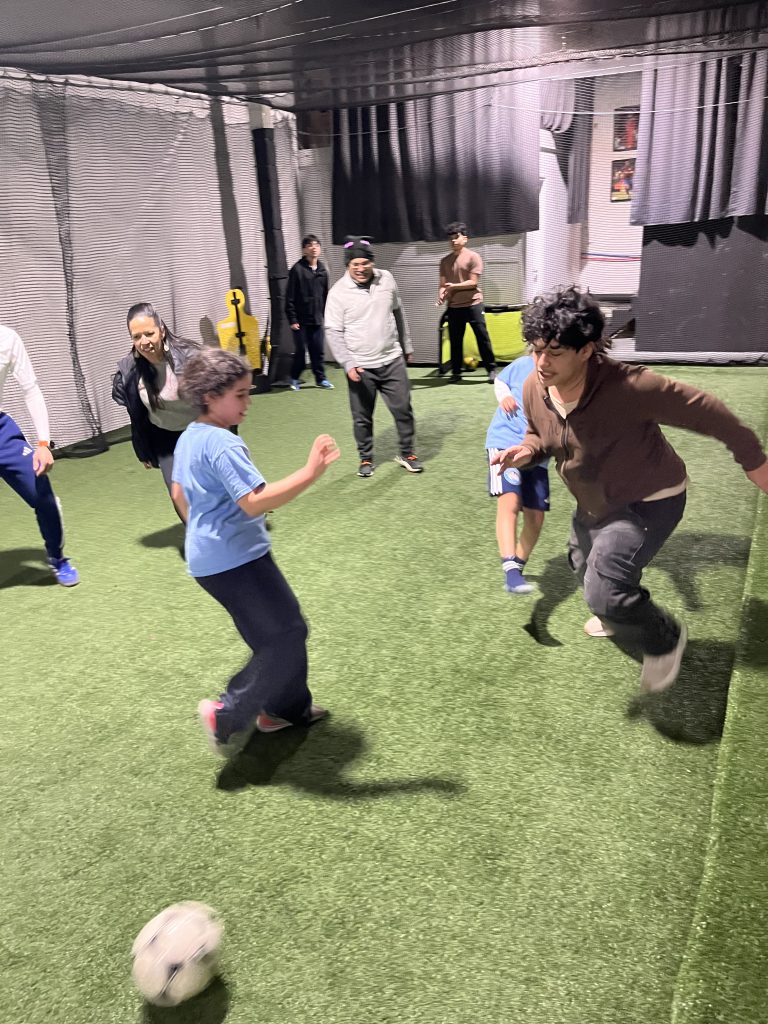
A curly-haired 9-year old named Maximiliano maneuvers the ball around the indoor soccer field in Greenpoint with the ease of a future pro. Coaches Virgilio Baez and Jeffrey Cortez — Maximiliano’s father and uncle, respectively — offer little in terms of defense. The goalie, a slightly older boy, masterfully intercepts Baez’s attempted shot, while 12-year-old Isaac, Maximiliano’s cousin, seems to be getting distracted.
Fortunately, Isaac’s mother, Isaira Abreu, is on the grown-ups team. “Isaac!” she shouts. “What are you doing? Kick the ball!”
This happens often, Abreu said. Isaac is highly intelligent, with near-encyclopedic knowledge of the universe, but can struggle with communication, focus, and hand-eye coordination.
“For you and I, it’s easy to open a door, or put on a scarf, or keep balance,” Abreu said. “But for him, it’s easier to tell you what is the distance from the Sun to the Earth. For him, the things that for us are so hard become easy.”
At ordinary soccer practice, such distraction would be grounds for reprimand. But at Open Goal soccer, held every Saturday, distractions are no problem at all. The program is designed to help kids like Isaac — who’s on the autism spectrum — stay active, build social skills and learn teamwork in a fun and judgement-free environment. It’s the project of brothers-in-law Jeffrey Cortez and Virgilio Baez, who launched Open Goal after struggling to find a soccer program that fit Isaac’s needs. The program is currently in its second season, and offers inclusive soccer lessons for kids on the spectrum without isolating them. Cortez and Baez — who have backgrounds in tech and banking, respectively — explained that the idea is to pair neurodivergent kids with neurotypical “buddies,” in an effort to help them both socialize and learn leadership skills.
“It’s really about movement, about connection,” Cortez said. “If they learn soccer, great. But it’s also unifying, it brings people together. So besides the soccer skills that we’re teaching, we’re also building community.”
Open Goal parents are invited to join a WhatsApp group chat upon registration, where they can share materials and connect over their shared struggles in raising neurodivergent children.
Abreu, Isaac’s mother and Cortez and Baez’s sister-in-law, said that while programs exist in the city for neurodivergent kids, they can be exclusionary, grouping children on the spectrum with children with other physical and developmental disabilities with whom they have little in common. This happened when Abreu placed Isaac in a program recommended by his school, the Manhattan Children’s Center.
“He actually wanted to be part of a team in which you have all types of kids,” Abreu said, “not just kids like him.
Open Goal offers an ideal solution, she said, as Isaac gets the opportunity to play soccer at his own pace alongside neurotypical peers like Maximiliano, who can serve as role models for teamwork and sportsmanship.
But the challenge at Open Goal, Baez said, is staying flexible while also maintaining the strict routine that kids on the spectrum so often need. In a traditional soccer program, the coach will give instructions, then expect the kids to complete the task without question. This doesn’t work for kids on the spectrum, who can be easily distracted and sometimes need breaks, Baez said.
“You cannot do whatever your traditional soccer program does with these kids,” he said. “It just doesn’t work. A lot of kids, you tell them an instruction and a minute later they’re off doing something else.”
“And sometimes,” he continued, “kids say, ‘I don’t want to do it.’ And I’ll say ‘ok, then don’t do it. Let’s sit on the turf for two or three minutes.”
Baez recalled a kid from a few weeks ago who didn’t want to do one of the planned exercises, so Baez offered to allow the child to take a break on the sideline. But once he realized that none of his teammates would be sitting on the sideline with him, he decided to rejoin the group.
Abrupt changes to routine are also off the table. Every one of the hour-long sessions, for example, ends with a game, during which neurodivergent kids like Isaac and budding soccer stars like Maximiliano play against the coaches and parents. If ever a Saturday session is canceled due to weather, rescheduling for Sunday simply will not do, Cortez said.
“Structure is very important,” he said. “The kids are like, ‘we have to go on a Saturday, it’s our routine.’”
The eight-week program costs $500 at registration, though parents can apply for reimbursements through the NY Office for People with Developmental Disabilities (OPWDD). Eventually, Cortez and Baez intend to register the company as a nonprofit, which could give them access to more funding that would expand the program’s accessibility.
For now, Baez and Virgilio are content with their roles as the program’s sole coaches. But as it expands, they said they plan to hire more coaches and offer them specific training for working with kids on the spectrum.