

By COLE SINANIAN | news@queensledger.com
On paper, the three socialists running to fill Mayor Mamdani’s former State Assembly seat have a lot in common.
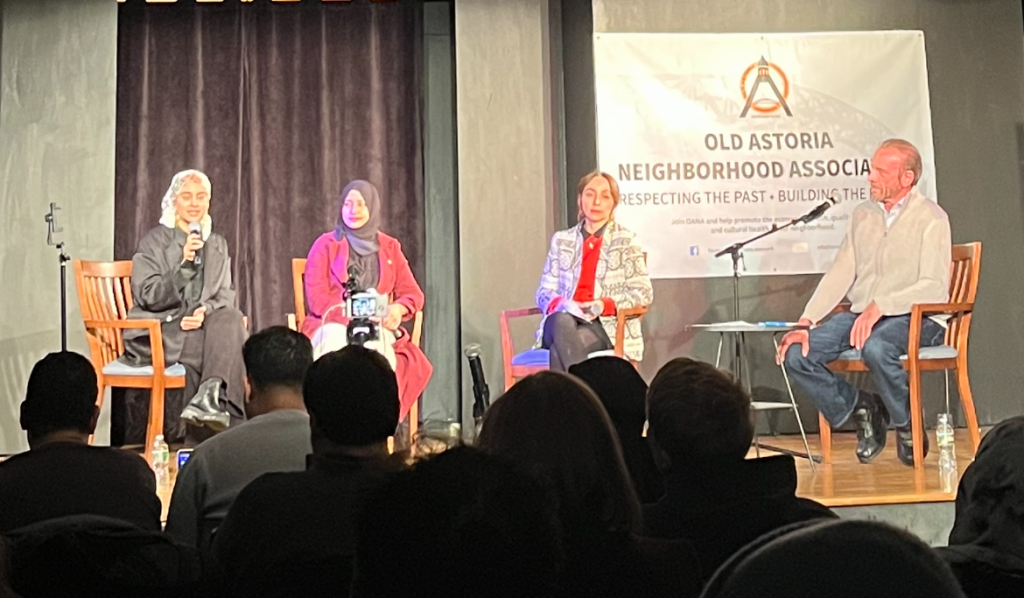
But while Diana Moreno, Rana Abdelhamid, and Mary Jobaida are all mothers and members of the NYC Democratic Socialists of America, each belongs to a different one of Astoria’s ethnic communities and brings a unique set of lived experiences that shape their approach to politics.
Assembly District 36, which spans Astoria and parts of Long Island City, is notable for being the only administrative district in the country to have elected socialists at the municipal, state, and federal levels.
On February 3, Astorians will head to the polls to elect a replacement for Mamdani, whose State Assembly seat was vacated when he was sworn in as mayor on January 1. During a three-way roundtable discussion at the Hellenic Cultural Center on January 22, the three women all pledged to protect immigrants from a hostile federal government, fund universal childcare and public transportation by taxing the rich, and slow neighborhood displacement, but offered different explanations as to how they would do so.
The Candidates
Moreno, who’s originally from Quito, Ecuador, arrived in the US in 1999 and has built a career working for immigrant justice-nonprofits and labor unions, most recently as communications manager for the New York State Nurses Association. She’s emerged as the race’s frontrunner, having secured key endorsements from the NYC-DSA, the NYC Working Families Party, Mayor Mamdani, and the Queens Democratic Party.
Jobaida, meanwhile, arrived in New York in 2001 as an immigrant from Bangladesh and self-described “Bengali housewife,” and quickly rose to prominence in Astoria’s South Asian community as a powerful local advocate and organizer. A mother of three, Jobaida has worked as a public school teacher and helped found Time Television, one of New York City’s first Bangladeshi TV networks. Many of Jobaida’s supporters live in and around Queensbridge houses, so she’s made sure to keep the working-class immigrant community she hails from at the center of her campaign.
And as the daughter of Egyptian immigrants, the Queens born-and-raised Abdelhamid is well-known among Western Queens’ Middle Eastern and North African communities for her work at Malikah, a nonprofit she founded that provides self-defense training to women vulnerable to gender-based violence. Known to some as “Mayor of Queens,” Abdelhamid also operates a mutual aid hub out of Malikah’s Steinway Street storefront.
The discussion was hosted by the Old Astoria Neighborhood Association in the Hellenic Cultural Center’s auditorium and moderated by Richard Khuzami, who began by requesting respect and civility from the audience and asking candidates to introduce themselves.
All three candidates pledged their support for the New York Health Act, a bill currently stuck in the state legislature that would implement a universal, single-payer healthcare system in New York state, as well as other affordability-focused legislation like Childcare for All and the Commercial Rent Stabilization Act, which would implement a rent-freeze for small businesses. The candidates supported funding these policies via a tax hike on high-earning businesses and individuals — a proposal promoted by Mayor Mamdani but criticized by Governor Kathy Hochul, whose approval is needed to make it law. Candidates argued that these tax hikes could also be used to fund both new transportation infrastructure projects like the Interborough Express, for which all three candidates expressed support.
On Immigration
When asked about how they’d respond to federal immigration enforcement in their district, the candidates described different approaches to protecting their district’s immigrant communities. Abdelhamid said she would work to immediately pass the NY for All Act, which would prohibit state and local agencies from enforcing federal immigration law, and the Mandating an End to Lawless Tactics (MELT) Act, a bill that would prohibit federal agents in New York State from wearing masks. Abdelhamid also said she would pass funding packages that would ensure immigrant legal council services are fully funded. She also proposed a state “mutual aid fund,” which could support immigrant families and street vendors who are in hiding from ICE and cannot work.
“So many of our immigrant neighbors who are street vendors, for example, do not feel safe going out in public and vending or going to work because they don’t know if they’re going to be able to make it home the next day,” Abdelhamid said.
Jobaida, for her part, took a more holistic approach to answering the question. She described the marginalization she felt in the years following her arrival to America and urged the importance of representation and services that help immigrants integrate into American society as the best protection against a hostile federal government.
“Home should be home, not a threatening place,” she said. “So we have to make sure that our new immigrant people, they are met with compassion and services and the care they need to become a productive member of our society.”
Moreno meanwhile, agreed that legislators must pass both NY for All and the MELT Act and went on to call for the total abolition of ICE, though she acknowledged that this falls beyond the scope of the State Assembly. She also promised to use her legislative offices as an “organizing hub” for supporting her immigrant neighbors.
“The next assembly person,” Moreno said, “which I hope will be me, should use their office as a hub of organizing to ensure that our immigrant neighbors have the resources that they need, the information that they need to keep each other safe.”
On Housing
When asked about how she’d address the city’s housing crisis, Moreno again vowed to turn her office into an “organizing hub,” this time for tenants. She called for the state government to construct more social housing in New York City for low-income residents, and said she would work to implement the Social Housing Development Authority, a proposed public benefit corporation that would develop permanently affordable, environmentally sustainable, union-built housing.
Abdelhamid pointed to several organizations she would support if elected. She mentioned the Astoria Tenant’s Union and the Western Queens Community Land Trust, an organization that seeks to preserve affordability by putting buildings under the control of tenants and community stakeholders instead of for-profit real estate companies. She also supported expanding rent stabilization, and called on the legislature to fund tenants’ legal representation.
“I’ve been to housing court,” Abdelhamid said. “The line is long. The lawyers are not enough. When you show up with a lawyer, you’re much more likely to be able to confront tenant harassment, landlords.”
Jobaida echoed calls to build more social housing, but was more blunt in her condemnation of the YIMBY, housing-maximalist approach to development promoted by prior mayoral administrations. In an effort to better understand her district’s housing supply, she vowed to fund a study that would reveal exactly how many apartments are currently vacant so they could potentially be converted into affordable units.
“The more high-rise luxury buildings we saw, the more people were displaced,” Jobaida said. “So the way they were using the word ‘housing’ never solved our problems, it only deepened the crisis.”
On Criminal Justice
When asked about their role in improving the state’s criminal justice system, the candidates diverged in their approach. Moreno highlighted the need to prevent public safety issues from being appropriated by right-wing agitators who seek to sow fear and division, and to instead focus on the systemic issues that lead to crime, like substance abuse disorder.
“That also means we should resort to treatment instead of jail when necessary when folks are suffering from substance abuse disorder,” Moreno said, “because substance abuse disorder is a public health issue and should be treated as such.”
Abdelhamid described what she’s learned from her experience running the Malikah self-defense center and the stories she’s heard from its patrons. Although rates of other kinds of violence in Astoria are low, gender violence remains a major issue, and must be taken just as seriously, Abdelhamid said. She also called out a criminal justice system that funnels underserved youths into the state prison system for petty crime and churns out lifelong criminals.
“So many young people in our communities are impacted by the school-to-prison pipeline,” she said. “If there’s a young person in our community who’s struggling, who’s dealing with a challenge, then they should be taken care of. They should be provided opportunity, not thrown away in a jail and left to a system that’s harmful to them and harmful to their communities long term.”
Jobaida used the opportunity to condemn what she called a “deeply flawed” criminal justice system that equates punishment with justice. She praised restorative justice, a practice that she grew up with in Bangladesh. In restorative justice, the person who commits the injustice is responsible for remedying it.
She argued that crime is best addressed by taking a holistic approach, tackling “the root causes where the problems are beginning,” which is usually poverty.
“I represent the working class, the excluded people, the poor people,” Jobaida said. “Rich people see us through their lenses. The people who come to us, who sell our struggles back to us, have zero idea how my people are living in Queensbridge, Ravenswood, and Astoria houses. You make us so ashamed that we don’t even feel comfortable talking about our struggle,” she said.
“I prefer justice over criminalizing people, over criminalizing poverty,” Jobaida concluded