

Courtesy NYC.Gov
Mamdani Starts Governing Within Hours of Inauguration
By MOHAMED FARGHALY & COLE SINANIAN
mfarghaly@queensledger.com
Zohran Kwame Mamdani was sworn in as New York City’s mayor just after midnight on Jan. 1, formally taking office before a larger public ceremony later in the day at City Hall that drew tens of thousands of supporters and progressive leaders from across the country.
At 34, Mamdani is the youngest mayor the city has had since the late 19th century. He is also the city’s first Muslim mayor, the first of South Asian descent and the first to be born in Africa. A democratic socialist, Mamdani enters City Hall after an insurgent campaign that pushed affordability to the center of the national political conversation.
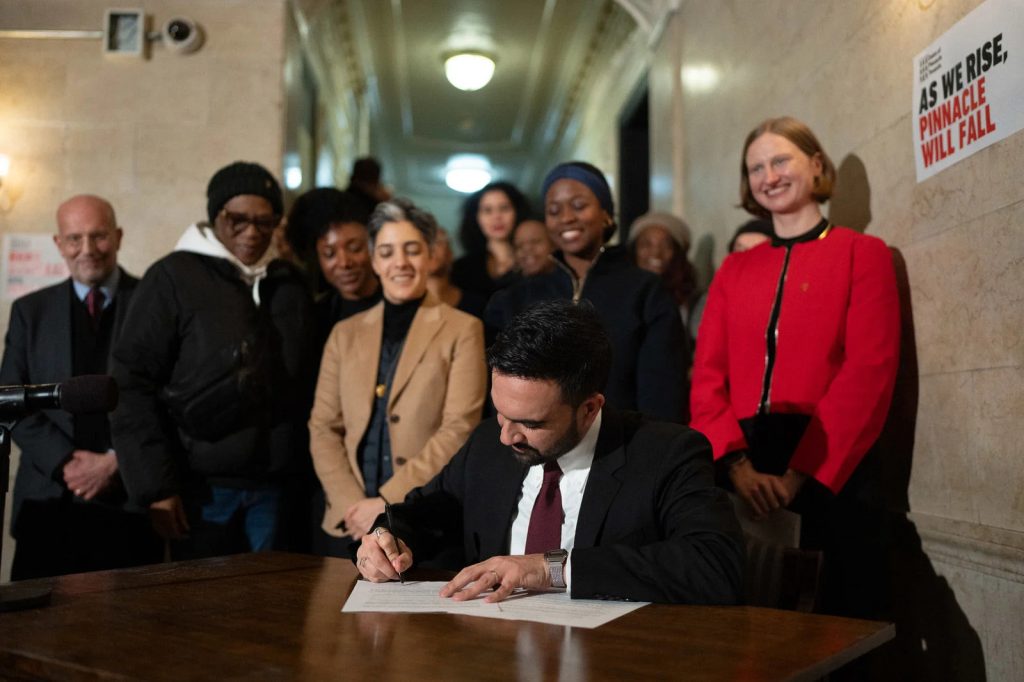
U.S. Sen. Bernie Sanders administered the ceremonial oath of office during last Thursday’s public inauguration, marking a symbolic handoff between two of the country’s most prominent democratic socialists. Hours earlier, Mamdani began governing immediately, announcing executive actions focused on housing, tenant protections and the structure of his administration.
Tens of thousands of New Yorkers braved plunging temperatures and single-digit wind chills Thursday afternoon to witness the swearing-in of democratic socialist Mayor Zohran Mamdani, City Comptroller Mark Levine and Public Advocate Jumaane Williams, as well as speeches from progressive leaders like U.S. Representative Alexandra Ocasio-Cortez and Senator Bernie Sanders.
Dubbed the “2026 NYC Inauguration block party,” the event had several blocks of Broadway between Liberty Street and City Hall blocked off and lined with several large screens. NYPD directed late arrivals into a slow-moving queue at Church Street that meandered for nearly two hours before spilling into a dense bottleneck where officers conducted security screenings.
As the crowd amassed at the corner of Broadway and Liberty Street, some spectators, many wrapped in scarves and keffiyehs or wearing Democratic Socialists of America beanies, gave into the cold and turned back before coming within sight of the screens broadcasting the speakers a few blocks north at City Hall.
Several chants erupted from the crowd as they awaited entry. One group began shouting, “Let us in! Let us in!”
“Free Palestine!” another shouted.
While spectators shivered, seven blocks away Jumaane Williams delivered a rousing and emotional speech after being sworn in for his third term as New York City public advocate.
The 49-year-old self-described “activist politician” evoked Grenadian revolutionary socialist Maurice Bishop, Kendrick Lamar’s protest anthem “Alright,” and the plight of separated immigrant families at nearby 26 Federal Plaza. He urged unity over division as the best antidote to what he described as an increasingly authoritarian federal government.
At one point, Williams directly addressed his younger self, the child of immigrants from the tiny Caribbean island nation of Grenada.
“I gotta take a second to say something to so many young people out there. And I’m gonna say it to one person who’s waited 49 years to hear it. Little black boy, you are worth it and you always were,” Williams said, his voice breaking. “And without any titles, you were enough. You were always enough. And you deserve to accept love, you deserve to be protected. And I’m honored to be here to help create a city that’s worthy of that for you.”
He continued, “So just hold on, we gon’ be alright.”
Amid a standing ovation from his political allies lining the steps of City Hall, Williams concluded by asking the audience to hold hands and repeat after him.
“We can all be the voice of the people. I know what’s ahead but I won’t lose hold. And I won’t lose hope. Anything can happen so anything can happen. And as we march forward, no one let go of anyone’s hands.”
Next, Grammy-winning singer-songwriter Lucy Dacus performed “Bread and Roses,” a song associated with the American labor movement and women’s suffrage, before Vermont Senator Bernie Sanders took the stage to deliver a short speech and swear in Mayor Mamdani. Sanders, who like Williams and Mamdani identifies politically as a democratic socialist, has become the de facto patriarch of American progressive politics since his unsuccessful but highly disruptive bids for president in 2016 and 2020.
“I’m here mostly to thank the people of New York City,” Sanders said. “You knocked on doors, you shared your dreams and your hopes for the future of this city. And in the process, you took on the Democratic establishment, the Republican establishment, and the president of the United States, and some enormously wealthy oligarchs. And you defeated them in the biggest political upset in modern American history.”
But it was Sanders’ rejection of the idea that his and Mamdani’s progressive policies are “radical” that drew the loudest applause of his speech.
“All of us have heard as Zohran’s opponents have called the agenda that he campaigned on radical, communistic, oh and absolutely unachievable,” Sanders said, pausing. “Really? That’s not what we believe.”
He continued, “In the richest country in the history of the world, making sure that people can live in affordable housing is not radical. Providing free and high quality child care is not radical.”
Mayor Mamdani’s speech, like the campaign that preceded it, evoked New York’s contradictions.
“Where else can you hear the sound of the steelpan, savor the smell of sancocho, and pay $9 for coffee on the same block?” Mamdani asked, drawing laughter from the audience. “Where else could a Muslim kid like me grow up eating bagels and lox every Sunday?”
Mamdani affirmed his allegiance to democratic socialist principles, declaring that he would not back down from the values that won him the election.
“I was elected as a democratic socialist, and I will govern as a democratic socialist,” the new mayor said. “I will not abandon my principles for fear of being deemed radical. As the great senator from Vermont once said, ‘What’s radical is a system which gives so much to so few and denies so many people the basic necessities of life.’”
As the sun lowered behind the towers of the Financial District and the air grew increasingly frigid, the thousands of New Yorkers who braved the January cold, some standing in line for more than two hours, beamed at the screens lining Broadway, a few with tears in their eyes.
At one point, Mamdani thanked Eric Adams for attending. The screens briefly flashed the former mayor’s face and were met with boos from the crowd.
An older woman in a wheelchair struggled to her feet to shout at the towering screen.
“I love you Zohran!”
As Mamdani’s speech drew to a close, ecstatic cries pierced the winter air.
“That’s my mayor! That’s my mayor!”
In his first two executive orders, announced in a press release, Mamdani revoked all executive orders issued after Sept. 26, 2024, the day former Mayor Eric Adams was indicted, saying “that was a date that marked a moment when many New Yorkers decided politics held nothing for them.”
He also established that his administration will include five deputy mayors, fewer than under the Adams administration. The roles include first deputy mayor, deputy mayor of housing and planning, deputy mayor of economic justice, deputy mayor of operations and deputy mayor of health and human services.
“Today marks the first step in building an administration that works for all New Yorkers,” Mamdani said. “We’ve established the foundations of it, and now it’s time to deliver on our affordability agenda, tackle the challenges facing New Yorkers, and usher in a new era for New York City, one that proves that government can deliver for working people.”

When asked about the future of the Rent Guidelines Board, Mamdani said, “I continue to be confident that the Rent Guidelines Board will assess the landscape of tenants for rent-stabilized units across this city and find they’re in dire need of relief.”
He also said he would keep the recently created Mayor’s Office to Combat Antisemitism.
“Beginning today, we will govern expansively and audaciously. We may not always succeed, but never will we be accused of lacking the courage to try,” Mamdani told a cheering crowd.
“To those who insist that the era of big government is over, hear me when I say this. No longer will City Hall hesitate to use its power to improve New Yorkers’ lives,” he said.
Since the inauguration, Mamdani has moved quickly to begin implementing campaign promises. In his first days in office, he signed additional executive orders, announced appointments and launched the Office of Mass Engagement. Several actions focused on housing, while others rolled back directives issued during the final months of the Adams administration.
Mamdani also unveiled three executive orders tied to housing and tenant protection, including the revival of the Mayor’s Office to Protect Tenants. The office will be led by Cea Weaver, who will serve as its executive director.
“There is no economic justice without safe, quality, affordable housing New Yorkers can live in. This is not just about building new housing, it’s also about enforcing the laws in existing housing,” said Deputy Mayor for Economic Justice Julie Su. “Through the Rental Ripoff hearings, City Hall will not only be listening, we will take action to ensure that the law is followed without exception and that New Yorkers know their rights when it comes to the often hidden or deceptive fees associated with the hunt for housing.”
Mamdani also clarified that New York City Police Commissioner Jessica Tisch reports directly to him after confusion over language in an executive order.
“My police commissioner will continue to report directly to me,” Mamdani said. “My police commissioner, just like my schools chancellor, will report directly to me. The executive order is in terms of the question of coordination.”
“This is about the daily minutiae of coordination, not about the question of reporting,” he added.
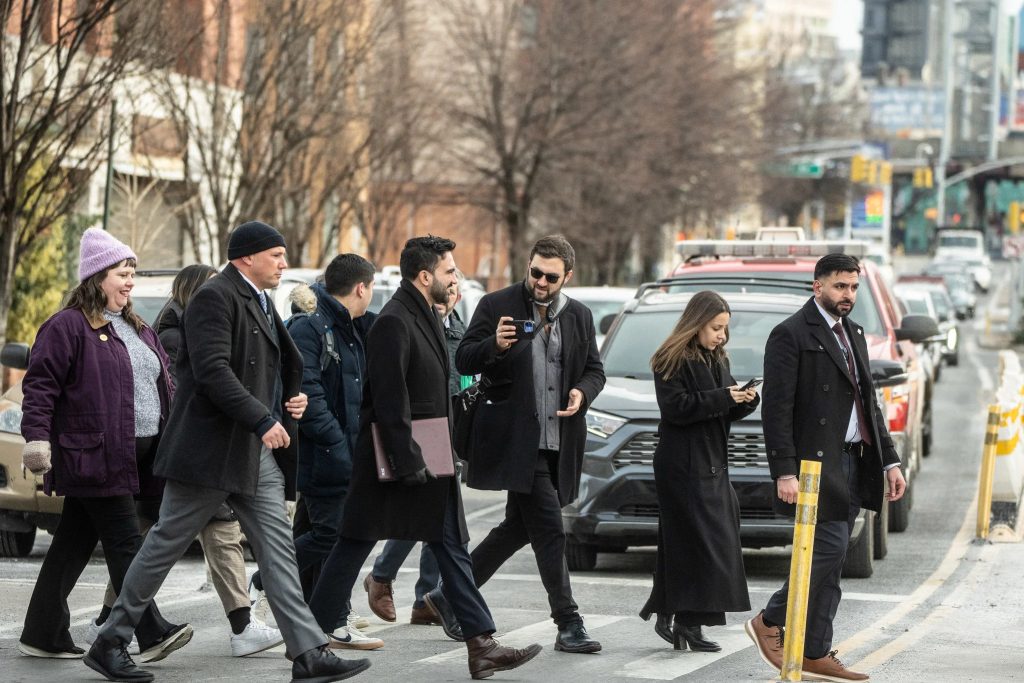
On the international stage, Mamdani condemned the abduction of ousted Venezuelan President Nicolás Maduro by U.S. forces after Maduro arrived in New York City to face charges. Mamdani said he called President Donald Trump to oppose the military operation, marking his first public break with Trump since their meeting in November. The White House has not responded.
Locally, Mamdani has leaned into his affordability agenda. He rode the Q70 bus, currently the city’s only free bus line, to promote his proposal for fare-free bus service citywide, speaking directly with riders.
He also traveled to Greenpoint, Brooklyn, to announce the completion of long-delayed safety upgrades along McGuinness Boulevard. Under the Department of Transportation, now led by Mamdani appointee Mike Flynn, the project will install parking-protected bike lanes and reduce traffic lanes to improve safety.
In one of his most sweeping housing actions, Mamdani signed an executive order directing multiple city agencies to hold “Rental Ripoff” hearings in all five boroughs within the administration’s first 100 days. The hearings will allow tenants to testify about unsafe conditions, hidden fees and abusive landlord practices.
“Standing together with the wind of purpose at our backs, we will do something that New Yorkers do better than anyone else: we will set an example for the world. If what Sinatra said is true, let us prove that anyone can make it in New York—and anywhere else too. Let us prove that when a city belongs to the people, there is no need too small to be met, no person too sick to be made healthy, no one too alone to feel like New York is their home. The work continues, the work endures, the work, my friends, has only just begun,” Mamdani said, closing his inauguration speech.