
“Wish You Were Here…Forest Park & Rego Park Historic Buildings” Mural, Uncovering The Rich History Behind The New Mural

By Michael Perlman

Last week’s column highlighted behind-the-scenes aspects and feedback on the new Forest Hills and Rego Park architectural mural, an exquisitely detailed 24-foot by 4-foot installation at The Bagel Spot at 101-01 Queens Boulevard, where the creative vision of several award-winning architects and old-word artisans is preserved. Since 2023, this columnist/Rego-Forest Preservation Council and Four Borough Neighborhood Preservation Alliance were in collaboration with the mural’s exceptional artist, Gigi Chen, appointed by this columnist as a project coordinator and historian. The highly skillful firm, Noble Signs, installed it on June 6.

Photo by Argenis Apolinario

In an ideal city, the featured historic buildings would be landmarked, but some underwent demolition. In the spirit of the Architectural Uprising movement, lost treasures can be replicated. Now it is time to explore architecture and history of what embodies “a living museum.”

Hollywood Lanes at the Metropolitan Industrial Bank Building ~ Opened on November 8, 1952 on 67th Avenue and Queens Boulevard in Forest Hills, and built at $400,000, the popular Hollywood Lanes housed 30 lanes, and offered lunch, dinner, a cocktail lounge, and a snack bar. General Manager Mannie Rose envisioned grand tournaments. The opening ceremony’s special guest was Dick Hoover of Akron, Ohio, who was the youngest bowler to win the All-Star tournament at age 21. Hollywood Lanes accommodated professional bowlers, championships, open bowling, and birthday parties. By 1990, New York City had 44 bowling alleys, in comparison to approximately 160 in the 1960s. It remained in operation until 2002, and is now occupied by New York Sports Club.

Architect Philip Birnbaum designed this bank, retail, and recreation building in partnership with builder Alfred Kaskel. The façade features concave polished stainless-steel horizontal fins. Swedish granite columns with vertical polished stainless-steel fins convey continuity throughout this Mid-Century Modern property, which won a first prize award by the Queens Chamber of Commerce in 1952.

Midway Theatre ~ This historic Art Moderne style theater stands proudly at 108-22 Queens Boulevard, with an accordion-like façade and vertical beacon, curved corner, and oval lobby with a sweeping stairway,  and opened in 1942. It was designed by America’s foremost theater architect, Scotland native Thomas Lamb and consulting architect S. Charles Lee, and achieved a record as one of Queens’ longest continuously operating movie theaters.

Upon making an entrance, theatergoers once took pride in a large illuminated WWII Battle of Midway map-inspired work of art. When residents picked up The Forest Hills-Kew Gardens Post on September 18, 1942, they came across an ad stating, “The Midway Theatre has been so named and dedicated as a tribute to the gallant men of our armed forces, who achieved so brilliant a victory at Midway Island.” Patrons were ready for a single-screen theater, where they could enjoy films and attempt to escape WWII traumas.

Opening attractions were the U.S. Navy’s Technicolor short subject, “The Battle of Midway,” as well as “The Pied Piper” and “Just Off Broadway.” Other popular films were “Yankee Doodle Dandy,” “Casablanca,” “Pride of the Marines,” “Help!,” “West Side Story,” and “Saturday Night Fever.” Among the celebrities who made appearances were Bob Hope and Lucille Ball.The Midway screened first-run films, Walt Disney cartoons, and up-to-the-minute news, and operations shifted from RKO to Skouras to United Artists. It also transitioned from a single screen to a quad to nine screens.

 Forest Hills Stadium with an eagle sculpture, and Frank Sinatra concert and Davis Cup tickets ~ The first tennis stadium countrywide was completed on August 11, 1923 in time for the Wightman Cup. The arched colonnade, graced with eagles and West Side Tennis Club crests, was designed by West Side Tennis Club member Kenneth Murchison, a foremost public buildings architect, and in partnership with engineer Charles Landers. It was erected by the Foundation Company of New York, whose expertise was superstructures and substructures internationally. In a 1922 edition of MIT’s “The Technology Review, an ad referenced it as “America’s Tennis Stadium.”

The nearby Tudor clubhouse features an extensive tennis player “wall of fame,” including portraits of Bill Tilden, Helen Jacobs, Rod Laver, John Newcombe, Andre Agassi, Billie Jean King, and John McEnroe. A series of firsts transpired on the stadium’s hallowed grounds. In 1953, Maureen Connolly Brinker was the first woman to win a Grand Slam. This was the U.S. Open’s birthplace. Singles and National Championships and the Davis Cup also made history. Since tennis was a segregated sport, racial color barriers were broken when Althea Gibson was the first African American to win a U.S. National Tennis title in 1957, and Arthur Ashe was the first African American man to achieve the U.S. Open title in 1968.

As of 1971, the stadium began hosting annual Robert F. Kennedy Pro-Celebrity Tennis Tournaments. The 1976 event, which benefited the Robert F. Kennedy Memorial, featured influential tennis players including Stan Smith, Jimmy Connors, Guillermo Vilas and Wimbledon crown recipient Björn Borg, who were joined by the Kennedy family, Chevy Chase, Walter Cronkite, Art Buchwald, and Muhammad Ali.

Frank Sinatra, Simon & Garfunkel, Bob Dylan, Barbra Streisand, Bette Midler, Trini Lopez, The Who, Hall & Oates, The New York Pops, and Santana are a miniscule percentage of musical legends since the stadium’s adaptation as a concert venue. The Forest Hills Music Festival originated in 1960, and the Stadium underwent a rebirth in 2013, where Mumford & Sons launched a new era. The stadium was also the setting of Alfred Hitchcock’s film, “Strangers on a Train” (1951), and The Beatles’ helicopter landing on grass courts before performing, which was among the most dramatic moments in 1964.

Howard Johnson’s ~ Rego Park residents were fortunate to have “The largest roadside restaurant in the U.S.” at 95-25 Queens Boulevard, which opened in 1940, a short distance away from the World’s Fair. The three-story, $300,000 restaurant occupied a Georgian Colonial mansion-like restaurant, designed by chief architect Joseph G. Morgan of the restaurant chain, and the building earned a 1st prize Queens Chamber of Commerce award. It was owned by Howard D. Johnson, who commissioned the Fair’s esteemed seafood chef, Pierre Franey. This is also where chef Jacques Pépin worked, and was later the recipient of an Emmy Award for Lifetime Achievement.

The façade featured sculptures, ornamental cast stone, pilasters, a portico, dormers, shutters, and urns, and was topped off with a cupola. An Art Deco roadside neon sign boasted 28 ice cream flavors, a grille, a cocktail lounge, steaks, chops, and chicken. The seating capacity was 700 indoors and 300 on its terraces. The Colonial Room and Empire Room dining spaces were available for weddings. Crystal chandeliers, murals designed by famed Parisian colorist Andre Durenceau (rescued by this columnist last year), and a winding grand stairway in the rotunda were regal appointments. By the early 1970s, industry standardization and a change in taste called for fast food, causing this American icon to undergo demolition in 1974. The Rego Park restaurant is depicted in author Paul Freedman’s book, “Ten Restaurants That Changed America.”

1939 World’s Fairgrounds featuring the Trylon & Perisphere monuments rising above Constitution Mall with the George Washington and Four Freedoms sculptures ~

“The World of Tomorrow” was a dominant theme of the 1939 – 1940 World’s Fair, which attracted millions of New York residents and tourists to Flushing Meadow for a celebration of technological innovations and cultural history like no other. It spanned the period of April 30, 1939 to October 27, 1940. Over 44 million visitors attended during the summers.

A linen postcard, designed for the Exposition Souvenir Corporation by the Grinnell Litho. Co. read, “On the theory that the best commemoration is a re-dedication, the New York World’s Fair 1939 celebrates the 150th anniversary of the inauguration of George Washington as the first President of the U.S. by dedicating itself to the task of building a ‘Better World of Tomorrow.’”

The Fair’s centerpiece was the symbolic Trylon and Perisphere monuments, which were a 700-foot spire and a 200-foot in diameter sphere, respectively, designed by Wallace K. Harrison and J. Andre Fouilhoux. In March 1937, Fair President Grover Whalen said, “Entering the sphere, the visitor will emerge on the moving platform. The effect will be that of suddenly stepping out into space. Far beneath he will see cities and towns and farmland, and all the interdependent activity that links them.”

Fairgoers would exit the Perisphere across a bridge to the ground by steps inside the obelisk or by an exterior 900-foot Helicline, a sweeping ramp around the fountain, which offered a commanding view. The Trylon’s monumentality was evident structurally and atop through a beacon of light. It was estimated to be the equivalent of five to ten million candlepower, which would be evident for 30 miles at sea and approximately 200 miles by plane.

Gulf Service Station ~ Rego Park once had its own version of the Empire State Building, as in a streamlined illuminated glass block Art Deco tower of the Gulf Station on the northeast corner of Queens Boulevard and Horace Harding Boulevard. A curved façade with curved windows and stainless steel accents were among the other novelty features, since nearby service stations exhibited Tudor and Mediterranean influences. It was erected by John Meehan & Son Construction Company for Gulf Oil Company. It was deemed futuristic, coinciding with the 1939 – 1940 World’s Fair’s “World of Tomorrow” theme, and was situated en route to the Fair when Horace Harding Boulevard was briefly known as World’s Fair Boulevard. The Gulf Station earned a 1st prize award by the Queens Chamber of Commerce in the commercial construction category. The site was redeveloped in 1987 when the 17-story Queens Boulevard Tower opened at 92-29 Queens Boulevard.

Trylon Theatre ~ With the advent of the 1939 – 1940 World’s Fair, Cooper Union alumnus Joseph Unger (1896 – 1996), designed an Art Deco neighborhood theater at 98-81 Queens Boulevard in Forest Hills to reflect the Fair’s technological innovations and respond to a booming population. It was named after the Fair’s symbolic monument, the Trylon, which was alongside the Perisphere. Analogous to the Fair’s theme, “The World of Tomorrow,” the theater was “The Theater of Tomorrow.” The marquee once boasted classics such as “The Wizard of Oz,” “Gone With The Wind,” and “The Ghost Breakers” starring Bob Hope.

Unique stone façade offered striated and fan-like details, an elliptical white tile marquee, and a sleek vertical glass block projection tower. The marquee and projection tower illuminated Queens Boulevard at night, much as the Trylon and Perisphere monuments made efficient use of light in Flushing Meadows. The projection tower was Joseph Unger’s rectangular variation of the globular Perisphere. The centerpiece of the entrance pavilion’s floor was terrazzo, bearing a 3D mirror image of the Trylon monument, complementary to the Trylon on the semicircular mosaic ticket booth. The floor was accompanied by a delightfully colorful array of inlaid mosaic tiles on both sides in a classic chevron pattern. The single-screen auditorium featured a stepped ceiling with curves among sleek accents, and the proscenium featured pilasters with thematic murals depicting media and sculpture in a growing city. The standee area featured a backlit Trylon mosaic fountain.

In 1999, the theater closed. In 2006, Ohr Natan, a synagogue and community center opened, but in 2022, the congregation was forced to relocate despite opposition due to condo plans.

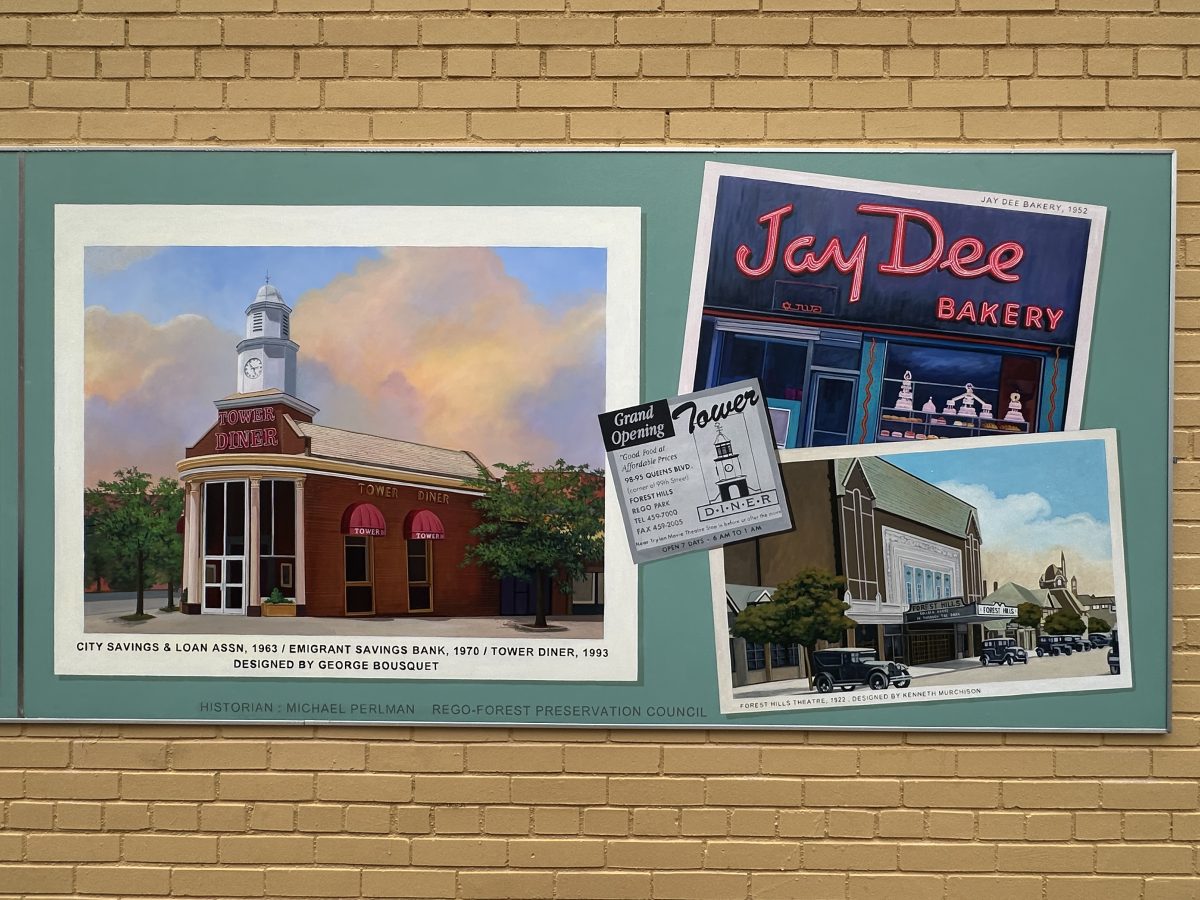
 Tower Diner bank building ~ Opened in 1993, Tower Diner at 98-95 Queens Boulevard in Forest Hills was a representation of a Greek-American dining classic. Owners Spiro and John Gatanas and their parents creatively adapted the Colonial Revival style Emigrant Savings Bank. Authentic features included an imposing clock tower/cupola with a weathervane and eagle, Corinthian columns, a slate pitched roof, a portico, and a cornice. Tower Diner was a must-stop for an extensive American and cultural menu, including chicken souvlaki, turkey burgers, spinach pies, cranberry chicken, and pasta primavera.

Earlier incarnations were a nightly dancing spot at Manna-Hatin Restaurant, which featured Billy Rose’s Aquabelles from the 1939 World’s Fair’s Aquacade, and Croft Chemists which housed a soda fountain. The corner Art Deco building was rebuilt for the City Savings & Loan Association circa 1963, and is believed to have been designed or inspired by Massachusetts native and award-winning architect George L. Bousquet, who once worked under Thomas Lamb, a foremost architect. Despite community resistance, Tower Diner was forced to shutter its location in late 2021, and was replaced by a condo.

 Jay Dee Bakery ~ In Mid-Century Modern style pinkish red neon, massive Art Deco letters read “Jay Dee Bakery,” a neighborhood cornerstone at 98-92 Queens Boulevard from the early 1950s through 2009. Philip Kampin and Maurice Goldstein were noted as the owners in 1952. It recalled an era where rye bread, Napoleons, and assorted cookies were freshly prepared on premise, and the staff and patrons exchanged stories. Jay Dee catered numerous social functions. The window was a neighborhood showcase filled with multi-layer cake models. The façade’s whimsical Ravenna glass mosaics in green, orange, and gold were a work of art, and Moderne curves characterized the interior ceiling and walls, where indented clouds displayed cake models. In 2009, this columnist rescued the sign among other relics.

 Forest Hills Theatre ~ The Tudor-style former theater at 107-16 Continental Avenue was designed by a foremost public buildings architect, Kenneth Murchison, and retains an ornate Tudor façade with lions, heraldic shields, fruits, knights, vines, urns, and tilework. For $300,000, the Sheer Amusement Company of Queens formally opened “the finest moving picture house on Long Island” on December 5, 1922, and it was the most complete of its kind and size countrywide. The façade would complement Forest Hills Gardens and was part of the adjacent section’s nickname, “The Village.” Its marquee boasted classics such as silent film “Through The Dark,” “Too Many Girls, “The Wizard of Oz,” “Alias Nick Beal,” “Planet of The Apes,” and “Dirty Dancing.”

The theater offered a resident orchestra and organist who played a rare four-manual Smith Unit Organ, sometimes embellished by singers and dancers for a silent film prelude. This also where the Garden Players of Forest Hills and Kew Gardens performed, and on Saturday mornings, children’s films endorsed by the Schools Motion Picture Committee were screened. The theater later featured mainstream and art films, and closed-circuit boxing broadcasts. In 1926, Helen Keller and Anne Sullivan lectured to benefit the American Foundation for the Blind’s mission. In 1971, Roger Williams, known for “Autumn Leaves,” played tunes, gave autographs, and introduced a computerized method of teaching piano and organ.
 

The Forgotten Patriotic Artists of Forest Hills Gardens The Voice Behind Patriotic Posters $ Bookplates Comes Alive

By Michael Perlman

Forest Hills Gardens, which was established in 1909, harbors an extensive history of residents who became known for their achievements on local to international levels. Back in 1914, the community began coordinating annual large-scale Fourth of July Festivals in an exquisitely decorated Station Square, often with activities at the Forest Hills Inn and Tea Garden, Olivia Park, and along Greenway Terrace and Flagpole Green, formerly Village Green.

One hundred and eleven years later, it is time to take a look at three of the community’s well-known artists with patriotic influences, whose success reached far beyond New York. They were Will Phillip Hooper and his wife Annie Betty Blakeslee Hooper of 84 Greenway South, as well as Herman Brown Rountree of 176 Slocum Crescent, but today they are long-forgotten.

Circa 1915

Circa 1915

Will Phillip Hooper (1855 – 1938) was a painter and illustrator who was born in Biddeford, Maine and pursued his studies in Boston and The Art Students League of New York. He founded the Hooper Advertising Service at 200 Fifth Avenue, and was a New York Watercolor Society member. Among the publications which featured his illustrations were Harper’s Weekly, LIFE, St. Nicholas, and The London Graphic. In 1892, “The Legend of The Lantern” featured his photogravures.

Annie Betty Blakeslee Hooper pursued her studies at San Francisco Art School, and then relocated eastward to study with Melville Dewey and Will Phillip Hooper. Her specialties ranged from bookplates to dinner plates, and was a remarkable patriotic poster artist. She exhibited bookplates at venues including the Pen and Brush Club of New York.

The spirit and voice of late artists educate current generations. In January 1916, she told The Christian Science Monitor of Boston, “Your book plate must try to express in symbols your occupation, special interests or hobbies. It may symbolize your home, your love of nature, your ideals, your activities, or your vision. It should be typical of you and you only, and the designer must blend all these symbols into a design which shall have both beauty and significance.” She continued, “After the design is made, it must be etched on copper or in cheaper form, on zinc, and printed on paper of fine quality. Collectors of book plates must look to the symbolism embodied in the composition, and also to the composition itself and to the fineness of line and delicacy of workmanship in its execution. Rare book plates are in demand, and those of famous people are greatly desired by the collectors, who are a growing class.” Orders for book plates were taken by first-class booksellers and jewelers who would retain plates to have a name inserted.

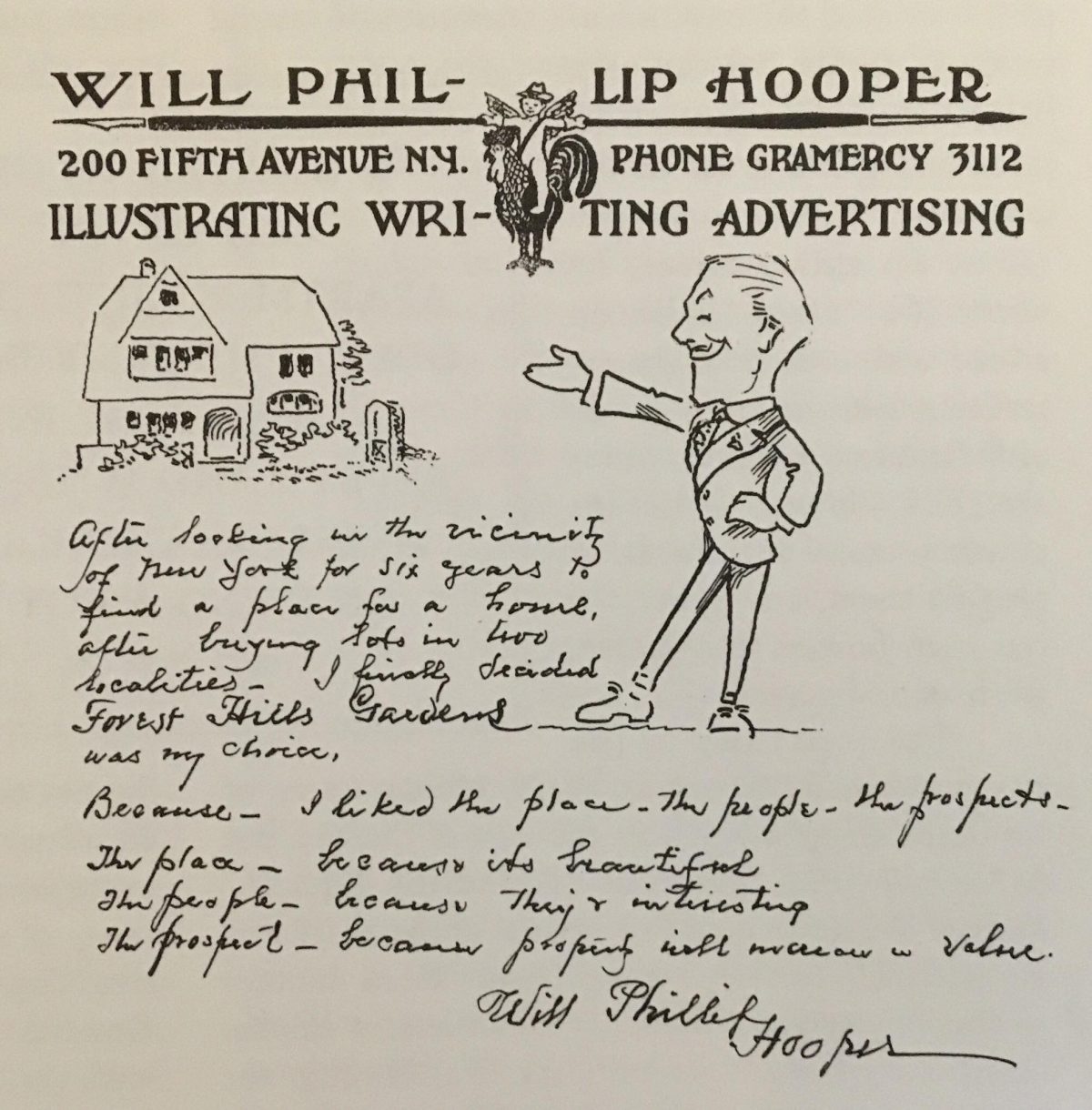
 Forest Hills Gardens was six years old when “Why We Have Chosen Forest Hills Gardens For Our Home” was published at the Village Press in 1915, after W.P. Hooper originated the idea and collaborated with Forest Hills Gardens resident Frederic Goudy, a prominent type designer, artist, and printer. At the time, Forest Hills Gardens featured 166 private homes, the Forest Hills Inn which operated as a hotel with 44 live-in staff members, and the adjacent Housekeeping Apartments (renamed The Marlboro) on the west and The Raleigh on the east. Between the apartments and houses were approximately 720 residents. Hooper selectively approached residents, and 53 entries were published alongside Goudy’s typography and decorations. Spontaneous expressions of villagers were captured and complemented by half-tone illustrations of homes.

In the publication, W.P. Hooper responded to his own question: “After looking in the vicinity of New York for six years to find a place for a home, after buying lots in two localities, I finally decided that Forest Hills Gardens was my choice, because I liked the place, the people, and the prospects. The place – because it’s beautiful; the people – because they’re interesting; the prospect – because property will increase in value.”

W.P. Hooper designed a poster in 1915 featuring a continental soldier carrying the flag and leading a child. His wife Annie designed an Independence Day 1916 “A.B. Hooper” signed poster announcing the circus coming to town. It depicts a whimsical child-like clown riding an elephant, whose upwards trunk is holding a 4th of July flag over a dog on its hind legs in anticipation. The Forest Hills Gardens Bulletin read, “It is not the animal of our books on natural history. But no finer specimen of the poster elephant has ever been seen in captivity. We are profoundly impressed with the peculiar expression conveyed by the treatment of the subject’s eye. Undoubtedly Leonardo da Vinci could have made his famous Mona Lisa smile about fourteen degrees more mysterious if he had seen this elephant first. There is something intensely human about the look in the said eye, suggesting that Mr. Hooper generously contributed that feature to the design.”

A 1917 Forest Hills Gardens Bulletin features their residence that offered a studio on the first floor and a third floor for billiards. Then in 1919, the couple relocated to 51 Summer Street.

Springfield, Missouri native Herman Brown Rountree (1878 – 1946) was a painter, newspaper artist, and magazine illustrator who designed posters for early 20th century Independence Day celebrations, where he served as the Chairman of the Poster Committee. He lived with his wife Nell Lamoine Lee, daughters Helen Cynthia and Eleanor Lee, and a Cuban servant. Forest Hills Gardens principal architect Grosvenor Atterbury designed their home at 176 Slocum Crescent with a two-story rear studio, which offered much light.

The July 12, 1919 Forest Hills Gardens Bulletin stated, “Mr. Rountree is one of this country’s most brilliant poster artists.” He is depicted on an ornate and whimsical 1927 N.M.F. caricature map of Forest Hills Gardens, Forest Hills Stadium, Austin Street, and Queens Boulevard, which features an artist in front of an easel.

Rountree’s illustrations were published for the foremost authors in leading magazines such as “Gunter’s Magazine,” “Appleton’s Booklovers Magazine,” “The Sportsman,” and Frank Buck’s “Bring ‘Em Back Alive” and the “Old Warden” series in “Field and Stream.” He illustrated for the Philadelphia Public Ledger, as well as newspapers in St. Louis, and Hartford, and one of many illustrated works was “On Many Trails.” In his obituary, he was regarded as “one of America’s best-known wildlife illustrators.” His paintings of animal life encompassed race horses, polo ponies, African hunting expeditions, and western ranch life.

Rountree’s 1916 poster, “Yes Mule – It’s The Greatest Show on Earth!!” captured the expressions of astonished children watching a clown that embraced a mule, sitting on its hind legs. The bottom further captured the Gardens’ festive and playful spirit with a lineup of a frivolous clown, a dog act with a carriage being pushed, a ballerina on a horse, boxers, acrobats, as well as a dog playing an instrument while balancing on a ball next to a woman holding a baton. The Forest Hills Gardens Bulletin drew a comparison of his poster to a mural decorative style. Referencing the mule, it stated, “Its neck is beautifully garlanded with flowers, which proves that Rountree is equally at home in the vegetable and animal kingdoms, as well as in our glorious republic. Your true artist is quite impartial in his attitude toward the various forms of government.”

His 1917 poster featured Forest Hills Gardens during WWI on Village Green (now Flagpole Green) with a 48-star American flag being raised and a backdrop of the iconic Forest Hills Inn. It depicted a planned garden community as a center for American values. This is where the community dedicated a new concrete base and bronze collar for the flagpole, in which American sailors assisted in flag-raising exercises. Also depicted are village residents, including a child who is witnessing history first-hand, alongside his mother. He displayed a sign of respect by tipping his hat.


Rountree’s colorful 1919 poster features an extravagant masquerade, bright lights, and the Long Island Railroad Station of Station Square as a backdrop. In July 1919, Long Island Life referenced his poster for its unusual charm and artistic value. It read, “Each year he has donated a poster, commemorating our Fourth of July celebration. They have all been good, but this year Mr. Rountree has fairly outdone himself. This poster (the original of which is on exhibit at the Inn) is of such high quality that the committee would not resist reproducing it in color in the Bulletin. We take occasion to thank him, in the name of the residents of Forest Hills Gardens.”

He also specialized in men’s style illustration for clothing manufacturers in New York. “Mr. Rountree’s wonderfully life-like work, not only in fashion portrayal, but also as a magazine and book illustrator, has singled him out as the most brilliant of the younger school of artists. His drawings interpret superlatively well that environment of good breeding and luxurious living which many artists attempt and few – very few – achieve,” read an ad by advertising agents Sherman & Bryan at One Union Square, which secured his services. It was published in a 1907 edition of “The Clothier and Furnisher.”

Rountree’s entry in “Why We Have Chosen Forest Hills Gardens For Our Home” read, “A friend used to bore me with wonderful stories about the beauty, convenience, and general superiority of Forest Hills Gardens. So, to prove him wrong, I came out here one afternoon. Within half an hour I was explaining to him that he didn’t half appreciate the place. And now after having lived here for over two years, my wife and I feel we are in the right place on account of the convenient location, the beautiful surroundings, and above all, the good people we’ve met here.”

If readers are aware of additional posters by these notable artists, have their portraits, are aware of descendants, or would be interested in designing new local patriotic among holiday posters to continue the tradition, please email mperlman@queensledger.com

Backstabbing A Community as 5G Tower Rises at P.S. 144 Uniting To Protest & Remove Obtrusive & Risky 5G Towers

By Michael Perlman

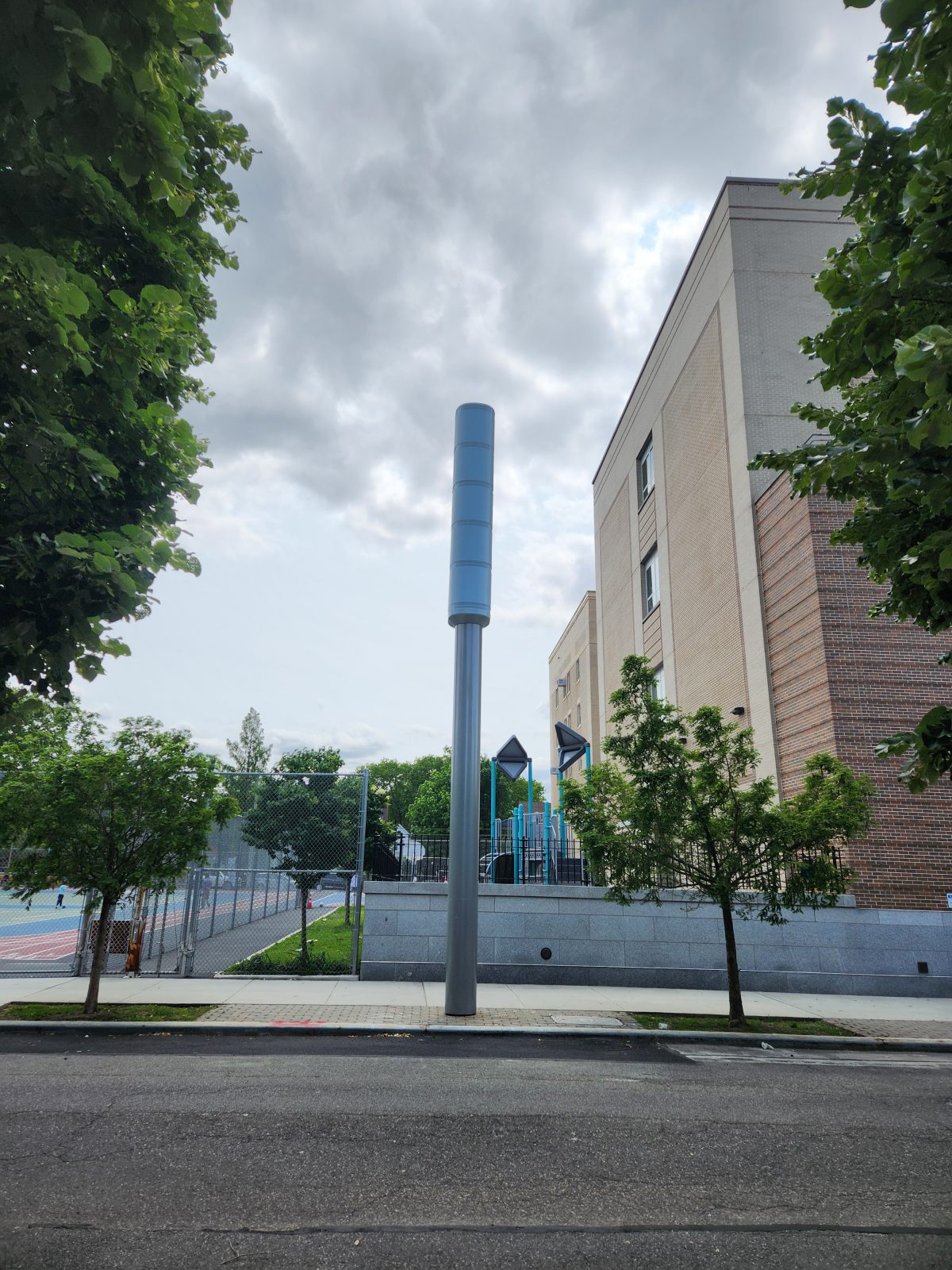
In a democracy, it is believed that the majority of united quality voices will be heard, and their wishes will be fulfilled by city, state, and federal agencies and representatives. At large, that is not the case for Forest Hills advocates among other residents for the past few years. The rise of massive metal 5G Towers citywide are not only leaving residents with great concerns about potential health risks, but aiming to prove how their 32-foot height and Brutalist style sharply contrasts with the architectural style of historical and traditional buildings, and harmonious landscapes and gardens. The intrusion does not discriminate between residential or commercial districts, or even alongside a school.


An online petition to stop the construction of a 5G Tower is garnering numerous signatures and comments, but fell upon deaf ears, as a tower recently rose in front of the P.S. 144 pre-k playground in Forest Hills: https://forms.gle/6aZSMzLK4tZ4sYzk6

“I do not want kids to be exposed to RF and EMF, and I do not want people who do not have access to the internet to gather around a school playground,” said petition signer Yelena Timasheva in October 2024. “5G Towers should be far away from developing brains,” said Jenn Shaffran in November.

February 2025, Llubica Janjic stated, “We don’t need this 32-foot 5G tower in our community. We never had the need for it. This is a residential neighborhood where we pay huge taxes. We like to live in a nice environment. The tower is going to make our streets look like a commercial area. We would like to preserve the beauty of this neighborhood, and keep our community safe from any long-term health effects.” In April 2025, Peggy Cecil said, “I object to the proposed site. It should be nowhere near a school for elementary age children. That is the most irresponsible act.”

Odette J. Wilkens is a community leader who calls Forest Hills home since the late 1960s, and is on a mission to preserve local character and advocate for the health of residents. She took the initiative to launch a nonprofit, Wired Broadband, Inc. to conduct further research and advocate for technology that harmonizes with the community’s intent and wishes. She has been pursuing the historic preservation review of Forest Hills and Rego Park, in conjunction with the 5G Tower that was proposed for P.S. 144 in Forest Hills’ covenant-safeguarded Van-Court section.

“The Federal Communications Commission requires that the site developer for the 5G Tower, CityBridge, conduct a historic preservation review for each of the 2,000 5G towers planned for NYC. The purpose is to determine whether the area or the structure in front of which the 5G Tower is proposed, has such historical significance, that the 5G Tower would visually mar the aesthetics of the area and/or the structure,” explained Wilkens.

In Rego Park, east of the 63rd Drive subway entrance on the south side of Queens Boulevard, a 32-foot 5G Tower was erected in front of a distinctive Art Deco commercial strip, in addition to a nearly identical multi-block 1930s assemblage on 63rd Drive, clashing with the harmonious flow that acclaimed architect Morris Lapidus played a role in.

The review is required under federal law, the National Historic Preservation Act (NHPA). This process enables consulting parties to comment, and the site developer will forward it to the NY State Historic Preservation Office (SHPO), to decide whether to approve or disapprove a proposed 5G Tower location. Wilkens is a consulting party for Forest Hills and Rego Park.

Wilkens’ interest in technology originated in her early days at HBO, at the cusp of a booming pay-TV industry, working as a paralegal. After law school, she joined a technology law firm and served as a corporate transactional attorney in technology for 20 years. In a November 2023, interview, she recalled, “When I heard about the 5G Towers coming to NYC, I began my in-depth research, and became increasingly concerned about a number of issues that were adversely affecting individuals. Many people approached me to complain about antennas everywhere, including rooftop antennas. When technology helps people, I’m all for it, but when some technologies bear the potential of running contrary to the health and aesthetics of neighborhoods that residents worked hard to maintain, that’s where I draw the line.”

That November, Wilkens submitted a 34-page consulting party factual report with photos, renderings, and maps to CityBridge and SHPO regarding the proposed 5G Tower site at P.S. 144, as well as the impact upon the surrounding historic vicinity of a 500-foot radius. Besides the architectural and landscaped-based restrictive covenants of Forest Hills Gardens, the community maintains covenants in the Van-Court section, as well as in Arbor Close and Forest Close.

On April 1, 2025, local residents could not be fooled, as they took to the streets with a rally at P.S. 144. Dynamic Forest Hills residents Emily Otalora and Wilkens partnered to bring the event to fruition. The Van-Court community is home to the historic P.S. 144 (Col. Jeromus Remsen School), “a second home” for pre-kindergarteners to 5th graders. Residents learned that the 5G Tower would be located in front of the pre-k playground, which would sadly become one of the students’ earliest encounters. It would consist of five bays for antennas, where one accommodates complimentary Wi-Fi and the other four bays accommodate 4G and 5G for paying customers. “This makes the 5G Tower largely a private enterprise using our public rights-of-way. Therefore, our community should have a say in whether it is needed,” explained Wilkens and Otalora.

P.S. 144 was completed in 1931 and erected by the John Kennedy & Co, acclaimed for Roman Catholic schools and churches and large buildings, such as the landmarked St. James Building at 1133 Broadway. It was designed by the notable Walter L. Martin, NYC Superintendent of School Buildings. The report also references that SHPO determined P.S. 144 to be “Eligible” for the National Register of Historic Places.

Otalora introduced the speakers. The Forest Hills Van-Court Association, Inc. is a homeowners association that oversees the district, including the site of concern. “The Forest Hills Van-Court Association voted unanimously against the Tower being erected here. We represent a community of 300 people,” said Association Vice President Steve Reichstein. The Association joined as a signer to the November 2024 submission to SHPO in opposition of the 5G Tower at P.S. 144. The submission was led by Wired Broadband, Inc, and numerous residents endorsed it as signers.

Young-ah Hur, a 35-year resident living across the street with her family, has a son who attended P.S. 144. She focused on wireless radiation’s adverse biological impacts. As a healthcare professional and former registered nurse at hospitals, she discussed the unfortunate reality of what may transpire for residents living near cell towers. She cited “headaches, fatigue, irritability, concentration and memory problems, depression and anxiety, cardiovascular issues, and muscular and joint pains.” “When people moved away from cell towers, their symptoms vanished. Sweden, Italy and Portugal banned the 5G Towers near schools, nursing homes and residential areas, but not here,” she said.

“Nobody knows what’s going to happen in five years, ten years. There’s a young kid here, who may get leukemia. There is not a guarantee that electricity and magnetic fields do not affect our health,” explained her husband, Hur.

Retired physical education teacher Bernard Otalora referenced P.S. 144 as a bridge to the future that is at risk of being under an electromagnetic field 24/7. He explained, “The children, the teachers, the staff, and the school principal are all at risk. Health is our most precious capital, and we cannot play Russian Roulette. We do not need this 5G Tower. It will be a magnet for vagrants. We need a safe environment. We would like the school superintendent and all elected officials to have this project nipped in the bud. P.S. 144 must remain a haven for all future generations. Fight for the children as a community.”

Retired travel consultant Maria Luisa Otalora called the 5G Tower “a manmade disaster in the making that is threatening our health.” “Many studies that the telecommunications companies refer to are outdated, and they ignore the truth about the 5G Towers… We need to tell our elected officials that this community has no need for 5G Towers, and it will serve no purpose other than to cause physical harm to residents, students, teachers, and staff at P.S. 144, and the community at large.”

Lifelong Forest Hills resident Samantha Wolner is in the scientific publishing industry and has an eight-year-old son who attends school nearby. She addressed the technology and smartphone addiction among children, as chronicled in Jonathan Haidt’s book, “The Anxious Generation: How the Great Rewiring of Childhood is Causing an Epidemic of Mental Illness.” She referenced how the World Health Organization classified wireless radiation as a Class 2B possible carcinogen.

Wilkens coordinates a number of greater community outreach Zoom meetings and hearings monthly. There are some wise representatives who embrace “power to the people,” value aesthetics, and are health conscious. A Committee on Technology Hearing was conducted on April 29. “Disgraceful!” said Brooklyn Councilmember Lincoln Restler regarding NYC Office of Technology & Innovation’s “complete lack of community engagement.” Restler echoed frustrations from his constituency with statements including “On private property in front of people’s homes” and “No communication with property owners whatsoever.” He pinpointed absent communication from OTI, besides letters to the community board, borough president, and himself.

“Never have I encountered a process that is so inconsiderate,” said Councilmember Restler, who referenced that DOT communicates with every property owner prior to installing Citi Bike lanes. Then OTI’s Brett Sikoff refuted that by stating the OTI dedicated many hours attending community board meetings. Restler then stated, “Instead of OTI taking responsibility to notify the stakeholders, it’s the responsibility of the community boards? I don’t understand how an agency can be so inconsiderate without meaningful community engagement.” Restler publicly assured that he would pursue legislation that would delineate the process that OTI should take “to talk to every stakeholder.”

“Having grown up with the values of building community by helping others in need, I saw the need to take action, since staying silent isn’t going to help anyone,” said Emily Otalora, who neighbors regard as their spokesperson. “The city continuously intrudes upon our lives without providing us advance notice how this will impact us, or a chance to voice opinions and concerns. When hearing about the 5G Tower, we were immediately concerned about it impacting us negatively.”

Wilkens aims to obtain the involvement of various civic leaders, who would ideally inform their memberships about the need to raise awareness with the elected officials. “City Hall and OTI are only listening to the telecom industry, rather than their constituents,” she said.

Otalora explained that although the 5G Tower was erected after the rally, the community should not view it as a losing battle. “Many folks think once it is built, it’s a done deal, but they need to know that is not true. The towers can still be taken down. The city needs to increasingly hear from the community that they want it gone,” she explained.

Democracy exists based on the ability to advocate for one’s self and others. “When a community presents a united front and delivers that message to their elected officials, with hopes they are heard and honored, that is the important power of advocacy. Without that, democracy is broken.”

Resistance from decisions-makers is inexcusable. “Their first responsibility is to their constituents. If a decision-maker is incapable of respecting the wishes of their constituents, then their time in office should come to an end. When campaigning you should not follow the corporate money, but listen to the people and act on their behalf,” continued Otalora.

To help defend your community, email owilkens@wiredbroadband.org

4th Annual Get Fit Sunnyside kicks off today

Get ready, Sunnyside!

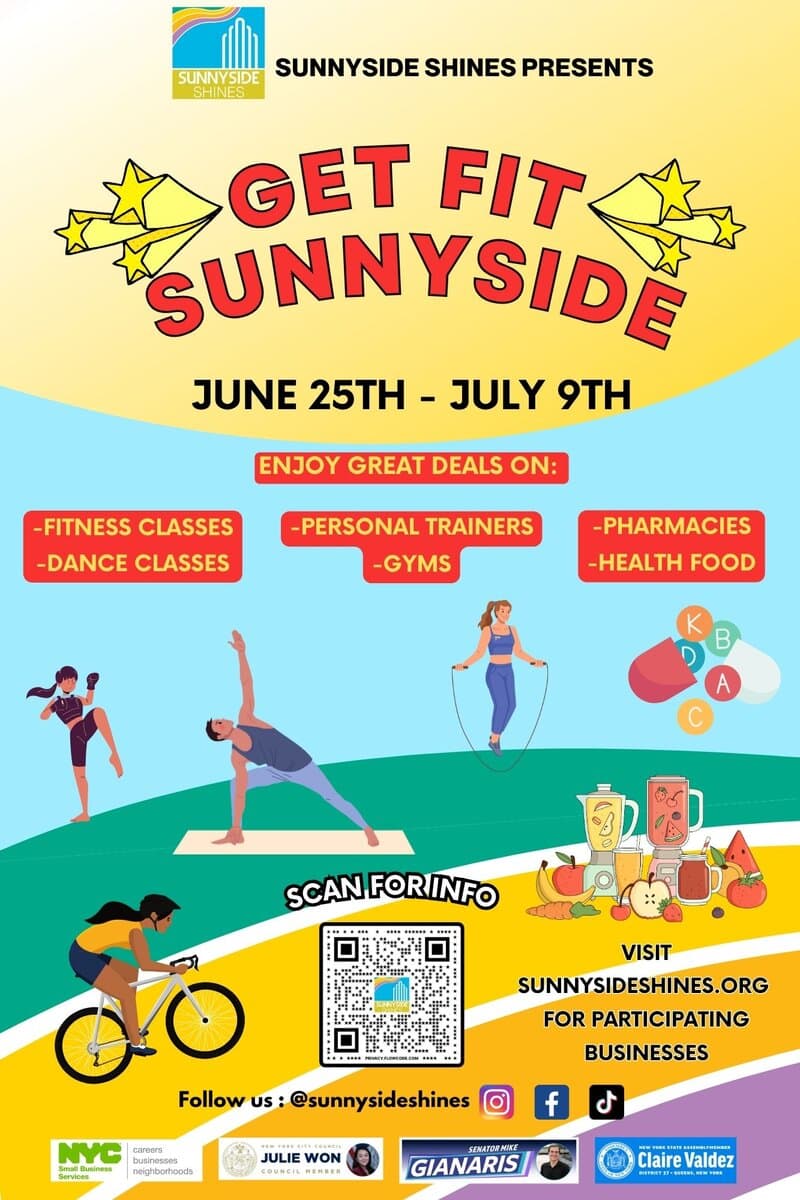
The 4th Annual Get Fit Sunnyside campaign, organized by the Sunnyside Shines, will run from June 25th through July 9th. This popular event offers incredible discounts of up to 50% on health and fitness services and products from 16 local merchants.

Discover fantastic offers such as free personal training sessions, three classes for the price of one at the Queens Training Club, and deals on smoothies and other healthy food options!

Get Fit Sunnyside is the perfect opportunity to kickstart your wellness journey and support our local businesses.

All of the deals are up on www.sunnysideshines.org. Local merchants include Courage Fitness Club, FirstMed Pharmacy, Ju-Go Juice Bar, and many more!

“Happy Get Fit Sunnyside! … there’s no better time to focus on your health and wellness and no better way to support our neighborhood businesses,” said NYS Assemblymember Claire Valdez.

Ready to find your perfect deal? Visit www.sunnysideshines.org for all the offers and participating businesses!

JOHN T. NASH

John T. Nash, died Wednesday, June 18, 2025 at the age of 76. Beloved husband of the late Sandra T. Nash, and loving father of Wesley Nash and Shanna Nash.​ Mr. Nash was a decorated United States Army Veteran who served during the Vietnam Era. Mass of Christian Burial offered at St. Stanislaus Church on Monday, June 23, 2025 at 9:30 AM.​ Interment followed at Calverton National Cemetery, Calverton, NY​ under the direction of Papavero Funeral Home, 72-27 Grand Avenue Maspeth, NY 11378 www.papaverofuneralhome.com

MANUEL DUTAN

Manuel Dutan, died Monday, June 16, 2025 at the age of 68. Beloved husband of Ellen Codd, loving father of Juliana Dutan and Tobias Dutan, cherished grandfather of Lucas, dear son of Edelmira, and also survived by loving brothers, sisters, nieces and nephews.​ Funeral Services held on Friday, June 20*, 2025 at The Green-wood Cemetery, Brooklyn, NY under the direction of Papavero Funeral Home, 72-27 Grand Avenue Maspeth, NY 11378
www.papaverofuneralhome.com

CATHERINE PAOLELLA

Catherine Paolella, died Thursday, May 29, 2025 at the age of 66.
Loving sister of Joan Sansouci, Peter Paolella and the late Albert Paolella and cherished aunt and great-aunt of many loving nieces, nephews, great-nieces and great-nephews. Mass of Christian Burial offered at Maria Regina Church (Seaford, NY) on Saturday, June 21, 2025 at 9:45 AM.​ Interment followed at St. Charles Cemetery, Farmingdale, NY under the direction of Papavero Funeral Home, 72-27 Grand Avenue Maspeth, NY 11378​ www.papaverofuneralhome.com

MARIE LOUIE

Marie Louie, died Sunday, June 15, 2025 at the age of 86.
Beloved wife of William Louie, loving mother of David Louie and Linda Nuzzo, mother-in-law of Marelina Louie and Michael Nuzzo, cherished grandmother of Mary Jo, Rachel, Baylee and Daniel, dear sister of Irene, John, Peter, Patrick and the late Charlie, and dear godmother of Nicole.​ Funeral Services held at Papavero Funeral Home on Saturday, June 21, 2025 at 10 AM. Interment followed at Kensico Cemetery, Valhalla, NY​ under the direction of Papavero Funeral Home, 72-27 Grand Avenue Maspeth, NY 11378​ www.papaverofuneralhome.com

DOREEN ANDERSON

Doreen Anderson, of Ridgewood died on June 12th, 2025 at the age of 70. Sehe was the beloved wife of the late Louis, devoted mother of Dawn, Robert, and Samantha, loving grandmother of Anthony and his wife Rebecca, Mariana, Josephine, and Omari, and dear great grandmother of Raina and Eren. Mass of Christian Burial will be offered at St. Matthias Church, Ridgewood on Saturday June 28th, 2025 at 10:15am. Cremation was in Fresh Pond Crematory under the direction of Hess-Miller Funeral Home, 64-19 Metropolitan Ave, Middle Village, NY 11379.

ANNA RAIA

Anna Raia, died Sunday, June 15, 2025 at the age of 94. Beloved wife of the late Vito Raia, loving mother of Frances Raia and Joseph Raia, and cherished aunt and great-aunt of many loving nieces, nephews, great-nieces and great-nephews. Mrs. Raia was a long-time member of the Secular Order of Franciscans. Mass of Christian Burial offered at Transfiguration Church on Thursday, June 19, 2025 at 10 Interment followed at St. John Cemetery, Middle Village, NY under the direction of Papavero Funeral Home, 72-27 Grand Avenue Maspeth, NY 11378
www.papaverofuneralhome.com

Fill the Form for Events, Advertisement or Business Listing